Probate Q&A Series

Page 357 of 654

Probate Q&A Series ·

What documents can I get from the insurance company to prove the automatic withdrawals were for the decedent’s property insurance? NC

What documents can I get from the insurance company to prove the automatic withdrawals were for the decedent’s property insurance? – North Carolina Short Answer In North Carolina estate administration, the most useful proof usually comes from the insurer’s own records tying the bank draft to a specific property policy and address. Common documents include…

Read more
Probate Q&A Series ·

If another relative handled the estate, how can I confirm what assets were in the estate and whether anything was distributed to heirs? NC

If another relative handled the estate, how can I confirm what assets were in the estate and whether anything was distributed to heirs? – North Carolina Short Answer In North Carolina, the fastest way to confirm what was in an estate and whether heirs received distributions is to get the estate file from the Clerk…

Read more
Probate Q&A Series ·

If the death certificate can’t be corrected quickly, are there other ways to prove marital status for survivor benefits? NC

If the death certificate can’t be corrected quickly, are there other ways to prove marital status for survivor benefits? – North Carolina Short Answer Yes. In North Carolina, a death certificate is commonly requested for survivor benefits, but it is not the only way to prove a legal marriage when the marital-status box is wrong.…

Read more
Probate Q&A Series ·

Can an estate representative close both the decedent’s account and the estate account, and what paperwork is usually required? NC

Can an estate representative close both the decedent’s account and the estate account, and what paperwork is usually required? – North Carolina Short Answer In North Carolina, the personal representative (executor or administrator) generally has authority to collect the decedent’s assets, which usually includes working with a bank to close a decedent’s sole-owned account and…

Read more
Probate Q&A Series ·

Can an estate pay a creditor directly after a collection agency stops handling the file, and how should that payment be documented? NC

Can an estate pay a creditor directly after a collection agency stops handling the file, and how should that payment be documented? – North Carolina Short Answer Yes. In North Carolina, if a collection agency says the creditor has recalled the account, the estate can usually deal with (and pay) the original creditor directly, as…

Read more
Probate Q&A Series ·

What can I do if a financial institution won’t release estate account statements or tax forms to anyone except the named administrator? NC

What can I do if a financial institution won’t release estate account statements or tax forms to anyone except the named administrator? – North Carolina Short Answer In North Carolina, a financial institution will usually only release estate-account statements and tax forms to the court-appointed personal representative (the “administrator” or “executor”) unless that personal representative…

Read more
Probate Q&A Series ·

What kinds of property and accounts can be included in a year’s allowance, and what happens if the total value is over the limit? NC

What kinds of property and accounts can be included in a year’s allowance, and what happens if the total value is over the limit? – North Carolina Short Answer In North Carolina, a spouse’s year’s allowance is generally satisfied from the deceased person’s personal property (not real estate), such as cash, bank accounts, vehicles, and…

Read more
Probate Q&A Series ·

What happens if I refuse to cash a distribution check because I disagree with how the estate was handled—can the estate still be closed? NC

What happens if I refuse to cash a distribution check because I disagree with how the estate was handled—can the estate still be closed? – North Carolina Short Answer In North Carolina, a beneficiary refusing to cash a distribution check does not automatically stop the personal representative from trying to close the estate. To close…

Read more
Probate Q&A Series ·

How do I access or transfer a certificate of deposit after the account owner dies if there is no payable-on-death beneficiary listed? NC

How do I access or transfer a certificate of deposit after the account owner dies if there is no payable-on-death beneficiary listed? – North Carolina Short Answer In North Carolina, if a certificate of deposit (CD) has no payable-on-death (POD) beneficiary and no surviving joint owner with survivorship rights, the CD usually becomes part of…

Read more
Probate Q&A Series ·

Can a lawyer contact a retirement plan or bank on my behalf to get balances and paperwork, and what authorizations do I need to sign? NC

Can a lawyer contact a retirement plan or bank on my behalf to get balances and paperwork, and what authorizations do I need to sign? – North Carolina Short Answer Yes. In North Carolina, a probate lawyer can contact banks and retirement plan administrators to request date-of-death balances, beneficiary information, and account paperwork, but most…

Read more
Probate Q&A Series ·

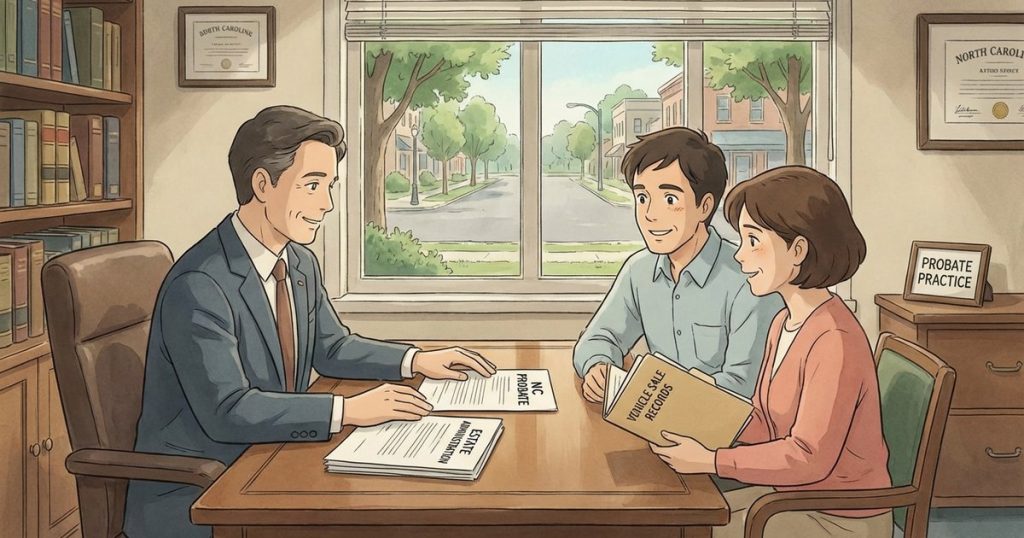
How can I challenge an estate administrator who sold estate vehicles for too little and won’t explain the pricing? NC

How can I challenge an estate administrator who sold estate vehicles for too little and won’t explain the pricing? – North Carolina Short Answer In North Carolina, a beneficiary can challenge an estate administrator’s low-priced vehicle sale by asking the Clerk of Superior Court (the estate court) to require a fuller report and accounting, and—if…

Read more

Questions about your situation?

Attorney Jared Pierce
Free case evaluation

Articles are a starting point, not legal advice. Talk through the specifics of your case with a North Carolina attorney — the case evaluation is always free.

Go to Top
Free Consultation

Talk with a North Carolina attorney

Tell us a bit about your situation and we'll respond within one business day.

This site is protected by reCAPTCHA and the Google Privacy Policy and Terms of Service apply.