
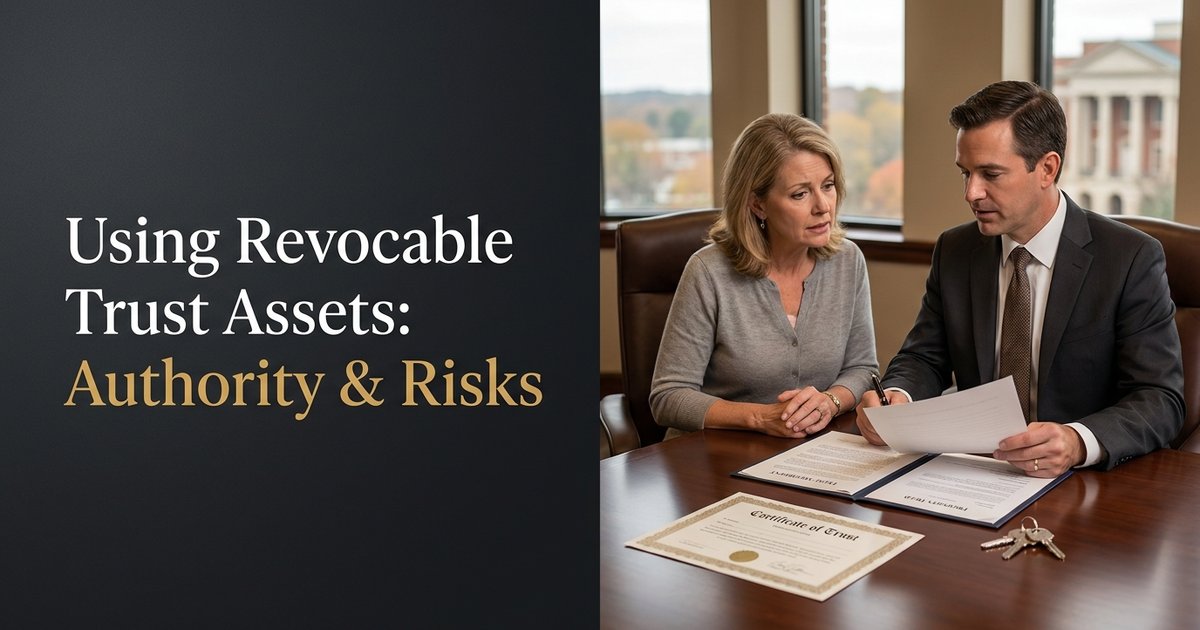
What This Issue Means in North Carolina
In North Carolina, assets placed in a revocable trust are usually still under the settlor’s control during the settlor’s lifetime. In plain English, if you created the trust and kept the power to revoke or amend it, you can generally move assets in and out of the trust, use them, sell them, or refinance them, so long as the trust terms do not limit that power.
The practical question is usually not whether the asset is "locked up," but who has authority to sign and what the trust document allows. If you are serving as your own trustee, access is often straightforward. If someone else is acting as trustee, or if you have become incapacitated, the answer depends on the trust language, any power of attorney, and whether a lender or title company requires extra documentation.
Timing matters because a delay often happens at the transaction stage. A bank, closing attorney, or lender may ask for a certificate of trust, proof of trustee authority, or a copy of the trust before allowing a withdrawal, sale, or loan closing.

The Legal Framework
North Carolina follows the Uniform Trust Code. A trust is presumed revocable unless its terms say it is irrevocable. A settlor may revoke or amend a revocable trust by substantially complying with the method stated in the trust instrument, and if the trust does not provide a method, North Carolina law allows revocation or amendment by other clear methods set out by statute. See N.C. Gen. Stat. § 36C-6-602.
That matters because the power to revoke usually means the settlor can reclaim trust property or direct how it is used during life. Also, while a revocable trust remains revocable, the rights of the beneficiaries are generally subject to the settlor’s control, and the trustee’s duties are owed exclusively to the settlor. See N.C. Gen. Stat. § 36C-6-603.
Key Requirements
- Trust terms control first: The trust document is the starting point. If it says the settlor may withdraw assets, direct distributions, revoke the trust, or act as trustee, those terms usually govern.
- Authority depends on your role: If you are both settlor and current trustee, you usually sign in your trustee capacity to transfer, sell, or encumber trust property. If a successor or co-trustee is serving, that person may need to act instead.
- Borrowing is transaction-specific: A revocable trust can hold property that is pledged as collateral, but the trustee must have authority under the trust or under North Carolina trust law to borrow money or mortgage trust property.
Important Statutes or Rules
- N.C. Gen. Stat. § 36C-6-602 - explains how a revocable trust may be revoked or amended.
- N.C. Gen. Stat. § 36C-6-603 - provides that while a trust is revocable, the trustee’s duties are owed exclusively to the settlor.
- N.C. Gen. Stat. § 36C-8-815 - gives a trustee broad powers to administer trust property, subject to the trust terms and fiduciary duties.
- N.C. Gen. Stat. § 39-6.7 - addresses conveyances to or by trusts and can matter when trust-owned real estate is transferred or encumbered.
- N.C. Gen. Stat. § 45-10 - addresses substitution of trustees in deeds of trust, which can matter when trust-owned real estate is used as collateral.
How the Rule Usually Applies
Most revocable living trusts are designed for flexibility, not to prevent the settlor from using property. If your house, brokerage account, or bank account is titled in your revocable trust, you can usually still live in the house, spend the money, sell the asset, or move it back into your individual name. The main issue is making sure the right person signs the right paperwork in the right capacity.
Borrowing against trust assets is also often possible, but lenders may be more cautious. For example, if real estate is titled in the trust, a lender may review the trust or a certification of trust to confirm that the trustee has power to mortgage the property. Some lenders prefer the property to be deeded out of the trust before closing and then deeded back afterward. Others will lend directly to the trustee of the revocable trust.
Common Scenarios
- You are the settlor and trustee: This is usually the simplest case. You can often withdraw funds, sell trust property, or sign loan documents as trustee, assuming the trust does not restrict those actions and the institution accepts the trust documentation.
- A successor trustee is acting because of incapacity: Access may still be possible, but the acting trustee must follow the trust terms and any fiduciary duties. If the trustee is using trust assets for the settlor’s support, the trust language should clearly allow it. A power of attorney may also matter under N.C. Gen. Stat. § 36C-6-602.1.
Process and Timing
- First step: Review the trust document and confirm who is serving as current trustee. For a bank withdrawal, refinance, or sale, the institution or closing attorney will usually want the trust name, trustee name, and proof of authority.
- Next step: Gather the transaction documents. That may include a certificate of trust, deed, account statement, power of attorney, and any lender forms. If real estate is involved, the closing attorney may also review title and the deed into the trust.
- Expected outcome: If the trust language is clear and the paperwork is in order, the trustee can usually complete the withdrawal, transfer, sale, or loan transaction. If the language is unclear, the institution may require additional review, a trust amendment, or a deed transfer before proceeding.
Risks, Exceptions, and Pitfalls
- A common mistake is assuming that because the settlor still controls the asset, no trust paperwork is needed. In practice, banks and title companies often require trustee documentation before they will act.
- Another issue is confusing a revocable trust with an irrevocable trust. If the trust is actually irrevocable, or became effectively restricted after incapacity, access and borrowing may be much more limited. See this discussion of control limits in an irrevocable trust.
- County recording practice, lender underwriting, and missing deeds can affect timing when real estate is involved. If the property was meant to be in the trust but was never properly deeded into it, the transaction may need corrective work first.
Practical Next Step
Pull the trust agreement, any amendments, the deed or account statement for the asset, and any power of attorney. Then ask the bank, lender, or closing attorney exactly what trust documentation they require. If the trust owns real estate or a large account and the authority language is unclear, have a North Carolina probate attorney review the trust before you sign transfer or loan papers.
Talk to a Probate Attorney
If this issue affects an estate, property dispute, court filing, or family decision, our firm can help explain the options and deadlines. Call 919-341-7055.
Disclaimer: This article provides general information about North Carolina law. It is not legal advice for a specific situation and does not create an attorney-client relationship. Laws, procedures, and local practice can change and may vary by county. If a deadline may apply, act promptly and speak with a licensed North Carolina attorney.
