
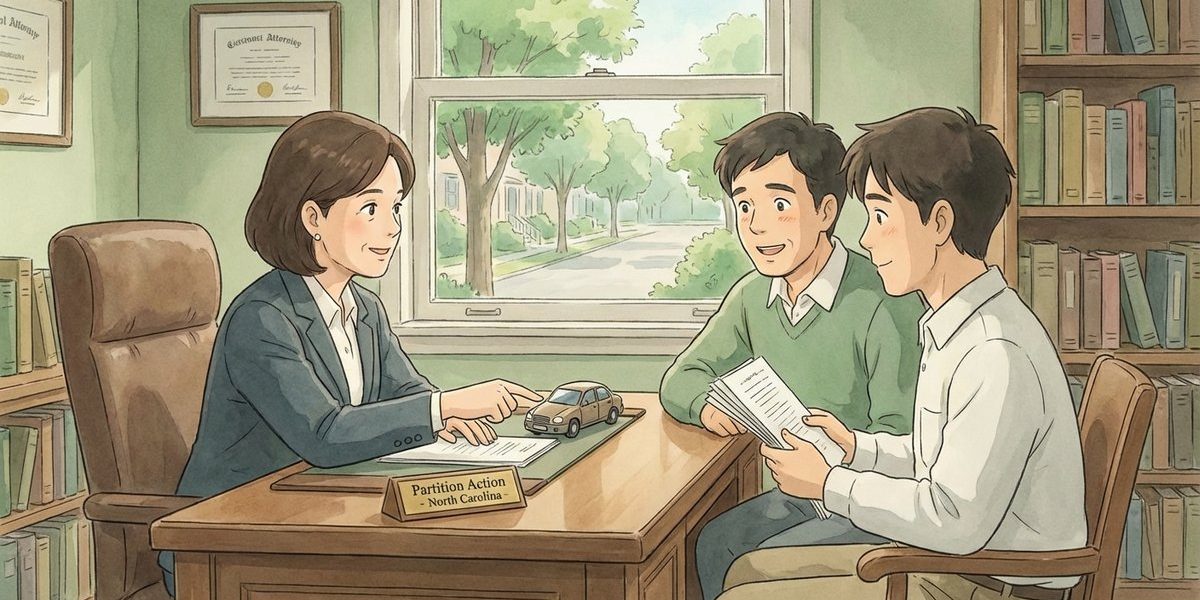
What rights do I have if I’m paying the ongoing costs on a vehicle that someone else wants to sell? – North Carolina
Short Answer
In North Carolina, a co-owner generally cannot sell a jointly owned vehicle as if it is solely theirs, but a co-owner can usually force a court-supervised sale of jointly owned personal property through a partition proceeding. If a sale happens, the paying co-owner may be able to argue for a fair allocation of sale proceeds based on ownership shares and certain documented payments that preserved the vehicle (like loan payoff or necessary expenses). The practical outcome often turns on the title, the type of co-ownership, and proof of what was paid and why.
Understanding the Problem
In North Carolina, the key question is what happens when two people co-own a vehicle, one co-owner has been paying the ongoing costs to keep it on the road, and the other co-owner now wants to sell. Can a co-owner sell the vehicle over the other co-owner’s objection, and if a sale goes forward, can the paying co-owner claim a larger share of the sale proceeds or reimbursement for certain payments? This issue commonly comes up when family members share title, one person relies on the vehicle for transportation, and a prior informal agreement about use or timing later breaks down.
Apply the Law
North Carolina treats a vehicle as personal property. When personal property is owned by two or more people as joint tenants or tenants in common, a co-owner can ask the Superior Court to partition the property. For personal property like a vehicle, partition usually means a court-ordered sale (because dividing a single vehicle “in kind” is not practical) and then distributing the net proceeds among the co-owners. In that process, the court can address each party’s ownership interest and may consider certain equitable adjustments tied to preserving the property and fairly distributing the proceeds.
Key Requirements
- Co-ownership exists: The vehicle must be jointly owned (for example, both names appear on the title, or there is other proof of shared ownership).
- One co-owner seeks court relief: A co-owner files a partition petition in North Carolina Superior Court asking the court to resolve the dispute (often by ordering a sale).
- Sale and distribution are supervised: If the court orders a partition sale, the vehicle is sold under court procedures and the net proceeds are distributed based on ownership interests, with arguments allowed about credits/adjustments supported by records.
What the Statutes Say
- N.C. Gen. Stat. § 46A-100 (Partition of personal property) – Allows a joint tenant or tenant in common to file in superior court to partition personal property.
- N.C. Gen. Stat. § 46A-102 (Partition sale of personal property) – Authorizes the court to order a sale of personal property when an actual division would injure a party, and directs that the sale follow court sale procedures.
Analysis
Apply the Rule to the Facts: Here, [CLIENT] and a child co-own a vehicle, and the child wants to sell it even though there was an earlier agreement that left [CLIENT] without a vehicle. If the vehicle is truly co-owned, the child typically cannot sell the entire vehicle as if it belongs only to the child; at most, the child can sell the child’s ownership interest or pursue a court process to force a sale of the whole vehicle. If a sale occurs (by agreement or court order), [CLIENT] should be prepared to document ongoing payments (loan, insurance, taxes/registration, necessary repairs) and explain which payments preserved the vehicle’s value versus which were personal “use” expenses.
Process & Timing
- Who files: Any co-owner (including the co-owner who wants to sell). Where: North Carolina Superior Court in the county where the defendants reside or where the property is located (venue can be fact-specific for personal property). What: A petition/complaint requesting partition of personal property and, if appropriate, a partition sale. When: There is no single universal “days to file” deadline for partition itself, but timing matters if a co-owner is threatening an immediate private sale or transfer.
- Case steps: The other co-owner is served and can respond, dispute ownership shares, and request protections (for example, asking the court to control possession pending sale, or to require that sale proceeds be held and distributed through the case).
- Sale and distribution: If the court orders a partition sale, the vehicle is sold under court-supervised procedures and the court distributes net proceeds after costs, based on ownership interests and any allowed credits/adjustments supported by evidence.
Exceptions & Pitfalls
- Title wording matters: Whether the title lists owners with “and” versus “or” can affect whether one signature can transfer title. Even when a transfer is possible, it does not automatically settle how proceeds should be split between co-owners.
- Not every payment increases the paying co-owner’s share: Courts often distinguish between necessary payments that preserved the property (for example, paying off a lien to prevent repossession) and ordinary costs tied to personal use. Keeping receipts, bank records, and payoff statements is essential.
- Informal agreements can be hard to enforce: A prior family agreement about who gets to use the vehicle or when it will be sold may be disputed later. Written proof and consistent conduct help, but partition focuses primarily on ownership and fair distribution.
- Self-help creates risk: Hiding the vehicle, blocking access, or selling it without agreement can trigger claims and escalate the case. A court process is usually safer when co-owners are in conflict.
For more background on how North Carolina courts handle co-owner disputes and forced sales, see force a sale or buy out the other co-owners and start a partition action.
Conclusion
In North Carolina, when a vehicle is co-owned, one co-owner generally cannot treat it as solely theirs, but a co-owner can ask Superior Court to partition personal property, which often results in a court-ordered sale and distribution of the net proceeds. Payments made to keep the vehicle from being lost or to preserve its value may support an argument for a fair adjustment when proceeds are divided, but proof matters. The next step is to gather the title and payment records and file a partition petition in Superior Court promptly if a sale or transfer is imminent.
Talk to a Partition Action Attorney
If you’re dealing with a co-owned vehicle where one owner wants to sell and the other has been paying the ongoing costs, our firm has experienced attorneys who can help explain the partition process and the timelines that may apply. Call us today at [919-341-7055].
Disclaimer: This article provides general information about North Carolina law based on the single question stated above. It is not legal advice for your specific situation and does not create an attorney-client relationship. Laws, procedures, and local practice can change and may vary by county. If you have a deadline, act promptly and speak with a licensed North Carolina attorney.

