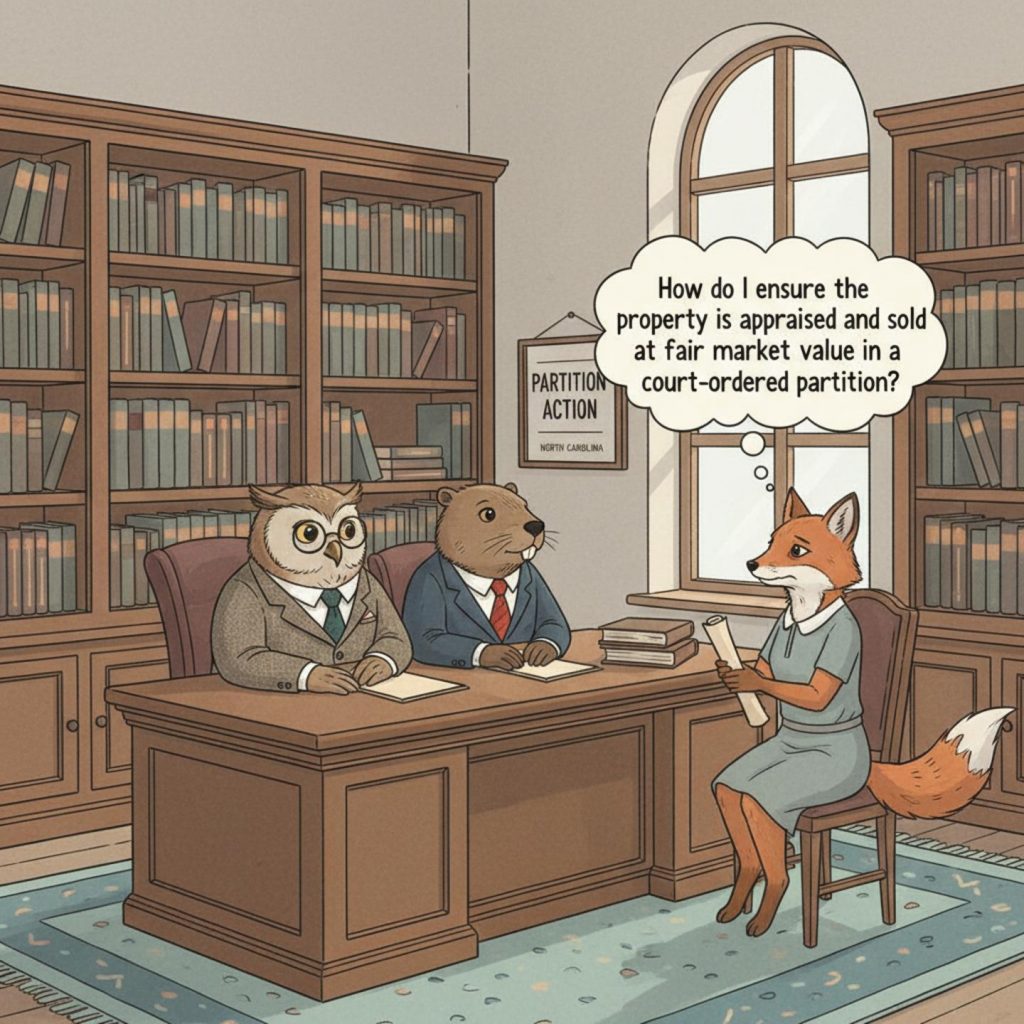
Partition Action Q&A Series

Page 77 of 87

What proof do I need at the partition hearing to show I made all mortgage, tax, and insurance payments?: Clear documentation that ties each payment to the property and shows you paid it

What proof do I need at the partition hearing to show I made all mortgage, tax, and insurance payments? – North Carolina Short Answer Bring competent, traceable documents that show who paid, what was paid, when, and why. In North Carolina partition cases, clerks commonly accept canceled checks, bank/credit card statements, lender payment histories, tax…

Read more

How can I challenge a partition action when I already had a signed purchase agreement to assume the mortgage?: North Carolina guidance

How can I challenge a partition action when I already had a signed purchase agreement to assume the mortgage? – North Carolina Short Answer In North Carolina, a co-owner can challenge a partition by raising contract and equity defenses, asking the Clerk of Superior Court to transfer the case to Superior Court, and seeking to…

Read more

What paperwork and notice requirements apply to serving tenants and filing eviction in this scenario?: North Carolina

What paperwork and notice requirements apply to serving tenants and filing eviction in this scenario? – North Carolina Short Answer In North Carolina, you must first end any month-to-month or week-to-week arrangement with a written notice (generally at least 7 days for month-to-month and 2 days for week-to-week). If the occupants do not leave, file…

Read more

How can I schedule a walkthrough to collect my belongings from co-owned property before settlement closes?: Practical steps under North Carolina partition law

How can I schedule a walkthrough to collect my belongings from co-owned property before settlement closes? – North Carolina Short Answer In North Carolina, a co-owner has a right to reasonable access to co-owned property, but you should not enter or remove items if others object or occupants are in place. The safest path is…

Read more

How do I document and claim my contributions to taxes and repairs in a partition action?: North Carolina

How do I document and claim my contributions to taxes and repairs in a partition action? – North Carolina Short Answer In North Carolina partition cases, a co-owner can ask the Clerk of Superior Court to credit them for necessary common expenses—like property taxes, insurance, and essential repairs—proved with clear records. You raise these credits…

Read more

Do I need to list myself differently if I’m filing the partition petition as power of attorney?: Answered for North Carolina

Do I need to list myself differently if I’m filing the partition petition as power of attorney? – North Carolina Short Answer Yes. In a North Carolina partition case, you list the co-owner (your principal) as the party and show your role. Style it like: “Principal’s Name, by and through Agent’s Name, attorney-in-fact.” Attach or…

Read more

How do I protect my interests if the estate administration is being used as leverage against my buyout?: North Carolina

How do I protect my interests if the estate administration is being used as leverage against my buyout? – North Carolina Short Answer In North Carolina, separate your estate rights from your co-ownership rights. Use the Clerk of Superior Court to compel a timely inventory and accounting, secure rent and tax records, and, if needed,…

Read more

What can I do if the estate administrator refuses to share rental income and expense records before mediation?: North Carolina

What can I do if the estate administrator refuses to share rental income and expense records before mediation? – North Carolina Short Answer In North Carolina, you can ask the Clerk of Superior Court to order the personal representative (estate administrator) to provide a full, itemized accounting of the estate’s receipts and disbursements. If the…

Read more

How do I include indemnification for unpaid property taxes and rental proceeds in a buyout agreement?: Practical guidance for North Carolina

How do I include indemnification for unpaid property taxes and rental proceeds in a buyout agreement? – North Carolina Short Answer In North Carolina, you can build indemnification for unpaid property taxes and unremitted rental proceeds directly into a written buyout agreement. Specify what is covered (taxes, penalties, interest, and rents through a defined date),…

Read more

Should I consider a partition action instead of a quiet title action for my property?: Clear guidance for North Carolina property owners

Should I consider a partition action instead of a quiet title action for my property? – North Carolina Short Answer In North Carolina, a partition action is used to split or sell property that has multiple co-owners; a sole owner cannot use partition. A quiet title action is used to resolve an adverse claim or…

Read more

Could lack of early documentation about my relative cause a title challenge?: Answered under North Carolina law

Could lack of early documentation about my relative cause a title challenge? – North Carolina Short Answer Yes. In North Carolina, real estate passes to heirs or devisees at death, but buyers, lenders, and title insurers rely on recorded proof. Missing probate filings, unrecorded deeds from heirs, or unidentified descendants can leave a “cloud” on…

Read more

How can I clear title issues on inherited property after co-owners signed over their shares?: Clear your inherited title without a partition in North Carolina

How can I clear title issues on inherited property after co-owners signed over their shares? – North Carolina Short Answer In North Carolina, once co-owners deed their interests to you, you generally do not need a partition. To prevent future challenges from old claims or unknown heirs, owners typically file a civil action in Superior…

Read more

Questions about your situation?

Attorney Jared Pierce
Free case evaluation

Articles are a starting point, not legal advice. Talk through the specifics of your case with a North Carolina attorney — the case evaluation is always free.

Go to Top
Free Consultation

Talk with a North Carolina attorney

Tell us a bit about your situation and we'll respond within one business day.

This site is protected by reCAPTCHA and the Google Privacy Policy and Terms of Service apply.