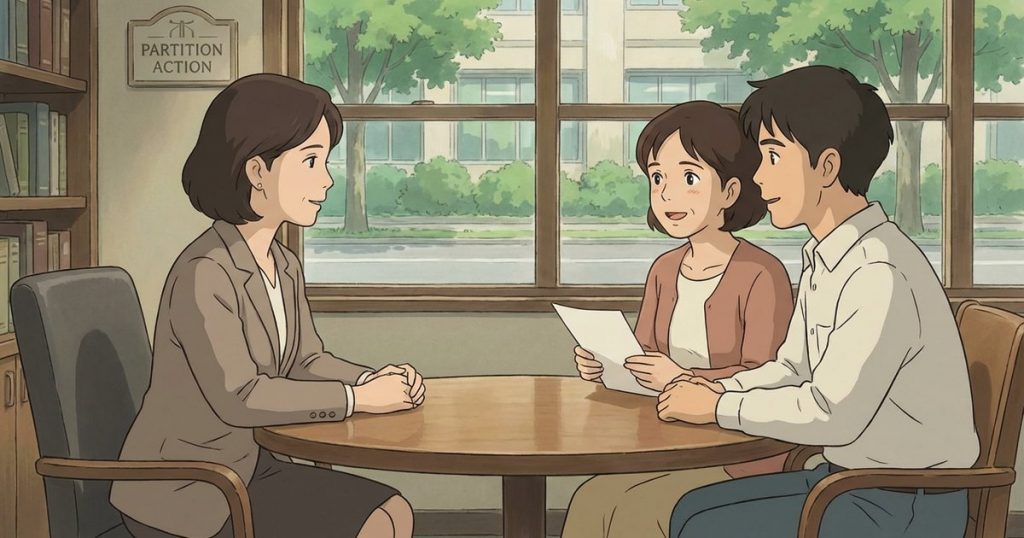
Partition Action Q&A Series

Page 47 of 87

How will the sale proceeds be used if the property is being sold to pay estate debts, and do co-owners get anything after debts are paid? NC

How will the sale proceeds be used if the property is being sold to pay estate debts, and do co-owners get anything after debts are paid? – North Carolina Short Answer In North Carolina, when a jointly owned property is sold through a court-supervised proceeding to raise money for estate obligations, the sale money is…

Read more

What happens if another co-owner transferred their share to someone else without telling the rest of the owners? NC

Recent Legal Update Updated: March 2026 Statute updated: N.C. Gen. Stat. § 41-90 (Alienation of a cotenant’s undivided interest). What changed: North Carolina enacted/updated § 41-90 in 2024 (S.L. 2024-47), expressly stating that each cotenant may convey, lease, mortgage, place a deed of trust on, or place a lien on that cotenant’s undivided interest without…

Read more

How is the sale money divided when two people co-own a home but contributed different amounts to the mortgage or upkeep? NC

Recent Legal Update Updated: April 2026 North Carolina added and clarified cotenancy rules in 2024 through N.C. Gen. Stat. §§ 41-85 and 41-86. Earlier guidance often relied more generally on partition principles and Chapter 46A contribution rules. The newer statutes now expressly address how cotenants share rents and profits, when a cotenant can obtain reimbursement…

Read more

If I sign an acceptance of service, am I agreeing to the sale of the property or just acknowledging I received the paperwork? NC

Recent Legal Update Updated: March 2026 Key update: North Carolina’s Rules of Civil Procedure now expressly address acceptance of service. Rule 4(j5) (added by a 2023 amendment) states that a party may accept service by completing an acceptance-of-service form (including an AOC form) or by signing and dating a notation of acceptance on the summons,…

Read more

Can a co-owner or estate executor sign a long-term lease on inherited land without the other owners’ knowledge or consent? NC

Recent Legal Update Updated: April 2026 North Carolina enacted new cotenancy provisions in 2024, including N.C. Gen. Stat. § 41-84 and N.C. Gen. Stat. § 41-90. These statutes now expressly state that one cotenant generally cannot bind another cotenant to a lease or similar act without prior authorization or later ratification, and that each cotenant…

Read more

What notice am I supposed to receive before a court-appointed commissioner lists co-owned property for sale in a partition case? NC

What notice am I supposed to receive before a court-appointed commissioner lists co-owned property for sale in a partition case? – North Carolina Short Answer In North Carolina, the notice required before a court-appointed commissioner sells partition property depends on whether the court orders a public sale (auction-style) or authorizes a private sale (listing with…

Read more

What happens if the other co-owner tries to buy the property through the partition sale process at a discounted price? NC

What happens if the other co-owner tries to buy the property through the partition sale process at a discounted price? – North Carolina Short Answer In North Carolina, a co-owner is generally allowed to bid and buy at a court-ordered partition sale, but the sale still must follow the court’s sale procedures and be confirmed…

Read more

Can I object to the commissioner’s choice of broker or the way the property is being marketed if I think it’s being handled unfairly? NC

Can I object to the commissioner’s choice of broker or the way the property is being marketed if I think it’s being handled unfairly? – North Carolina Short Answer Yes. In a North Carolina partition by sale, a co-owner can raise objections with the Clerk of Superior Court if the court-appointed commissioner’s broker choice or…

Read more

What’s the difference between signing a disbursement agreement for closing versus a full settlement agreement with mutual releases? NC

What’s the difference between signing a disbursement agreement for closing versus a full settlement agreement with mutual releases? – North Carolina Short Answer In North Carolina, a closing disbursement agreement usually answers a narrow question: how the closing attorney will split the net sale proceeds at closing. A full settlement agreement with mutual releases goes…

Read more

How can co-owners agree in writing on a listing price or sale process so one person can’t keep changing the price or delaying the sale? NC

How can co-owners agree in writing on a listing price or sale process so one person can’t keep changing the price or delaying the sale? – North Carolina Short Answer In North Carolina, co-owners can reduce price changes and delays by signing a written agreement that (1) sets a clear pricing method (not just a…

Read more

Can we include language that releases everyone from future claims related to the property, and what rights would we be giving up by doing that? NC

Can we include language that releases everyone from future claims related to the property, and what rights would we be giving up by doing that? – North Carolina Short Answer Yes. In North Carolina, co-owners who are selling a jointly owned house can sign a broader settlement agreement with mutual releases that waives future claims…

Read more

What is the difference between dividing inherited land into separate portions versus selling it and splitting the proceeds? nc

Recent Legal Update Updated: April 2026 North Carolina partition law now appears in Chapter 46A, including N.C. Gen. Stat. § 46A-26 (methods of partition) and § 46A-75 (sale in lieu of actual partition). The current statute expressly requires the party seeking a partition sale to prove by a preponderance of the evidence that actual partition…

Read more

What documents or evidence should I bring to a partition hearing about jointly owned property? nc

What documents or evidence should I bring to a partition hearing about jointly owned property? – North Carolina Short Answer For a North Carolina partition hearing, the most helpful evidence usually falls into a few buckets: (1) proof of ownership and each person’s percentage interest, (2) evidence about the property’s value and whether it can…

Read more

Questions about your situation?

Attorney Jared Pierce
Free case evaluation

Articles are a starting point, not legal advice. Talk through the specifics of your case with a North Carolina attorney — the case evaluation is always free.

Go to Top
Free Consultation

Talk with a North Carolina attorney

Tell us a bit about your situation and we'll respond within one business day.

This site is protected by reCAPTCHA and the Google Privacy Policy and Terms of Service apply.