
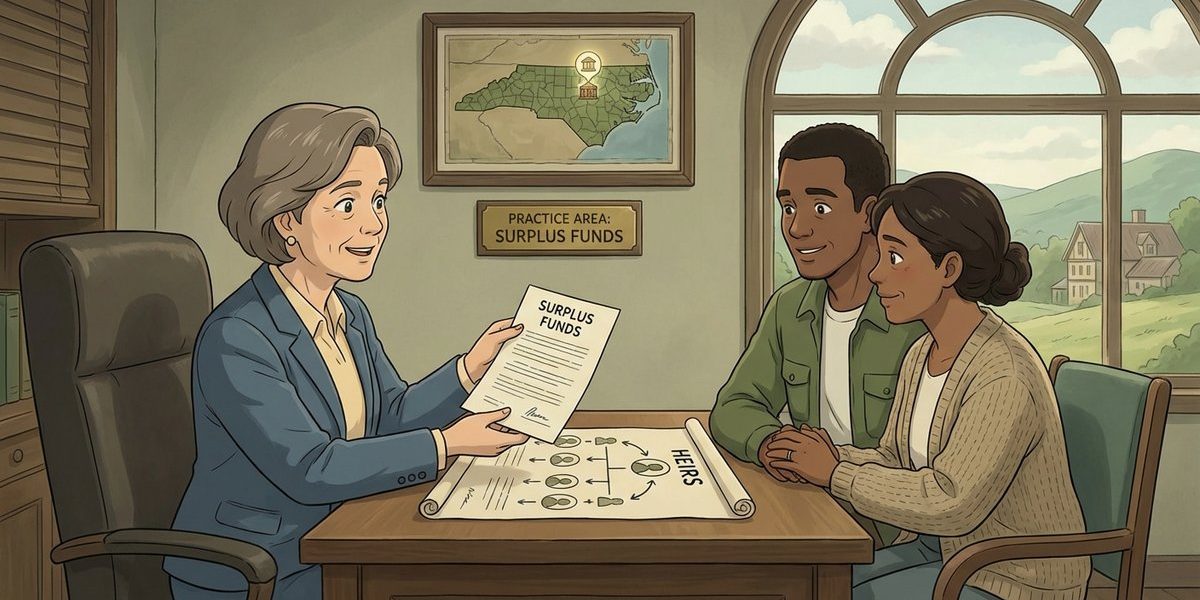
Can someone who isn’t a blood relative be listed as an heir when there is no will? – North Carolina
Short Answer
Usually no. In North Carolina, when someone dies without a will, “heirs” are the people who inherit under the intestate succession laws, and that list is primarily made up of a surviving spouse and blood relatives (and certain legally recognized family relationships). A non-relative generally does not qualify as an “heir” just because of a close relationship, caregiving, or a promise—unless there is a legal relationship that North Carolina treats like family for inheritance purposes.
Understanding the Problem
When a person dies in North Carolina without a will, can a non-blood relative be treated as an “heir” for purposes of claiming property or money tied to the person’s estate, including surplus funds connected to real property? The key decision point is whether North Carolina’s intestate succession rules recognize the claimant as an heir based on a legally recognized family relationship, rather than based on friendship, caregiving, or informal promises. This question often comes up when surplus funds are being held and the clerk’s office requires proof of who is legally entitled to receive them.
Apply the Law
Under North Carolina law, if there is no will (or the will does not dispose of everything), the estate passes to “heirs” under the intestate succession statutes. In general, heirs are the surviving spouse and the decedent’s relatives in a statutory order (such as children, parents, siblings, and more remote kin). A person who is not related by blood or marriage typically does not inherit through intestacy. If no heirs exist under the statute, unclaimed property can escheat (go) to the State, and the State Treasurer may pursue a court process to have the property declared escheated.
Key Requirements
- Intestacy applies: The person died without a valid will, or the will did not cover the property at issue.
- Heir status must exist under statute: The claimant must fit within the categories North Carolina recognizes as heirs (commonly a spouse or relatives in the statutory line).
- Proof controls the outcome: The clerk of superior court (and, if disputed, the superior court) typically requires documentation showing the family relationship and the chain of inheritance before releasing surplus funds.
What the Statutes Say
- N.C. Gen. Stat. § 45-21.32 (Special proceeding to determine ownership of surplus) – Allows a special proceeding before the clerk of superior court to decide who is entitled to foreclosure surplus funds paid into the clerk’s office.
- N.C. Gen. Stat. § 116B-2.2 (Escheat when no heirs) – Provides that property can escheat to the State when a person dies intestate (or partially intestate) without surviving heirs as defined by North Carolina law.
- N.C. Gen. Stat. § 116B-3 (Unclaimed personal property in estates) – Addresses payment of unclaimed estate assets to the State Treasurer when an estate is ready to close and there are no known heirs or the assets remain unclaimed.
- N.C. Gen. Stat. § 29-22 (Shares of others than the surviving spouse) – Part of North Carolina’s intestate succession framework for determining who takes when there is no will.
Analysis
Apply the Rule to the Facts: The situation involves recovering surplus funds connected to real property in North Carolina, but no paperwork has been received. In a surplus funds claim, the clerk’s office generally releases funds only to the person legally entitled to them. If the claimant is not a spouse and not a legally recognized heir under North Carolina intestacy law, the claimant typically cannot be listed as an heir in the surplus funds process, even if the claimant had a close relationship with the deceased owner.
Process & Timing
- Who files: A person claiming the surplus funds. Where: The Clerk of Superior Court in the county where the foreclosure/surplus funds were paid into the clerk’s office. What: A petition to determine entitlement to surplus funds (a special proceeding) and supporting documents showing the right to inherit (family tree/kinship information, death certificate, and any estate filings if one exists). When: As soon as possible after learning funds exist, because other claimants may file and because unclaimed property issues can arise if no lawful heirs come forward.
- Notice to other claimants: Other people who have filed claims, or who are known to assert a claim, must be included as parties. If someone disputes heirship, the matter can become a factual dispute.
- Hearing and decision: The clerk can decide entitlement in the special proceeding. If factual issues are raised, the case can be transferred to superior court for trial, and the court can decide who gets the funds.
Exceptions & Pitfalls
- Confusing “heir” with “beneficiary”: A beneficiary is named in a will or contract; an heir inherits only because the intestacy statutes say so. Without a will, a non-relative usually cannot inherit as an heir.
- Assuming caregiving or promises create inheritance rights: Providing care, paying bills, or being “like family” usually does not create heirship under intestacy. Separate claims (if any) may exist, but they are not the same as being an heir in an intestate estate.
- Missing documents: Surplus funds claims often stall because the claimant cannot prove the family relationship or cannot show the chain of inheritance from the deceased owner to the claimant.
- Disputes trigger a court case: If another person claims to be an heir (or challenges the family tree), the proceeding can be transferred for trial, increasing time and cost and requiring stronger proof.
Conclusion
In North Carolina, when there is no will, a non-blood relative usually cannot be listed as an heir because heirs are determined by the intestate succession statutes, which generally favor a surviving spouse and relatives in a set order. In surplus funds cases, the clerk typically requires proof of that legal heir status before releasing money. The next step is to file a special proceeding with the Clerk of Superior Court under the surplus funds statute as soon as the funds are identified and provide documents proving the legal right to inherit.
Talk to a Surplus Funds Attorney
If you’re dealing with surplus funds tied to real property and questions about who qualifies as an heir when there is no will, our firm has experienced attorneys who can help explain the process, the proof required, and the timelines. Call us today at (919) 341-7055.
Disclaimer: This article provides general information about North Carolina law based on the single question stated above. It is not legal advice for your specific situation and does not create an attorney-client relationship. Laws, procedures, and local practice can change and may vary by county. If you have a deadline, act promptly and speak with a licensed North Carolina attorney.

