
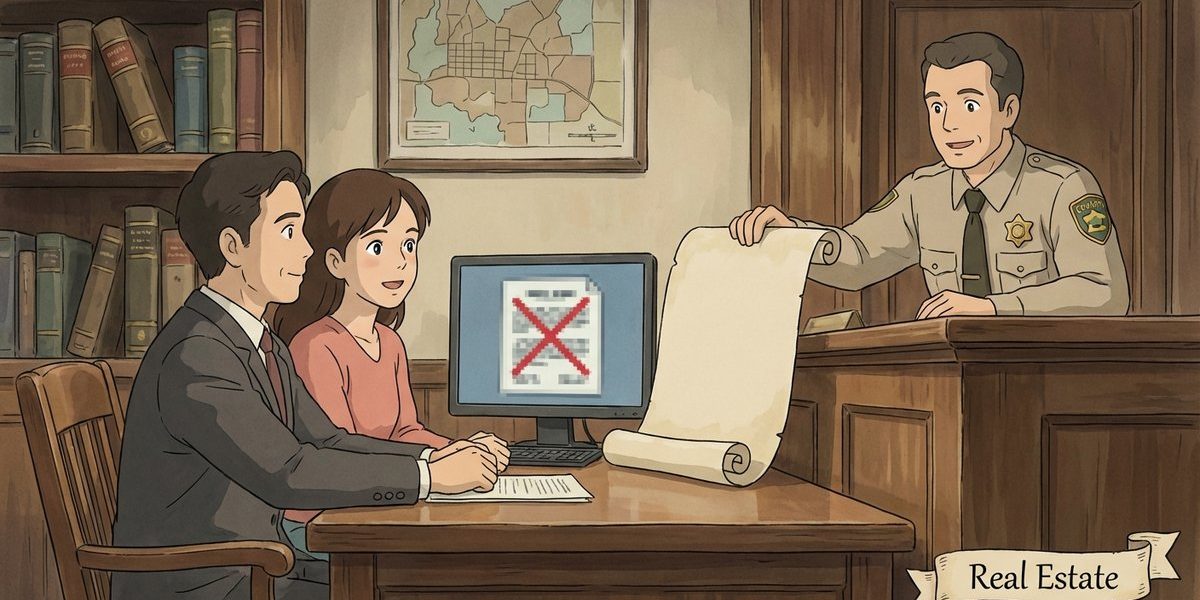
How can I get a clearer copy of a recorded deed if the online image is unreadable? – North Carolina
Short Answer
In North Carolina, the practical fix is to request a new copy directly from the county Register of Deeds instead of relying on the online image. Ask for a certified copy or a fresh reproduction of the specific deed book and page, and request that any hard-to-read pages (like a map exhibit) be re-scanned or copied at higher clarity. If the Register of Deeds cannot produce a readable copy from its records, the next step may involve locating another record source or using a legally acceptable certified copy process.
Understanding the Problem
In North Carolina real estate work, a common question is: can a clearer copy of a recorded deed be obtained when the online image is blurry or unreadable, especially for an exhibit page like a map or plat? The key decision point is whether the county Register of Deeds can provide a readable reproduction from the official recorded record using the deed book and page reference. If the recorded image remains unreadable, the issue becomes what other official routes exist to obtain a usable copy for review and file documentation.
Apply the Law
In North Carolina, deeds are recorded and maintained by the county Register of Deeds. The Register of Deeds can provide copies from the official record, and in many situations can provide certified copies that serve as official proof of what is recorded. When a document affects land in more than one county, North Carolina law also recognizes a process where the Register of Deeds can certify a copy after comparing it to the original presented for recording, and that certified copy can be used for registration purposes in the other county. If the problem is not the legal validity of the deed but the readability of the image, the most direct solution is usually an administrative one: ordering a new copy (often certified) and requesting the clearest available reproduction of the specific pages that are unreadable online.
Key Requirements
- Correct recording reference: The request should identify the deed by the county, deed book, and page (or instrument number), and specify the page(s) that are unreadable (for example, a map exhibit page).
- Request through the proper office: The request should go to the county Register of Deeds that holds the official recorded record for that deed.
- Appropriate copy type: The request should specify whether a plain copy is sufficient or whether a certified copy is needed for the file, court use, or another recording-related purpose.
What the Statutes Say
- N.C. Gen. Stat. § 161-15 (Certify and register copies) – Describes a process where the Register of Deeds compares a copy to an original presented for recording, certifies it as a true copy, and uses that certified copy for registration purposes (commonly relevant when land lies in more than one county).
- N.C. Gen. Stat. § 98-13 (Copies contained in court records may be recorded) – Allows certain copies from court records to be recorded on application to the Clerk of Superior Court with proof of genuineness, which can matter when the original record path is not available.
- N.C. Gen. Stat. § 8-32 (Certified copies of deeds and wills from other states) – Recognizes that properly certified copies can be used as evidence when an original cannot be obtained for registration in North Carolina (most relevant when the source record is outside North Carolina).
Analysis
Apply the Rule to the Facts: The facts describe a legal assistant who already has the deed book and page reference but cannot read the online image, especially a map page. Because the Register of Deeds maintains the official recorded record, the most direct step is requesting a new copy from that office and identifying the specific unreadable page(s). The request in the facts resulted in delivery by fax, which fits the practical approach of obtaining a clearer reproduction from the official custodian of the record.
Process & Timing
- Who files: The requesting party (often a law firm staff member, title professional, or property owner). Where: The county Register of Deeds in North Carolina where the deed was recorded. What: A request for a copy of the recorded deed by deed book and page (or instrument number), specifying that the online image is unreadable and identifying the problem page (for example, “map exhibit page”). When: As soon as the readability issue is discovered, especially if the deed is needed for a closing, title review, or litigation deadline.
- Ask for the clearest format available: Request a certified copy if an official copy is needed, and ask whether the office can provide a higher-resolution scan, a re-copy of the specific page, or delivery by email, mail, pickup, or fax depending on what the office supports.
- If the office copy is still unclear: Ask whether the Register of Deeds has access to a better source image (for example, a different scan, microfilm image, or the originally recorded paper image) and whether the office can reproduce the exhibit page separately. If the deed involves multiple counties, consider whether a certified-copy process may help confirm the recorded content for registration purposes in another county.
Exceptions & Pitfalls
- Online image is not the official record: The online portal image can be a lower-quality reproduction; relying on it without ordering an office copy can lead to missed legal descriptions, missing exhibit details, or misread book/page references.
- Exhibits can be filed in ways that are easy to miss: Map pages, plats, and other exhibits may be embedded as separate pages, recorded as attachments, or referenced by another recording (such as a plat book/page). A request should identify the exhibit page specifically.
- Certified vs. plain copy confusion: A plain copy may be fine for internal review, but a certified copy may be needed for court, certain lender requirements, or to prove what is recorded. Asking for the wrong type can cause delays.
- Record-quality limits: If the underlying recorded image is degraded (older scans, microfilm artifacts, or faint original printing), even a new copy may not fully resolve readability. In that situation, the next step may involve locating a better source record (such as a file copy from the drafting party) and then evaluating what legally acceptable options exist under North Carolina procedures.
Conclusion
In North Carolina, the best way to get a clearer copy of a recorded deed when the online image is unreadable is to order a new copy directly from the county Register of Deeds using the deed book and page (or instrument number) and to request the clearest available reproduction of the problem pages, such as a map exhibit. If an official copy is needed, request a certified copy. The most important next step is to submit the copy request promptly to the Register of Deeds to avoid delays tied to closing or court timelines.
Talk to a Real Estate Attorney
If a recorded deed image is too blurry to read and a clearer copy is needed for a title review or transaction timeline, our firm has experienced attorneys who can help explain options and coordinate with the Register of Deeds. Call us today at (919) 341-7055.
Disclaimer: This article provides general information about North Carolina law based on the single question stated above. It is not legal advice for your specific situation and does not create an attorney-client relationship. Laws, procedures, and local practice can change and may vary by county. If you have a deadline, act promptly and speak with a licensed North Carolina attorney.

