
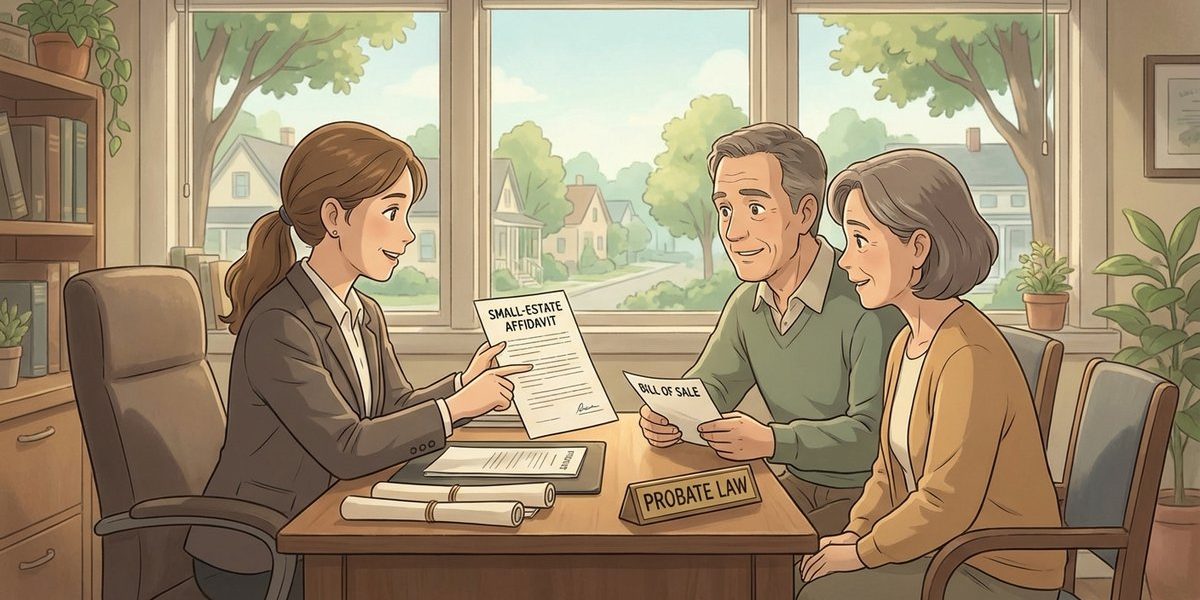
When listing sold personal property in a small‑estate affidavit, should the purchaser be shown as the recipient instead of the personal representative? – North Carolina
Short Answer
Usually, no. In a North Carolina small-estate “collection by affidavit” process, the affidavit is designed to show what estate property was collected by the affiant (the collector) and how it was distributed, not to document a sale to a third-party buyer. If estate personal property was sold, the purchaser is typically documented in the bill of sale/title transfer paperwork, while the affidavit and final accounting generally show the affiant receiving the asset (or its sale proceeds) and then distributing the proceeds to the proper payees.
Understanding the Problem
Under North Carolina probate practice, when a small estate is handled by affidavit, the key decision point is how to correctly describe a transaction where estate personal property (such as a vehicle or trailer) was sold: should the affidavit list the third-party purchaser as the “recipient,” or should it list the collector by affidavit (sometimes informally called the personal representative) as the person who received the property and then later distributed the sale proceeds? The question matters because the Clerk of Superior Court uses the affidavit and any final affidavit/accounting to track what was collected for the estate and where it ultimately went.
Apply the Law
North Carolina allows certain small estates to be handled through a collection-by-affidavit procedure. The affiant’s role is to collect the decedent’s personal property, pay allowed items in the required order, and distribute what remains to the people entitled to it under the will or intestacy. In that framework, a third-party buyer is not usually treated as a “recipient” of an estate distribution; the buyer is simply the counterparty to a sale, and the estate’s “recipient-side” event is the affiant receiving the sale proceeds and then distributing those proceeds to the proper estate payees.
Key Requirements
- Collector-by-affidavit authority and limits: The affidavit process is for collecting and distributing personal property within the statutory limits; it is not the same as qualifying as a full personal representative in an estate administration.
- Distribution order matters: The collector must apply collected personal property (including cash proceeds from sales) in the required order—allowances first when applicable, then valid debts/claims, then the remainder to the people entitled under the will or intestacy.
- Clear paper trail: Sales are usually proven by sale documents (title transfer, bill of sale, receipts), while the affidavit/accounting shows what the collector received and how the collector disbursed it.
What the Statutes Say
- N.C. Gen. Stat. Chapter 28A (Administration of Decedents’ Estates) – contains North Carolina’s small-estate procedures (including collection/administration by affidavit) and the rules that govern collecting and distributing estate personal property.
- N.C. Gen. Stat. § 1-339.35 (Report of private sale) – in court-supervised private sales, the report must identify the purchaser; this illustrates that “purchaser identity” is typically captured in sale documentation/reporting, separate from distribution accounting.
Analysis
Apply the Rule to the Facts: The facts describe a vehicle and trailer that were sold and a desire to list the purchasers as “recipients” on the small-estate affidavit rather than listing the collector/trustee. Under the small-estate-by-affidavit concept, the cleaner approach is usually to treat the sale as converting estate property into cash: the collector receives the proceeds (supported by the bill of sale/title paperwork and deposit records), then distributes proceeds according to the required order and the will/trust plan. The purchasers generally belong in the sale paperwork, not as estate distribution recipients.
Process & Timing
- Who files: The person eligible to act as the collector by affidavit (often an heir or person named in the will). Where: The Estates Division of the Clerk of Superior Court in the North Carolina county with proper venue. What: The AOC small-estate affidavit form used by that county, plus supporting documents the Clerk requires. When: After death and once the estate qualifies for the small-estate procedure; timing can vary by county practice and what assets must be gathered.
- Document the sale separately: Keep the bill of sale, title transfer/DMV documents (for vehicles/trailers), and proof of payment. Treat the sale proceeds as the “collected” asset for accounting purposes.
- Distribute and close out: Provide beneficiaries a clear breakdown and obtain signed receipts/releases if used in the administration plan, then complete the final affidavit/accounting required by the Clerk for the small-estate file.
Exceptions & Pitfalls
- Clerk form instructions may drive the answer: Some counties’ affidavit/accounting formats have specific fields for “to whom delivered” that can be misread as “buyer.” If the form is really tracking distributions, listing a purchaser can confuse the record. When in doubt, confirm with the Estates Clerk what they want shown on that line and attach the sale documentation.
- Mixing roles (estate vs. trust vs. agent under POA): A trustee paying trust funds to an agent under a power of attorney is a separate step from the estate’s small-estate collection and distribution. The estate paperwork should reflect estate receipts/disbursements; trust distributions should be documented in the trust’s records.
- Vehicle/trailer transfers are document-driven: DMV/title paperwork typically proves who bought the vehicle/trailer. Trying to force the purchaser into the “recipient” slot on an estate affidavit can create inconsistencies between the probate file and the title record.
Conclusion
In North Carolina small-estate administration by affidavit, sold personal property is usually best shown as having been collected by the affiant (or converted into cash proceeds collected by the affiant), with the later distributions shown to the proper estate payees—not as a “distribution” to the purchaser. The purchaser is typically documented in the bill of sale and title/DMV transfer records. The next step is to file the small-estate affidavit with the Clerk of Superior Court and attach or retain sale documentation so the probate file and the title record match.
Talk to a Probate Attorney
If a North Carolina small-estate affidavit needs to reflect a sale of a vehicle, trailer, or other personal property—and the form fields do not clearly fit the transaction—our firm has experienced attorneys who can help clarify how to document the sale and distributions in a way the Clerk will accept. Call us today at (919) 341-7055.
Disclaimer: This article provides general information about North Carolina law based on the single question stated above. It is not legal advice for your specific situation and does not create an attorney-client relationship. Laws, procedures, and local practice can change and may vary by county. If you have a deadline, act promptly and speak with a licensed North Carolina attorney.

