
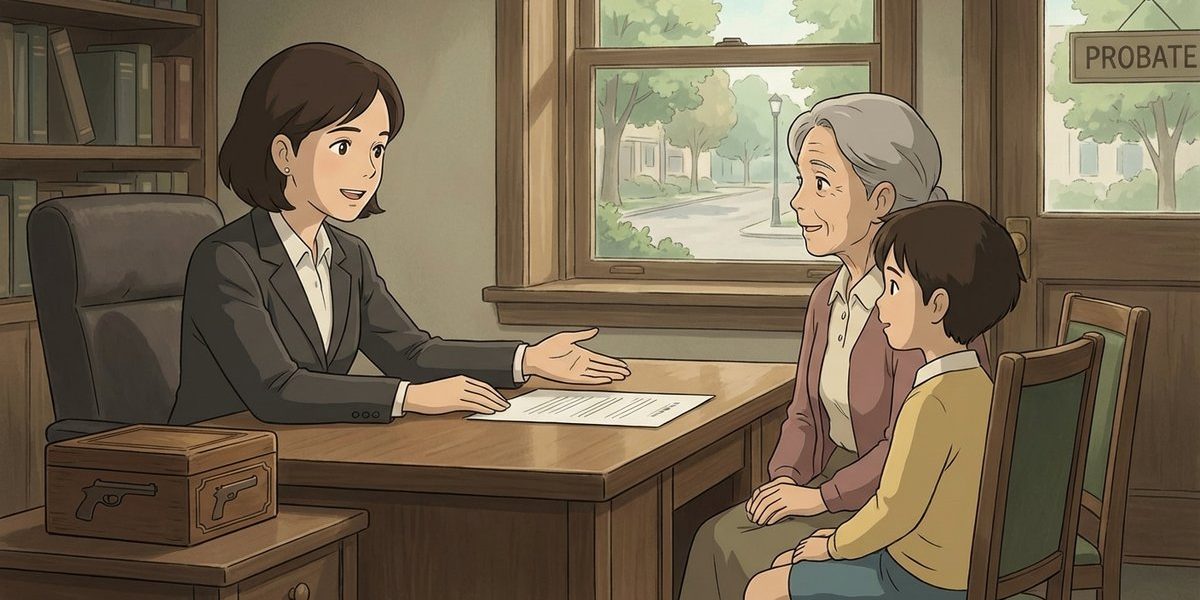
What is the process for handling firearms held by law enforcement after the owner dies, and can they be transferred to an heir or held for a child? – North Carolina
Short Answer
In North Carolina, firearms held by law enforcement after an owner’s death are usually released only to a legally authorized person (often the estate’s personal representative) and often only after a court order, depending on why law enforcement has them. If the firearms are estate property, they can typically be transferred to an eligible heir, but a minor child generally cannot take possession; instead, the estate may need to use a lawful custodian arrangement or hold/sell the firearms until the child is legally able to possess them. If the firearms were surrendered under a domestic-violence protective order, special court procedures and deadlines can control release or disposal.
Understanding the Problem
In North Carolina probate, the key question is: when law enforcement is holding a deceased person’s firearms, who has the legal authority to request release, and can those firearms be transferred to an heir or kept for a minor child? The answer depends on why the firearms are in law enforcement custody (for example, evidence in a case versus surrendered under a domestic-violence protective order), and on who is legally entitled to possess them under state and federal law. The process usually runs through the Clerk of Superior Court (estate administration) and, in some situations, the District Attorney and the court that controls the law-enforcement agency’s custody of the firearms.
Apply the Law
North Carolina treats firearms held by law enforcement differently depending on the legal basis for custody. If the firearms are being held as seized property or evidence, the District Attorney and the court can control release and disposition. If the firearms were surrendered under a Chapter 50B domestic-violence protective order, the statute sets out who may move for return, the time limits, and when the sheriff must seek a disposition order. Separately, when firearms are part of an estate, the personal representative generally handles collection, safeguarding, and distribution of personal property, but transfers must still comply with firearm-eligibility rules and practical safety requirements—especially when a minor child is involved.
Key Requirements
- Identify the custody basis: Determine whether the firearms are held as evidence/seized property, as “unclaimed” property, or because they were surrendered under a domestic-violence protective order. The correct procedure and decision-maker changes based on that reason.
- Show legal authority and entitlement: The person requesting release generally must prove a right to possess the firearms (for example, appointment as personal representative and proof the firearms are estate property) and must not be legally prohibited from possessing firearms.
- Use a lawful transfer method for heirs (especially minors): Adult heirs can often receive firearms if eligible, but a minor child typically cannot take possession directly; the estate may need a custodian arrangement under North Carolina law or another lawful plan that prevents the minor from accessing the firearms.
What the Statutes Say
- N.C. Gen. Stat. § 15-11.1 (Seizure, custody, and disposition of seized property; firearms disposition) – Allows the District Attorney to seek a court order to return or dispose of a firearm once it is no longer needed as evidence, with specific options for return, destruction, or transfer/sale through law enforcement.
- N.C. Gen. Stat. § 50B-3.1 (Surrender and disposal of firearms in domestic-violence protective orders) – Sets the surrender rules, requires a court order for release, and creates deadlines for motions to return firearms (including a short deadline for third-party owners).
- N.C. Gen. Stat. § 14-269.8 (Firearm possession prohibited while subject to certain DV orders) – Makes possession/purchase/receipt unlawful for a person ordered to surrender firearms while a qualifying protective order is in effect.
- N.C. Gen. Stat. § 14-315.1 (Storage of firearms to protect minors) – Creates criminal exposure when a firearm is left accessible to an unsupervised minor and the minor gains access and uses/possesses it in certain prohibited ways.
- N.C. Gen. Stat. § 33A-5 (Transfers to a custodian for a minor) – Authorizes certain transfers to a custodian for a minor under North Carolina’s transfers-to-minors framework when permitted by the governing instrument.
Analysis
Apply the Rule to the Facts: The facts describe a death during separation with a domestic-violence protective order involved, and firearms being held by law enforcement. In that setting, the first step is to confirm whether the firearms were surrendered under a Chapter 50B order (which triggers the motion-and-deadline process and requires a court order for release) or whether they are being held as seized property/evidence (which typically runs through the District Attorney and a court order under the seized-property statute). If the firearms are estate property, the personal representative is usually the proper party to coordinate retrieval and then arrange a compliant transfer to an eligible heir; if the intended beneficiary is a child, the estate generally must avoid direct possession by the minor and instead use a lawful custodian or other court-approved handling plan.
Process & Timing
- Who files: Usually the estate’s personal representative (executor/administrator) or another person claiming lawful ownership/entitlement; in a Chapter 50B situation, the defendant (or a qualifying third-party owner) files the motion described in the statute. Where: (a) For Chapter 50B firearms, the court that entered the protective order (file maintained by the Clerk of Superior Court). (b) For seized/evidence firearms, the criminal court with authority over the case, typically through the District Attorney and a judge. What: A written motion/request for return or a request that the District Attorney seek a disposition order; supporting documents commonly include death certificate, letters of administration/testamentary, and proof the firearms are estate property. When: If the firearms were surrendered under a Chapter 50B order, a third-party owner must file within 30 days after seizure, and the defendant’s motion for return must be filed by the statutory deadline (commonly within 90 days after expiration of the order or final disposition of related pending charges).
- Hearing and eligibility check: The court typically sets a hearing. The judge considers whether the requesting party is legally allowed to possess firearms and whether any order or pending charge prevents release. In Chapter 50B cases, the sheriff generally cannot release firearms without a court order and may require storage fees to be paid before release.
- Transfer to the heir or lawful holding plan: Once released to the estate (or otherwise lawfully controlled), the personal representative can distribute firearms as estate personal property, but should document the transfer and use a compliant method. A common practical approach is to transfer through a federally licensed firearms dealer (FFL) so the dealer can run the required background check process and create a clear paper trail. If the beneficiary is a minor child, the estate typically cannot simply hand the firearms to the child; the estate may need to place the firearms with an eligible adult custodian under a lawful arrangement or keep them secured and inaccessible to the child until a lawful transfer is possible.
Exceptions & Pitfalls
- Protective-order restrictions can block release: If a qualifying protective order is still in effect, or if the court finds another legal disqualifier, the judge can deny return and order disposal under the statute’s process.
- “Estate property” does not automatically mean “immediate release”: Law enforcement may require a court order, and the District Attorney/court may control the timeline if the firearms were tied to a criminal matter or are being handled under a statutory disposition process.
- Minor-child requests are high-risk: A plan that allows a minor unsupervised access can create criminal exposure under North Carolina’s minor-access storage law. A safer approach is to keep the firearms secured and inaccessible and use a lawful custodian/transfer method that prevents the child from possessing them.
- Unsafe transport and prohibited locations: Handling and transporting firearms during estate administration can create avoidable problems. A careful chain of custody, safe storage, and a direct transfer to lawful storage or an FFL reduces risk.
- Spouse status is a separate probate issue: Whether a separated spouse still qualifies as a “surviving spouse” for estate purposes can affect who has priority to serve as personal representative and who inherits, but the law-enforcement release process still generally requires proof of legal authority and firearm eligibility.
Conclusion
In North Carolina, firearms held by law enforcement after an owner’s death are released only through the correct legal channel for the reason they are being held—often requiring a court order—and then must be handled by a legally authorized, eligible person (commonly the estate’s personal representative). Adult heirs can often receive firearms if legally eligible, but a minor child generally cannot take possession, so the estate must use a lawful custodian or secure holding plan. The most important next step is to confirm the custody basis and file the appropriate motion/request with the correct court, watching the Chapter 50B deadlines if a protective order was involved.
Talk to a Probate Attorney
If law enforcement is holding firearms after a death and there is any protective-order history or a minor child beneficiary, the process can turn on the right court filing and tight deadlines. Our firm has experienced attorneys who can help clarify who has authority to request release, how to document estate ownership, and how to complete a lawful transfer. Call us today at [919-341-7055].
Disclaimer: This article provides general information about North Carolina law based on the single question stated above. It is not legal advice for your specific situation and does not create an attorney-client relationship. Laws, procedures, and local practice can change and may vary by county. If you have a deadline, act promptly and speak with a licensed North Carolina attorney.

