
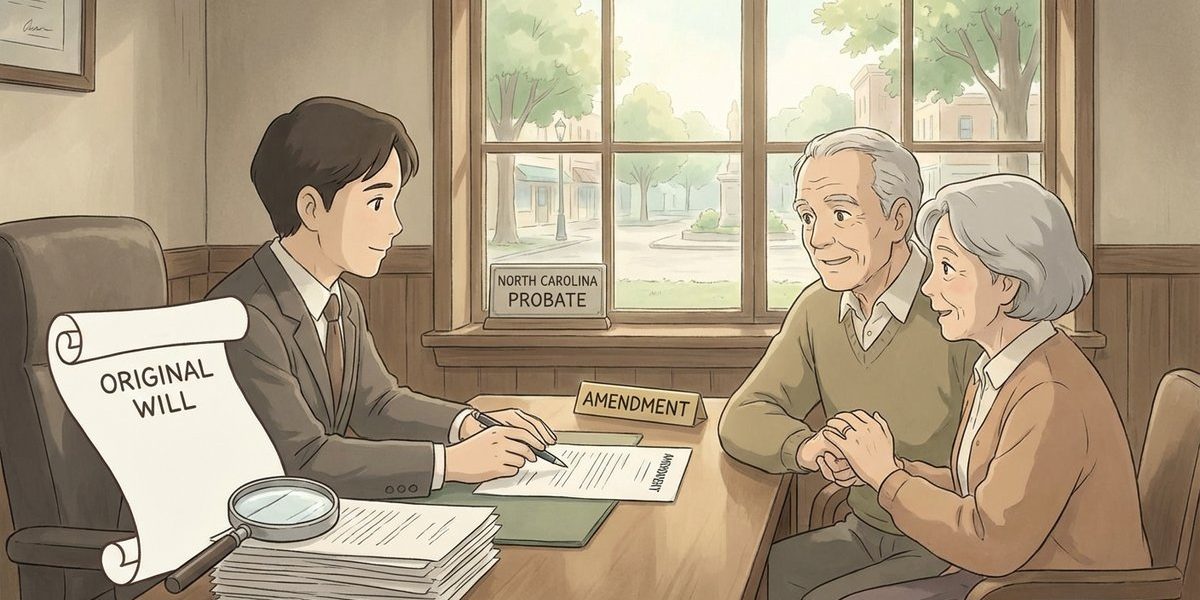
What happens if there’s a signed amendment to a will but the original will can’t be found? – North Carolina
Short Answer
In North Carolina, a signed amendment to a will (often called a “codicil”) usually cannot stand on its own if the original will it amends cannot be found. When the original will is missing, the estate typically must either (1) prove and probate the missing will as a “lost will” (often using a copy and witness evidence) and then probate the amendment with it, or (2) if the lost will cannot be proven, the estate may be treated as if there is no will for the property that needs probate. The Clerk of Superior Court (as judge of probate) decides whether the evidence is strong enough to admit a lost will.
Understanding the Problem
In North Carolina probate, the key question is what happens when a deceased person left a signed amendment to a will, but the original will itself cannot be located after death. The practical issue often shows up when a surviving spouse and family need authority to transfer assets that are not set up to pass automatically at death, such as a jointly titled home or vehicle titles that do not include survivorship language. The decision point is whether the missing original will can be treated as a valid “lost will” so the amendment can be used, or whether the estate must move forward without a will for the assets that require probate.
Apply the Law
North Carolina gives the Clerk of Superior Court exclusive original jurisdiction over probate and estate administration. When an original will cannot be found, North Carolina law and case law allow a “lost will” to be admitted to probate only if the person offering it can meet specific proof requirements. A signed amendment (codicil) generally works by changing a valid will; if the will cannot be admitted, the codicil may not have anything to “attach” to, and the estate may be administered as if there is no will for the assets that require probate.
Key Requirements
- Prove the will was properly executed: For an attested written will, North Carolina generally requires the testator’s signature and at least two competent witnesses who signed in the testator’s presence, with the testator signifying to the witnesses that the instrument is the testator’s will.
- Prove the contents of the missing will: The Clerk must be satisfied about what the missing will said (often shown through a copy, draft, or credible witness testimony about the terms).
- Overcome the “revocation” problem and show a diligent search: If the original will was last in the testator’s possession and cannot be found at death, North Carolina courts commonly apply a rebuttable presumption that the testator revoked it. The person offering the lost will typically must also show a good-faith, diligent search in the places the will would most likely be found and facts suggesting the will was lost or destroyed without an intent to revoke.
What the Statutes Say
- N.C. Gen. Stat. § 7A-241 (Probate jurisdiction) – Gives the Clerk of Superior Court (as judge of probate) authority over probate of wills and estate administration.
- N.C. Gen. Stat. § 31-3.3 (Attested written will requirements) – Sets the core signing and witness rules for a typical written will.
- N.C. Gen. Stat. § 31-11.6 (Self-proved wills) – Allows a will to be made “self-proved,” which can reduce the need to locate witnesses later.
- N.C. Gen. Stat. § 31-46 (Probate of lost or destroyed wills) – Governs probate of a lost or destroyed will in North Carolina.
Analysis
Apply the Rule to the Facts: Here, most bank and retirement accounts were handled using the death certificate, which often means those assets passed by beneficiary designation or similar non-probate transfer. The remaining problem assets are a jointly titled home and vehicle titles that were not set up with survivorship language, which commonly means a probate estate (and a personal representative) is needed to transfer title. If the only testamentary document available is a signed amendment, the family usually still needs to prove the missing original will (and its contents) as a lost will before the amendment can be applied as part of the estate plan.
Process & Timing
- Who files: Usually the named executor in the will, or another interested person if the executor cannot act. Where: The Clerk of Superior Court (Estates Division) in the North Carolina county where the decedent was domiciled at death. What: A probate filing asking to admit the will, plus a lost-will petition or supporting affidavits if the original cannot be produced, and the signed amendment (codicil) offered for probate along with it. When: As soon as practical after death, especially if real estate or vehicles must be retitled.
- Evidence gathering: Collect any copy of the will, the signed amendment, information about where the original was kept, and a written description of the search (home files, safe, safe deposit box, attorney’s office, digital vaults, and inquiries to family members). If the will was self-proved, that can simplify proof; if not, witness affidavits or other competent evidence may be needed.
- Clerk’s decision and next steps: If the Clerk admits the lost will (and the amendment) to probate, the Clerk can issue letters (authority) to the personal representative, who can then handle probate transfers for assets like the home and vehicle titles. If the lost will cannot be admitted, the estate may proceed as an intestate estate (no will) for the probate assets, and the amendment generally will not control those transfers.
Exceptions & Pitfalls
- Presumption of revocation: If the original will was last known to be in the decedent’s possession and it cannot be found, the Clerk may presume it was revoked. The case for a lost will is stronger when there is credible evidence of accidental loss (fire, flood, misfiling, third-party custody, etc.) and a well-documented search.
- “Signed amendment” problems: A document labeled as an amendment or codicil still must meet will-execution formalities to be valid, and it typically needs an underlying will to amend. If the amendment references a will that cannot be proven, the amendment may not accomplish the intended distribution plan.
- Proof of contents: A copy is often the best evidence of what the missing will said, but the process can still require witness testimony or affidavits about execution and contents. Missing witnesses, incomplete copies, or unclear terms can slow the case or lead to denial.
- Title transfer delays: Even when many accounts pass outside probate, real estate and vehicle title issues can force probate. Waiting too long can create practical problems (insurance, maintenance, sale timing, and creditor issues).
Conclusion
In North Carolina, a signed amendment to a will usually does not solve the problem if the original will cannot be found, because the amendment typically depends on a valid will being admitted to probate. The estate generally must prove the missing will as a “lost will” by showing proper execution, the will’s contents, a diligent search, and facts that rebut the presumption the will was revoked. The next step is to file a probate proceeding with the Clerk of Superior Court in the county of domicile and submit the evidence supporting admission of the lost will and the amendment.
Talk to a Probate Attorney
If there’s a signed amendment to a will but the original will cannot be found and probate is needed to transfer a home or vehicle title, our firm has experienced attorneys who can help explain the options, evidence needed, and likely timelines in North Carolina. Call us today at [CONTACT NUMBER].
Disclaimer: This article provides general information about North Carolina law based on the single question stated above. It is not legal advice for your specific situation and does not create an attorney-client relationship. Laws, procedures, and local practice can change and may vary by county. If you have a deadline, act promptly and speak with a licensed North Carolina attorney.

