
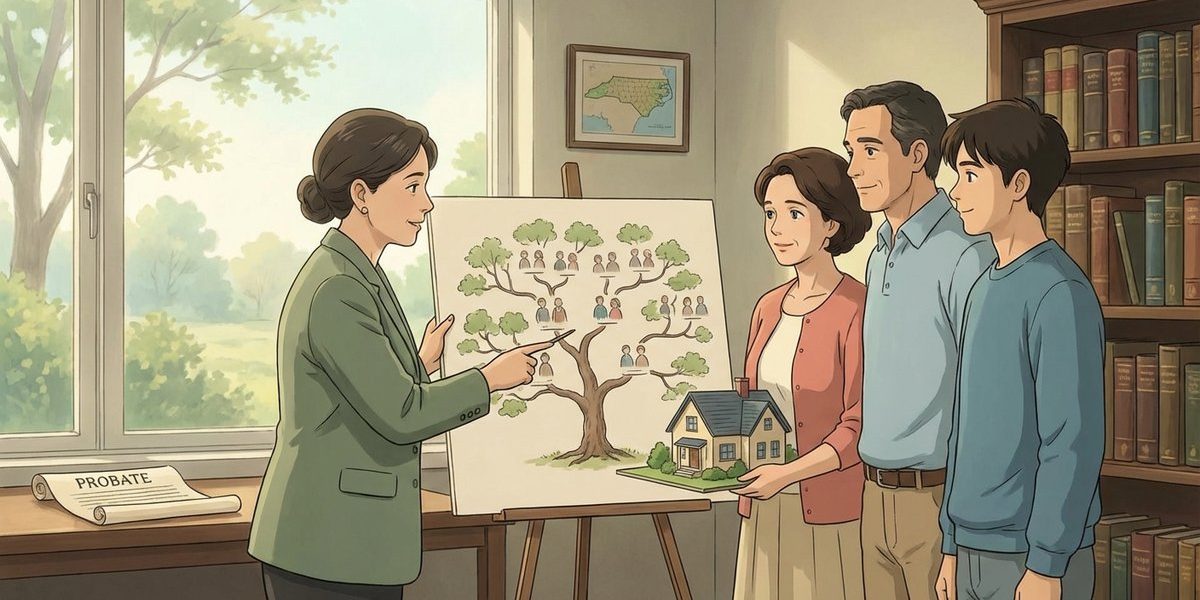
If my relative died without a will and had a spouse, do other family members inherit anything? – North Carolina
Short Answer
Not always. In North Carolina, when someone dies without a will (intestate), the surviving spouse may inherit everything only if the decedent had no surviving children (or other lineal descendants) and no surviving parents. If the decedent had children or surviving parents, other family members may inherit a share, depending on who survived and what type of property is involved.
Understanding the Problem
When a North Carolina resident dies without a will and leaves a surviving spouse, the key question is whether anyone else (children, parents, siblings, or more distant relatives) also has inheritance rights under North Carolina intestacy rules. The answer turns on which close relatives survived and whether the estate includes real estate, personal property, or both. The issue is not whether family members were close to the decedent, but whether North Carolina’s intestate succession statute places them in a class that receives a share.
Apply the Law
North Carolina’s Intestate Succession Act controls who inherits when there is no valid will. The surviving spouse’s share depends on whether the decedent also left (1) children or other lineal descendants, or (2) parents. If neither children/descendants nor parents survive, the spouse takes the entire intestate estate. If children/descendants or parents survive, the spouse takes a defined share and the remaining share passes to the next class of heirs.
Key Requirements
- No valid will: The estate is distributed under North Carolina intestacy rules rather than a written plan.
- Identify who survived: The spouse’s share changes depending on whether the decedent is survived by children (or other lineal descendants) and/or by one or both parents.
- Identify what property is in the probate estate: The spouse’s intestate share is calculated from the net intestate estate (after administration costs and lawful claims), and the statute treats real property and personal property differently in some situations.
What the Statutes Say
- N.C. Gen. Stat. § 29-14 (Share of surviving spouse) – Sets the spouse’s intestate share based on whether the decedent left descendants and/or parents, and distinguishes between real and personal property.
- N.C. Gen. Stat. § 29-15 (Shares of others than surviving spouse) – Explains who inherits the portion not going to the spouse (children/descendants first, then parents, then siblings, then more distant relatives).
- N.C. Gen. Stat. § 29-13 (Descent and distribution upon intestacy) – States that intestate distribution is subject to administration costs and lawful claims against the estate.
Analysis
Apply the Rule to the Facts: Here, a records search did not locate a will, so North Carolina intestacy rules likely control. The facts state the decedent had a surviving spouse and that the spouse is treated as the sole heir; that outcome generally fits the situation where the decedent had no surviving children (or other lineal descendants) and no surviving parents, so there is no “remainder share” for other family members under the intestacy statute. If children/descendants or a parent survived, then other family members could inherit a portion that does not pass to the spouse.
Process & Timing
- Who files: Typically the surviving spouse or another interested person. Where: The Clerk of Superior Court (Estates) in the county where the decedent lived in North Carolina. What: An application/petition for Letters of Administration to open the estate when there is no will. When: As soon as practical after death, especially if assets need to be collected, bills are due, or property needs to be protected.
- Heirship determination: The personal representative identifies heirs under Chapter 29 and inventories estate assets; the spouse’s share depends on whether there are surviving descendants or parents and on the mix of real vs. personal property.
- Distribution: After paying allowed costs and claims, the personal representative distributes the net intestate estate to the spouse and any other heirs who qualify under the statute.
Exceptions & Pitfalls
- Children or parents change the answer: If the decedent had surviving children (including adult children) or surviving parents, the spouse may not receive 100% of the intestate estate, and other heirs may inherit the remaining share.
- Real vs. personal property can matter: North Carolina’s intestacy statute can give the spouse different fractions of real property versus personal property, and personal property may include a statutory dollar “first amount” before percentages apply. Misclassifying assets can lead to incorrect distributions.
- “Estate” does not always mean everything owned: Some assets may pass outside probate (for example, by beneficiary designation or survivorship). Intestacy rules generally control only the probate intestate estate, not every asset connected to the decedent.
- Debts and expenses come first: Intestate shares are calculated from the net estate after proper costs and lawful claims, so assuming an inheritance before administration is complete can create conflict and confusion.
For more background on how a spouse’s share can work when there is no will, see whether a surviving spouse can take everything when there is no will.
Conclusion
In North Carolina, when a person dies without a will and leaves a surviving spouse, other family members inherit only if the intestacy statute leaves a share that does not go to the spouse—most commonly because the decedent also left surviving children (or other lineal descendants) or a surviving parent. If there are no surviving descendants and no surviving parents, the spouse generally inherits the entire intestate estate. The next step is to open an intestate estate by applying for Letters of Administration with the Clerk of Superior Court in the county of domicile.
Talk to a Probate Attorney
If a family member died without a will and there is a surviving spouse, our firm has experienced attorneys who can help clarify who qualifies as an heir, what property is part of the estate, and what filings are needed with the Clerk of Superior Court. Call us today at [919-341-7055].
Disclaimer: This article provides general information about North Carolina law based on the single question stated above. It is not legal advice for your specific situation and does not create an attorney-client relationship. Laws, procedures, and local practice can change and may vary by county. If you have a deadline, act promptly and speak with a licensed North Carolina attorney.

