
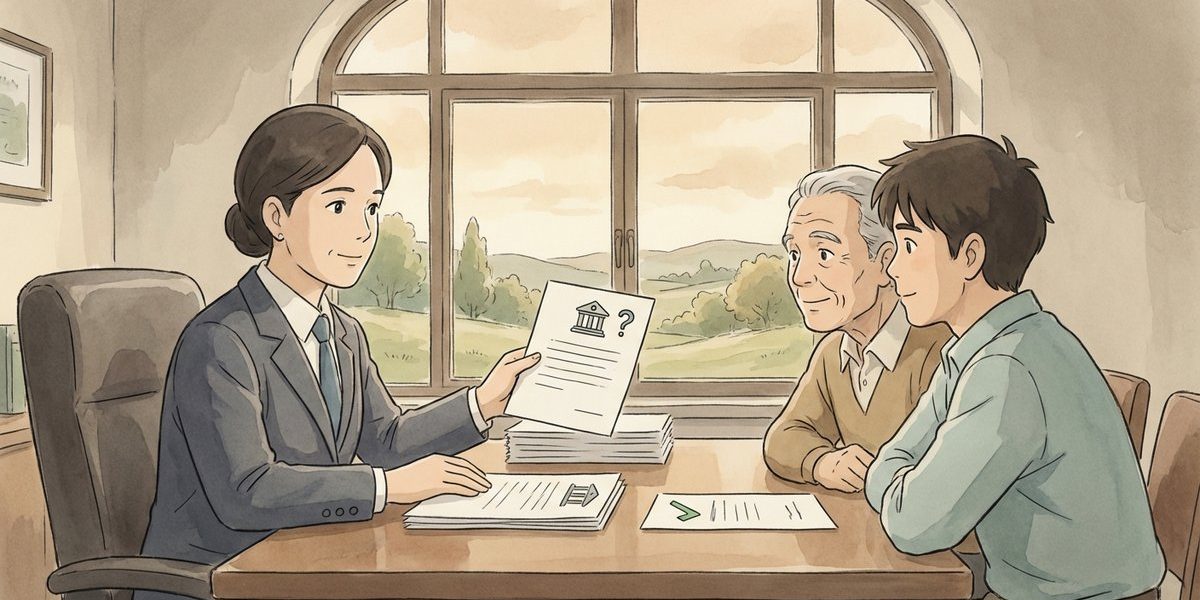
How do I prove who the beneficiaries are on a deceased person’s IRA if the bank can’t find the original signature card? – NC
Short Answer
In North Carolina, the missing original IRA signature card does not automatically mean the beneficiary designation fails. The key question is whether the financial institution can produce reliable business records showing that a beneficiary designation was made, accepted, and still appeared in its system at death. Written confirmation from the institution after internal review can be important evidence, but the exact proof needed may depend on whether the account is paid directly by the institution or disputed in an estate proceeding.
Understanding the Problem
In North Carolina probate matters, the issue is whether a deceased account owner’s IRA beneficiaries can be identified when the financial institution cannot locate the original signed designation document. The decision point is narrow: whether the institution’s remaining records are enough to establish who takes the IRA at death, instead of the account being treated as payable to the estate. This usually matters when the estate’s attorney has account statements and internal bank confirmation, but not the older paper signature card or beneficiary form.
Apply the Law
Under North Carolina law, assets with a valid beneficiary designation generally pass at death under the account contract rather than through the probate estate. For securities and similar accounts registered in beneficiary form, ownership passes to the surviving beneficiary on proof of death and compliance with the registering entity’s requirements. North Carolina law also allows the registering entity to set reasonable terms for proving death, identity, and other facts needed to carry out the designation, which matters when older paper records are missing and the institution must rely on archived system records or successor records after mergers and record conversions.
Key Requirements
- Valid beneficiary designation: There must be evidence that the account owner made a beneficiary designation that the institution accepted for the IRA.
- Reliable institutional records: The bank or custodian should be able to show, through its business records, system notes, archived images, or written confirmation after review, who was listed as beneficiary at death.
- Compliance with payout procedures: The person claiming the IRA usually must provide a death certificate, identification, and any claim forms the custodian requires before the account is transferred or paid.
What the Statutes Say
- N.C. Gen. Stat. § 41-43 (Origination of registration in beneficiary form) – explains when a security is registered with a beneficiary designation.
- N.C. Gen. Stat. § 41-46 (Ownership on death of owner) – states that ownership passes to the surviving beneficiary on death, subject to proof and the registering entity’s requirements.
- N.C. Gen. Stat. § 41-49 (Terms, conditions, and forms for registration) – allows the institution to set reasonable rules for proof, assurances, and identification needed to implement a beneficiary designation.
- N.C. Gen. Stat. § 54B-130.1 (Payable on Death accounts) – shows that North Carolina recognizes written beneficiary arrangements at certain financial institutions and that the funds pass outside the will when the designation is valid.
Analysis
Apply the Rule to the Facts: Here, the estate requested the IRA records, and the financial institution responded that the account is old and the original signature card cannot be found. That does not end the inquiry. If the institution can give written confirmation that beneficiary designations exist and were accepted based on system records after supervisor review, that confirmation can support the position that the IRA has named beneficiaries and is not simply an estate asset. The stronger the confirmation, the better: it should identify the beneficiaries, the percentages or shares if available, and whether the designation on file was the last one in effect at death.
North Carolina estate practice also recognizes a practical point that often arises with older accounts: because of mergers, record conversions, and storage limits, the original signature card is sometimes unavailable, and the institution may only be able to confirm ownership or beneficiary information from its records. In that setting, the estate’s attorney usually tries to gather the complete paper trail available, including account statements, change-of-beneficiary records, correspondence, internal account screens, and a letter from the custodian explaining what records were reviewed and what the system showed at the date of death. If the institution will pay based on those records, that often resolves the issue without court litigation.
If a dispute develops, the missing original card becomes an evidence problem rather than an automatic defeat. For example, if the bank’s system shows two named beneficiaries and states the designation was accepted after review, that tends to support direct payment to those beneficiaries. If the system only shows that a designation once existed but does not identify the names or shares, the estate may need more proof, and the account may be harder to administer until the custodian clarifies its records or a court addresses the dispute. For more on related issues, see whether an IRA has a beneficiary listed and system beneficiary information.
Process & Timing
- Who files: usually the named beneficiary makes the claim, while the personal representative or estate attorney requests records if ownership is unclear. Where: first with the IRA custodian or financial institution; if there is a dispute, in the Clerk of Superior Court handling the estate in the North Carolina county where the estate is pending, or in a related civil action if needed. What: death certificate, claim or transfer forms required by the custodian, letters testamentary or letters of administration if the estate is requesting information, and a written request for all beneficiary records, including archived system notes and supervisor review confirmation. When: as soon as the issue is identified, because institutions may freeze distributions until documentation is complete.
- Next, the institution reviews its records and states whether it will honor the beneficiary designation based on system data, archived records, or other internal proof. Timeframes vary by institution, and older accounts often take longer because legacy records may need manual review.
- Final step: the custodian either transfers the IRA to the confirmed beneficiary claimant or refuses payment pending more proof or a court order. If refused, the estate or claimant may need a formal proceeding to determine who is entitled to the account.
Exceptions & Pitfalls
- A system note that a beneficiary designation exists is stronger if it also identifies the beneficiary names, shares, and effective date; vague confirmation may not be enough if someone contests the account.
- A will does not usually override a valid IRA beneficiary designation, so treating the IRA as an estate asset too early can create avoidable conflict.
- Missing records after mergers or account conversions are common, but the institution should still be pressed for archived images, audit trails, and written explanation of its review process.
- If competing claimants appear, the custodian may require a court order before paying anyone, even if internal records favor one side.
- Service and notice problems can arise if the estate opens a dispute proceeding without giving proper notice to all persons claiming an interest in the IRA.
Conclusion
In North Carolina, a missing original IRA signature card does not automatically defeat a beneficiary claim. The controlling issue is whether the financial institution can reliably show, through accepted business records, who the beneficiaries were at the owner’s death. The most important next step is to obtain a detailed written confirmation from the custodian identifying the beneficiaries and the records reviewed, then submit the custodian’s claim or transfer paperwork promptly.
Talk to a Probate Attorney
If a deceased person’s IRA records are incomplete and the financial institution cannot locate the original beneficiary paperwork, our firm can help sort out the available proof, the estate’s role, and the next steps with the custodian or court. Call us today at 919-341-7055.
Disclaimer: This article provides general information about North Carolina law based on the single question stated above. It is not legal advice for your specific situation and does not create an attorney-client relationship. Laws, procedures, and local practice can change and may vary by county. If you have a deadline, act promptly and speak with a licensed North Carolina attorney.

