
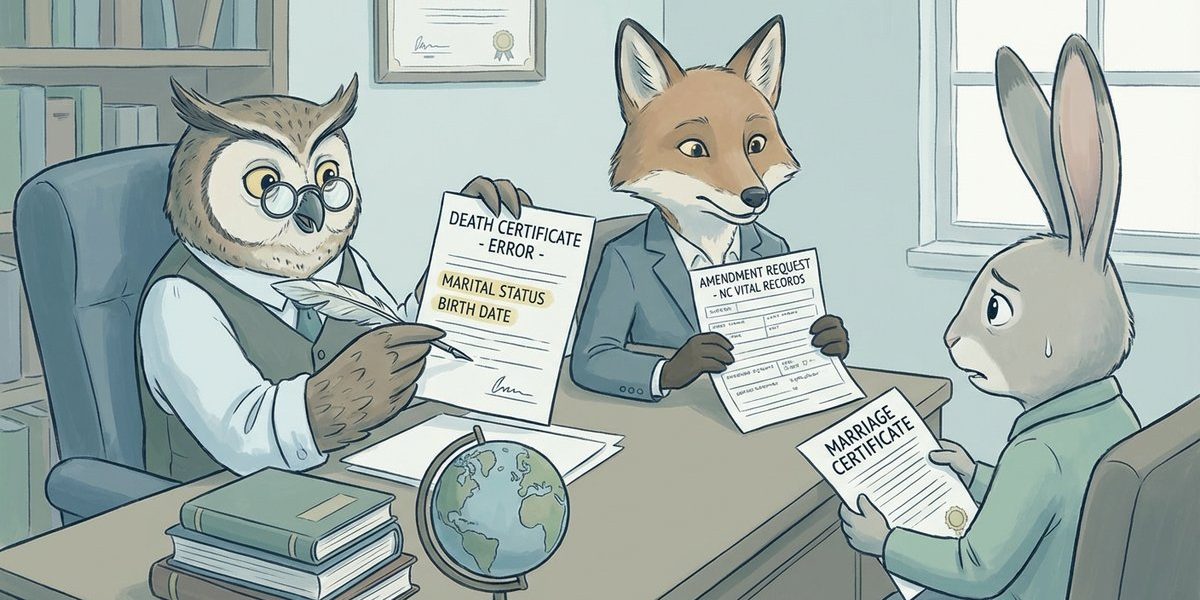
How do I correct errors on a death certificate, such as wrong marital status and birth date? – North Carolina
Short Answer
In North Carolina, a death certificate generally cannot be changed after it is filed unless an amendment request is submitted through the State Registrar (NC Vital Records) using the required form and proof. Many factual items (like marital status and date of birth) are corrected by working through the funeral home/medical certifier and then submitting supporting documents to NC Vital Records. If the error is blocking estate or benefits issues, the Clerk of Superior Court can often accept other evidence of death and family status for probate purposes while the amendment is pending.
Understanding the Problem
In North Carolina, when a surviving spouse needs a death certificate corrected because it lists the decedent as divorced (or lists the wrong birth date), the decision point is whether the item is a factual “amendment” that must go through the State Registrar’s amendment process before banks, insurers, and other institutions will accept it. The situation often comes up when family members provided information to the funeral home, the funeral home filed the certificate, and the surviving spouse later discovers the errors while trying to handle cremation decisions, benefits, or estate administration.
Apply the Law
North Carolina treats a death certificate as a vital record. After the State Registrar accepts it for registration, it generally cannot be altered informally. Instead, the law requires a formal request for amendment, and the State Registrar can require specific forms and proof. In practice, corrections often run through the funeral home that filed the record (and sometimes the medical certifier, depending on what field is wrong), with the final approval and issuance handled by NC Vital Records.
Key Requirements
- A filed record must be amended (not “edited”): Once the death certificate is accepted for registration, changes typically require an amendment request through the State Registrar rather than a simple correction by the funeral home.
- Proof must match the type of error: For marital status, proof commonly includes a marriage certificate. For a birth date error, proof commonly includes a birth certificate or other government record that reliably shows the correct date.
- The right person must submit or certify the change: Depending on the field being corrected, NC Vital Records may require the funeral home (as the filer) and/or the medical certifier to submit the amendment, even if the surviving spouse supplies the proof.
What the Statutes Say
- N.C. Gen. Stat. § 130A-118 (Amendment of birth and death certificates) – After acceptance for registration, a vital record generally may be changed only by a request for amendment under rules set by the State Registrar, with proof requirements and a fee.
Analysis
Apply the Rule to the Facts: The facts describe a death certificate that lists the decedent as divorced and shows the wrong birth date, even though the surviving spouse has a marriage certificate and identification. Under North Carolina’s amendment framework, those items are the kind of factual entries that usually require a formal amendment request processed through NC Vital Records, often with the funeral home’s involvement as the filer. While the amendment is pending, the incorrect marital status can create real-world delays with cremation decisions, benefits, and estate tasks, so it is important to push the amendment through the correct channel and keep copies of the supporting documents and written communications.
Process & Timing
- Who files: Often the funeral home that filed the death certificate submits the amendment paperwork, with the surviving spouse providing proof; some corrections may also require the medical certifier’s participation. Where: North Carolina Vital Records (State Registrar). What: The State Registrar’s amendment request form and supporting documentation (commonly a certified marriage certificate for marital status and a birth record for date of birth). When: As soon as the error is discovered, because institutions may refuse to act on an incorrect certificate.
- Follow-up and documentation: Request written confirmation from the funeral home that it submitted the amendment request, and keep a complete packet (copies of IDs, certificates, and any correspondence). Processing times can vary, and delays are common when the wrong person is trying to submit the change or the proof does not match the field being corrected.
- Use the corrected certificate: Once the amendment is approved, order certified copies of the amended death certificate from NC Vital Records or the Register of Deeds in the county where the death occurred, depending on availability and county practice, for banks, insurers, and other entities that require certified copies.
Exceptions & Pitfalls
- Probate may still move forward without a corrected certificate: For estate intake, the Clerk of Superior Court can often rely on other evidence of death if a certified death certificate is not available immediately, and a death certificate is not always required to start probate. That said, many third parties (like insurers) commonly insist on a certified copy, and errors can still cause delays.
- Wrong channel: A common mistake is trying to “fix it” only with the funeral home or only with the county office after the record is filed. After registration, the amendment typically must be processed through the State Registrar’s amendment procedure.
- Proof mismatch: Another common problem is submitting informal proof (like an uncertified copy) when the agency or institution expects certified records. Using certified copies of the marriage certificate and birth record often avoids repeat requests.
- Family conflict can slow cooperation: When other relatives are controlling arrangements and disputing marital status, the amendment process may require careful documentation and persistence. Keeping communications factual and written helps reduce confusion about what was submitted and when.
Conclusion
In North Carolina, correcting a filed death certificate (including marital status and birth date) usually requires a formal amendment request processed through NC Vital Records under the State Registrar’s rules, supported by reliable documents like a certified marriage certificate and a birth record. Because errors can delay cremation authorization, benefits, and estate tasks, the most important next step is to have the funeral home (as the filer) submit the amendment request to the State Registrar promptly and track the submission in writing.
Talk to a Probate Attorney
If a death certificate error is delaying cremation decisions or creating conflict about marital status in North Carolina, a probate attorney can help coordinate the amendment process, document family status for estate purposes, and keep the estate timeline on track. Call us today at (919) 341-7055.
Disclaimer: This article provides general information about North Carolina law based on the single question stated above. It is not legal advice for your specific situation and does not create an attorney-client relationship. Laws, procedures, and local practice can change and may vary by county. If you have a deadline, act promptly and speak with a licensed North Carolina attorney.

