
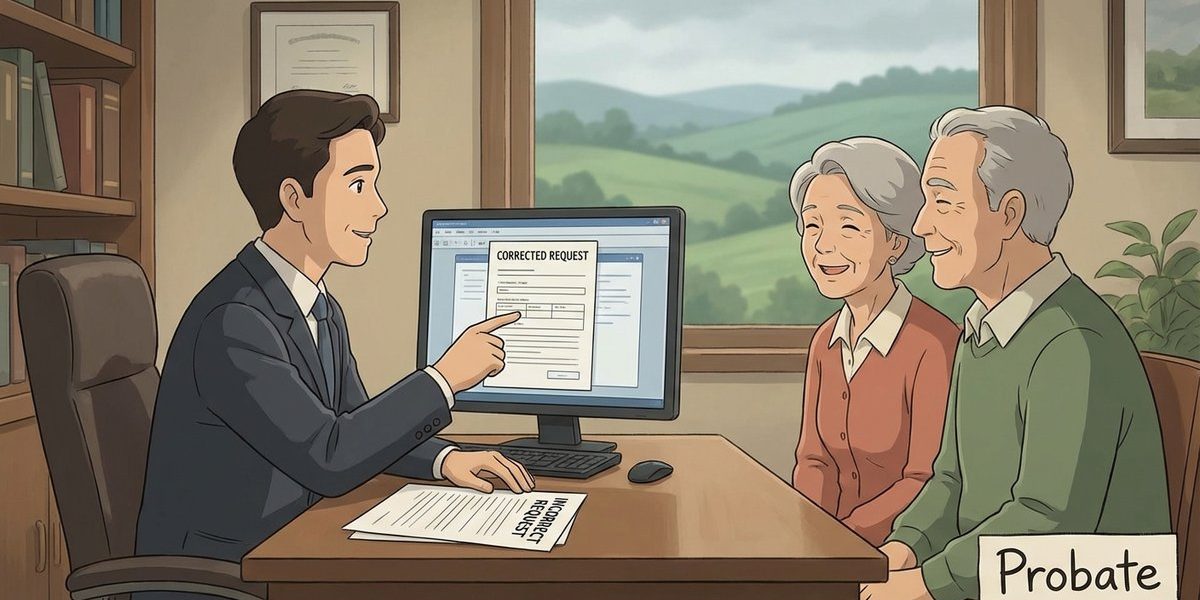
How do I correct and resubmit a probate records request when the wrong document was requested? – NC
Short Answer
In North Carolina, a probate records request usually needs to match the document that actually exists in the estate file. If the request asked for a certified copy of an original will, but the file involves a lost will or a probated copy, the clerk may reject that request and require a corrected resubmission. In many cases, the only document needed is the certificate of probate from the court file, not a certified copy of an original will.
Understanding the Problem
In North Carolina probate, the issue is whether the estate representative must correct a records request after asking the clerk for the wrong probate document. The decision point is narrow: when the court file shows a lost will, a copy of a will, or another probate record instead of an original will, the request must match what the clerk can actually certify and issue from the estate file. The key timing point is when the clerk has not yet accepted the e-file request and indicates that it should be rejected and resubmitted.
Apply the Law
North Carolina clerks of superior court have original jurisdiction over probate matters, and the estate file controls what records can be issued. When a will is lost or destroyed, North Carolina law allows probate of a copy in some circumstances, but that is a different record situation from a file containing an original will. For records requests, the practical rule is simple: ask for the document the file actually contains, which may be a certificate of probate, a certified copy of a recorded will, or certified probate proceedings. If the request does not match the file, the clerk may reject it and require a corrected submission through the estate division.
Key Requirements
- Match the request to the court file: The request should identify the exact probate record that exists, such as a certificate of probate or certified probate proceedings, rather than assuming an original will is on file.
- Use the proper probate office: Requests go through the Clerk of Superior Court handling the estate file, because that office maintains and certifies probate records.
- Correct and resubmit promptly: If the clerk flags the request before acceptance, the safer course is to reject or withdraw the incorrect request and submit a new one that accurately describes the needed document.
What the Statutes Say
- N.C. Gen. Stat. § 8-28 (Copies of wills) – Duly certified copies of wills may be used as evidence when the will’s contents are relevant.
- N.C. Gen. Stat. § 8-29 (Copies of wills in Secretary of State’s office) – Copies of wills filed or recorded in the Secretary of State’s office may be used as evidence, but no such will may be given in evidence or taken as sufficient proof of a devise unless a certificate of probate appears thereon.
- N.C. Gen. Stat. § 98-4 (Copy of lost will may be probated) – A copy of a lost will may be admitted to probate under the rules that apply to proving wills in the circumstances described by the statute.
- N.C. Gen. Stat. § 98-5 (Copy of lost will as evidence; letters to issue) – Once a copy is admitted to probate, a certified copy of the will and probate record may be used as competent evidence.
Analysis
Apply the Rule to the Facts: Here, the estate representative asked for certified copies of a will and a certificate of probate, but the clerk indicated the file likely involves a lost will or a probated copy rather than an original will. That matters because the request must track the record actually in the estate file. If the file only supports issuance of the certificate of probate, or certified probate proceedings tied to a copy, the original request was overbroad and should be corrected before resubmission.
North Carolina practice also treats lost-will probate differently from ordinary probate of an original will. A party seeking to probate a lost will must account for the missing original, show the contents of the will, and show that the loss was not an intentional revocation after a diligent search. Those distinctions explain why a clerk may not process a request framed as though an original will were on file when the estate record instead reflects probate of a copy or other substitute proof.
In the same way, a certificate of probate often serves as the key proof that the will or copy was admitted. If the immediate need is to show that probate occurred, requesting only the certificate of probate may solve the problem without asking for a document the file does not contain in original form. For related guidance on available estate records, see certified copies or regular copies of an estate court file and what documents are available from the court when a will was admitted as a lost will or copy.
Process & Timing
- Who files: The estate representative, applicant, or law office handling the estate file. Where: The Clerk of Superior Court, Estates Division, in the North Carolina county where the estate is pending. What: A corrected records request that identifies the exact document needed, such as the certificate of probate, a certified copy of the recorded will if one exists, or certified probate proceedings. When: As soon as the clerk indicates the e-file request has not been accepted or should be rejected and resubmitted.
- The clerk reviews the corrected request against the estate file. If the file reflects probate of a lost will or copy, the clerk may issue only the records supported by that file, and local processing steps may vary by county.
- The final step is issuance of the certified record actually available in the file, often a certificate of probate or certified probate proceedings, which can then be used for the estate matter that prompted the request.
Exceptions & Pitfalls
- A lost-will or copy-probate file may not contain an original will available for certification, even though the estate was properly probated.
- A common mistake is requesting both a certified will and a certificate of probate without first confirming what the estate file actually contains.
- Service is usually not the issue for a records request, but e-file rejection notices, county-specific submission steps, and delays in correcting the request can slow down the estate administration process.
Conclusion
In North Carolina, a probate records request should be corrected and resubmitted when it asks for a document the estate file does not contain, such as an original will in a lost-will or probated-copy matter. The controlling point is to match the request to the actual court record, which may be only a certificate of probate or certified probate proceedings. The next step is to file a corrected request with the Clerk of Superior Court promptly after the rejection notice.
Talk to a Probate Attorney
If a probate file involves a lost will, a probated copy, or a rejected records request, our firm has experienced attorneys who can help clarify which court documents are available and how to request them correctly. Call us today at [919-341-7055].
Disclaimer: This article provides general information about North Carolina law based on the single question stated above. It is not legal advice for your specific situation and does not create an attorney-client relationship. Laws, procedures, and local practice can change and may vary by county. If you have a deadline, act promptly and speak with a licensed North Carolina attorney.

