
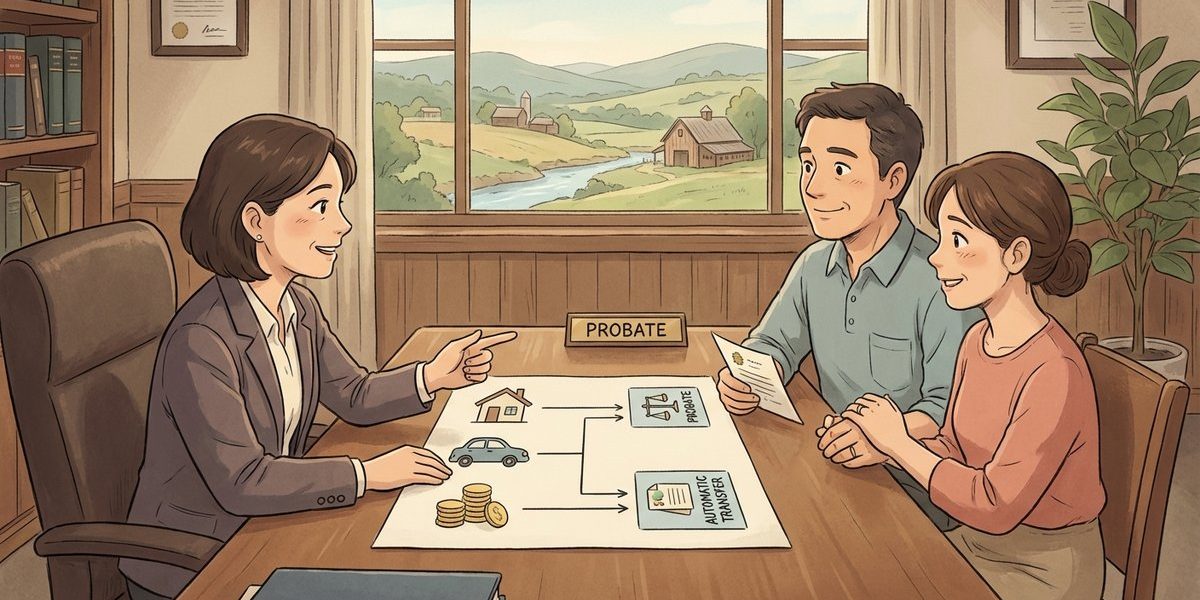
How do I confirm whether a house, vehicle, or financial accounts pass through probate or transfer automatically because of survivorship or beneficiary designations? – North Carolina
Short Answer
In North Carolina, the fastest way to confirm whether an asset must go through probate (the estate) or transfers automatically is to match each asset to its legal title and any beneficiary/survivorship paperwork. Real estate is confirmed through the Register of Deeds records, vehicles through the NCDMV title, and financial accounts through the institution’s account agreement showing “right of survivorship,” “POD,” or “TOD.” Even when an asset transfers automatically, the estate’s personal representative may still be able to seek recovery in limited situations if the estate lacks funds to pay valid debts and expenses.
Understanding the Problem
In North Carolina probate, the key question is whether a deceased parent’s house, vehicle, and accounts were owned in a way that requires an estate administration (probate) or instead transfer automatically at death because of survivorship or a beneficiary designation. When a parent dies without a will, the decision point is whether each asset was titled in the parent’s name alone (usually probate) or titled/contracted to pass to someone else at death (often non-probate). The practical issue is confirming ownership using the correct office or institution records so the adult child can decide whether to open an estate and seek appointment as administrator.
Apply the Law
North Carolina separates assets into (1) probate assets (owned by the decedent in a way that becomes part of the estate and is handled by an administrator through the Clerk of Superior Court) and (2) non-probate transfers (assets that pass by title or contract at death, such as survivorship accounts or transfer-on-death registrations). The label a family uses (“it has survivorship”) is not enough; the controlling proof is the deed/title/registration or the signed account agreement on file with the institution. Also, some non-probate transfers can still be reachable for estate debts and administration costs if the probate estate is insufficient, even though the asset does not pass under intestacy.
Key Requirements
- Identify the asset and the record-keeper: House (Register of Deeds), vehicle (NCDMV title), bank/brokerage/credit union (institution’s account agreement and beneficiary records), retirement/insurance (plan/insurer beneficiary designation).
- Confirm the legal ownership form: Sole ownership and “tenants in common” interests typically point toward probate; “right of survivorship,” “POD,” or “TOD” typically points toward automatic transfer.
- Obtain the right documents: Certified death certificate plus the deed/title/account paperwork showing survivorship or beneficiary language; if the institution will not release information, estate appointment documents may be needed.
What the Statutes Say
- N.C. Gen. Stat. § 41-2.1 (Right of survivorship in bank deposits) – Allows survivorship in deposit accounts when created by a signed written agreement, and explains how survivorship funds can still be subject to certain estate claims.
- N.C. Gen. Stat. § 54B-130.1 (Payable on Death accounts) – Authorizes POD accounts at savings and loan associations and describes how POD ownership passes to beneficiaries at death (with limited estate recovery rights).
- N.C. Gen. Stat. § 54C-166.1 (Payable on Death accounts) – Authorizes POD accounts at savings banks and sets out how beneficiaries take at death under the account contract.
- N.C. Gen. Stat. § 41-44 (TOD/POD registration form) – Recognizes “TOD”/“POD” wording in beneficiary-form registrations for covered securities.
- N.C. Gen. Stat. § 41-46 (Ownership on death for TOD securities) – States that securities registered in beneficiary form pass to the surviving beneficiary on proof of death and compliance with the registering entity’s requirements.
- N.C. Gen. Stat. § 41-48 (TOD transfers are nontestamentary; debt liability) – Provides that TOD transfers are not testamentary and explains that TOD interests can remain liable for decedent debts if the estate is insufficient.
Analysis
Apply the Rule to the Facts: Here, the parent died in North Carolina without a will, and the family is unsure what assets exist and whether they pass automatically. The confirmation step is to pull the house deed, the vehicle title record, and the account/beneficiary paperwork to see whether each asset is titled solely to the parent (likely probate) or is set up with survivorship or a beneficiary designation (often non-probate). Because uncertainty exists and the family wants to protect inheritance rights, opening an estate and having an administrator appointed can be the practical way to obtain authority to request information and, when appropriate, collect probate assets.
Process & Timing
- Who checks records: A family member or the eventual administrator. Where: (a) Register of Deeds where the real estate is located; (b) NCDMV title/registration records; (c) each bank, credit union, brokerage, retirement plan administrator, and insurer. What: Request copies of the recorded deed and the current vesting language; request the vehicle title status/ownership; request the account’s ownership type and any POD/TOD/beneficiary designation on file. When: As soon as death certificates are available and before property is sold or accounts are closed.
- Match each asset to a category: (a) House—the deed controls. If the deed shows a survivorship form of ownership, the survivor may take automatically; if it shows the parent alone or a non-survivorship co-ownership, the parent’s interest usually requires probate. (b) Vehicle—the title controls; if titled only in the parent’s name, it is typically an estate asset that the administrator handles. (c) Financial accounts—the account contract controls; look for “right of survivorship,” “POD,” or “TOD,” and confirm the named beneficiary(ies).
- Open an estate if needed to get authority: If assets appear to be in the parent’s name alone, or institutions will not provide information without authority, file for estate administration with the Clerk of Superior Court (Estates Division) in the county where the parent resided. Once appointed, the administrator can gather probate assets and also evaluate whether any non-probate transfers must be brought back only to the extent necessary to pay valid estate debts and expenses.
Exceptions & Pitfalls
- “Survivorship” must be in the paperwork: North Carolina survivorship and POD/TOD arrangements are document-driven. If the signature card/account agreement or registration does not meet the statutory requirements, the asset may be treated as a probate asset despite family assumptions.
- Non-probate does not always mean “untouchable”: Survivorship accounts and TOD/POD transfers can still be subject to limited recovery by the estate’s personal representative when the probate estate cannot pay valid debts and administration costs, even though the asset does not pass under intestacy.
- Co-ownership can be misunderstood: “Joint” does not always mean “with right of survivorship.” Some co-owners hold as tenants in common, which can leave the decedent’s share in probate.
- Beneficiary forms can be outdated: Retirement and insurance benefits usually pay by beneficiary designation, but old forms, missing contingent beneficiaries, or a predeceased beneficiary can change where the benefit goes and may require additional paperwork.
- Access problems without appointment: Financial institutions often will not disclose full account details to family members who are not owners or named beneficiaries. Appointment as administrator can provide the authority needed to investigate and collect probate assets.
Conclusion
In North Carolina, confirming whether a house, vehicle, or accounts pass through probate or transfer automatically requires checking the controlling document for each asset: the recorded deed for real estate, the title record for a vehicle, and the signed account agreement or beneficiary designation for financial accounts. “Right of survivorship,” “POD,” and “TOD” language usually means an automatic transfer, while sole ownership typically means probate. A practical next step is to open an estate with the Clerk of Superior Court so an administrator can gather records, confirm ownership, and protect inheritance rights.
Talk to a Probate Attorney
If a family is dealing with uncertainty about whether a parent’s house, vehicle, and accounts are probate assets or transfer automatically by survivorship or beneficiary designation, our firm has experienced attorneys who can help explain the documents to request, the steps to open an estate, and the timelines to watch. Call us today at 919-341-7055.
Disclaimer: This article provides general information about North Carolina law based on the single question stated above. It is not legal advice for your specific situation and does not create an attorney-client relationship. Laws, procedures, and local practice can change and may vary by county. If you have a deadline, act promptly and speak with a licensed North Carolina attorney.

