
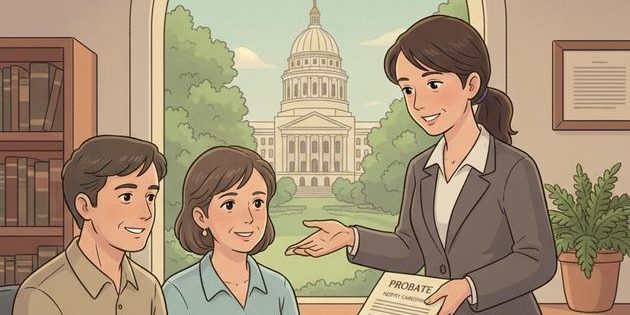
Does a power of attorney or an old will still control anything after death, especially if the person divorced the named spouse? – North Carolina
Short Answer
In North Carolina, a power of attorney generally stops working at death, so it does not give anyone authority to access an apartment, sell a car, or move money after the person dies. An older will can still control what happens after death, but a divorce usually cancels any will provisions that benefit the former spouse or name the former spouse for roles like executor. To get “court-recognized authority” for third parties (like a landlord), someone typically must qualify through the Clerk of Superior Court, often using a small-estate affidavit when the estate is small enough.
Understanding the Problem
In North Carolina probate, the decision point is whether any document signed during life—like a power of attorney or an older will—still gives someone legal authority after death to handle the decedent’s remaining property. The question commonly comes up when a former spouse is named in old paperwork and a third party (such as an apartment complex) will not release belongings without authority recognized by the Clerk of Superior Court. The same issue affects practical tasks like transferring a vehicle title and collecting funds from a bank account.
Apply the Law
North Carolina draws a sharp line between authority during life and authority after death. A power of attorney is designed for lifetime decision-making, and after death, authority to act for the decedent usually shifts to (1) the executor named in a will once qualified, or (2) an administrator appointed by the Clerk if there is no qualified executor. An older will can still be valid after death, but North Carolina law generally treats a divorced former spouse as having predeceased the decedent for will purposes unless the will clearly says otherwise or another statutory exception applies. That rule typically removes the former spouse as a beneficiary and also removes the former spouse from roles such as executor.
Key Requirements
- Authority must come from the Clerk after death: After death, third parties usually look for Letters Testamentary, Letters of Administration, or a small-estate affidavit filed with the Clerk of Superior Court—not a power of attorney.
- Divorce changes how an old will is read: If the will predates an absolute divorce, the former spouse is usually treated as if they died before the decedent for purposes of gifts and appointments in the will, unless an exception applies.
- Small-estate procedures have thresholds and timing: North Carolina allows collection of personal property by affidavit after a short waiting period if the estate is under a value cap (with a higher cap in limited spouse-only situations). The affidavit must identify heirs/beneficiaries and assets.
What the Statutes Say
- N.C. Gen. Stat. § 31-5.4 (Revocation by divorce or annulment; revival) – Divorce usually cancels will provisions in favor of a former spouse and removes the former spouse from roles like executor, unless an exception applies.
- N.C. Gen. Stat. § 32C-1-110 (Termination of power of attorney or agent’s authority) – A power of attorney terminates at the principal’s death, subject to limited protection for certain good-faith acts taken without actual knowledge of the termination.
- N.C. Gen. Stat. § 32C-1-119 (Agent’s certification as to the validity of power of attorney and agent’s authority) – Allows an agent to provide a certification concerning the power of attorney in certain contexts; it does not make a power of attorney survive death.
Analysis
Apply the Rule to the Facts: The reference to a power of attorney in older paperwork does not usually help after the death, so it will not satisfy an apartment complex that demands court-recognized authority to release belongings. The older will may still be the controlling will, but because the named spouse is now a former spouse, North Carolina law generally treats that former spouse as having predeceased the decedent for gifts and for roles like executor. That means the remaining named beneficiary (such as a sibling) or another eligible person may need to qualify with the Clerk to obtain authority documents that third parties will accept.
Process & Timing
- Who files: Typically a person named in the will as executor (if not disqualified by divorce) or an heir/beneficiary who can use a small-estate option. Where: The Clerk of Superior Court in the county where the decedent was domiciled at death. What: Often an “Affidavit for Collection of Personal Property of Decedent” (commonly an AOC small-estate form) if the estate fits the value limits; if there is a will, it is usually submitted for probate in connection with that filing. When: Commonly 30 days after death for the small-estate affidavit procedure.
- Use the Clerk-filed authority to deal with third parties: Once the affidavit is properly filed (or the Clerk issues letters after a formal qualification), it can be presented to the landlord or apartment management as the authority to receive and distribute the decedent’s personal property.
- Handle vehicle and account transfers with the right paperwork: For a vehicle, the collector/distributor usually presents the Clerk-filed affidavit to the Division of Motor Vehicles along with required DMV documents. For bank funds, whether the account passes outside probate depends on how the account is titled and what beneficiary designations exist; if it is payable-on-death or jointly owned with survivorship, it may not be an estate asset.
Exceptions & Pitfalls
- Divorce does not erase the entire will: North Carolina commonly removes the former spouse’s gifts and roles, but other parts of the will can remain effective. If the will’s plan depends heavily on the former spouse (for example, all gifts flow through the former spouse), the result can change who inherits and may require careful reading.
- Asset type matters: Life insurance with named beneficiaries usually pays outside probate. A bank account with a child “listed” might be joint-with-survivorship or payable-on-death, which can mean it is not controlled by the will and not part of the small-estate value calculation. Misclassifying an account can create delays or disputes.
- Estate value and later-discovered property: If additional assets show up later and the estate exceeds the small-estate limit, a formal personal representative may need to qualify and take over, and the person who used the affidavit may have to account for what was collected and spent.
- Landlord access and timing pressure: Even when the family agrees, an apartment complex often will not allow entry or release property without Clerk-recognized documentation. Waiting too long can also create practical problems with rent, storage, or disposal policies.
Conclusion
In North Carolina, a power of attorney generally does not give authority after death, so it usually cannot be used to access an apartment or transfer property once the person has died. An older will can still control the estate, but divorce usually cancels provisions benefiting the former spouse and removes the former spouse from roles like executor under the will. The typical next step is to file the appropriate paperwork with the Clerk of Superior Court—often a small-estate affidavit—after 30 days have passed to obtain authority a landlord and others will recognize.
Talk to a Probate Attorney
If a family needs court-recognized authority to access a decedent’s apartment and handle a small estate with an older will that names a former spouse, our firm has experienced attorneys who can help explain the options and timelines under North Carolina probate rules. Call us today at (919) 341-7055.
Disclaimer: This article provides general information about North Carolina law based on the single question stated above. It is not legal advice for your specific situation and does not create an attorney-client relationship. Laws, procedures, and local practice can change and may vary by county. If you have a deadline, act promptly and speak with a licensed North Carolina attorney.

