
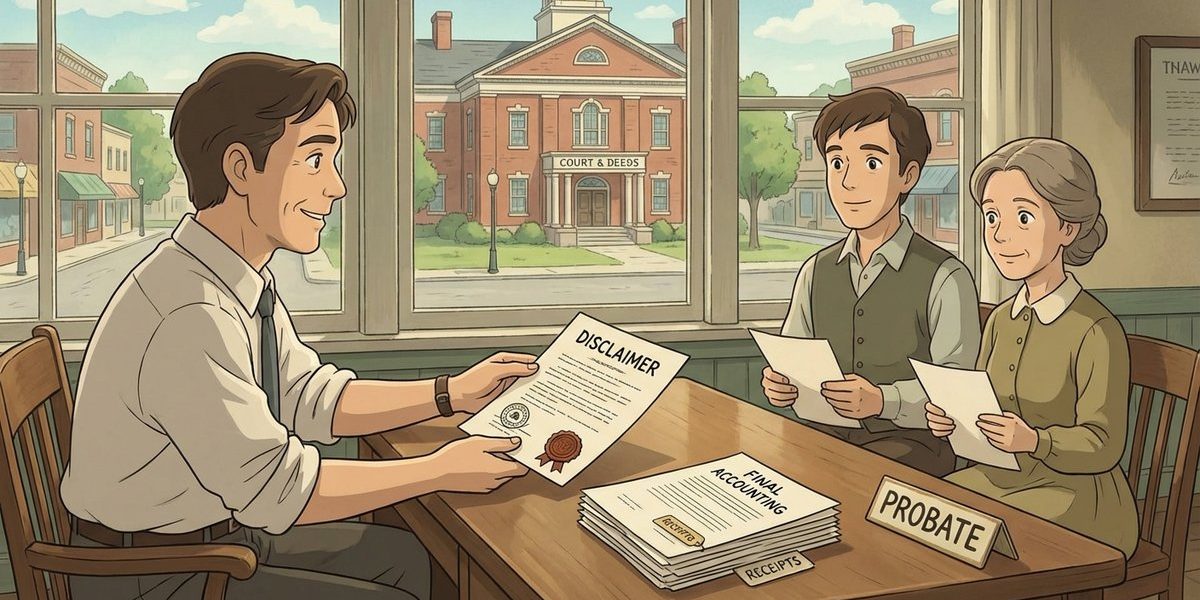
Do any of the forms for the disclaimer or final accounting need to be notarized, and where do I file them? – North Carolina
Short Answer
In North Carolina, a disclaimer (also called a renunciation) of an inherited interest in real estate should be signed in a form that can be recorded, which usually means signing before a notary so the Register of Deeds will accept it. The disclaimer becomes effective when it is filed with the Clerk of Superior Court in the county where the estate is being administered, and it must also be recorded with the Register of Deeds to clear record title. Final accountings are filed with the Clerk of Superior Court (Estates), and they are typically supported by vouchers and beneficiary receipts/releases rather than notarization.
Understanding the Problem
Under North Carolina probate practice, a personal representative can ask: can an inherited share of a house be disclaimed so the sibling becomes the only owner on the deed, and what paperwork must be filed with the Clerk of Superior Court versus recorded with the Register of Deeds? The same estate administration often reaches a second decision point: when debts are paid and the estate is ready to close, must the final accounting paperwork be notarized, and where does it get filed for the Clerk’s review and discharge? The timing and filing location matter because a disclaimer affects title to real estate, while a final account affects the personal representative’s discharge from duties.
Apply the Law
North Carolina treats a disclaimer of an inherited interest as a written “instrument of renunciation.” For estate administration purposes, the key filing is with the Clerk of Superior Court in the county where the estate proceeding is pending. If the disclaimer involves real property, North Carolina also requires recording with the Register of Deeds so the public land records show the change and record title is clear. Final accountings are filed with the Clerk of Superior Court (Estates), and the Clerk audits the accounting by checking that receipts, disbursements, and distributions are supported by documentation and beneficiary receipts/releases.
Key Requirements
- File the disclaimer with the right probate office: A renunciation is effective when filed with the Clerk of Superior Court in the county where the estate is being administered (or, if no estate is open, in a county where it could be opened as an estate matter).
- Record real estate disclaimers to clear title: If the disclaimed interest is in real property, the renunciation must also be recorded with the Register of Deeds so record title passes in the public records.
- Support the final account with proof, not usually notarization: A final account is filed with the Clerk of Superior Court and is typically supported by vouchers for disbursements and receipts/releases showing distributions to heirs/beneficiaries.
What the Statutes Say
- N.C. Gen. Stat. § 31B-2 (Filing and registering of renunciations) – States where a renunciation must be filed to be effective and requires recording when real property (or an interest in it) is renounced; also explains that record title does not pass until the renunciation is registered.
- N.C. Gen. Stat. § 47-37.1 (Other forms of proof) – Explains that a compliant notarial certificate is a sufficient acknowledgment for recording purposes and should not be a reason for the Register of Deeds to refuse registration.
- N.C. Gen. Stat. § 47-62 (Probates before interested notaries) – Confirms that acknowledgments for instruments to be registered can still be valid even if the notary had an interest as attorney or otherwise, which can matter when notarizing recordable estate-related instruments.
Analysis
Apply the Rule to the Facts: The estate is at the stage where debts are paid and a final accounting will be filed with the Clerk. Because the estate includes a home co-inherited with a sibling, a disclaimer of the inherited real estate interest should be handled as a written renunciation filed in the estate with the Clerk of Superior Court, and it should also be recorded with the Register of Deeds so the land records show the sibling as the sole owner. For the final accounting, the Clerk will typically focus on whether the accounting is complete and whether vouchers and beneficiary receipts/releases support disbursements and distributions, rather than requiring notarization of the accounting itself.
Process & Timing
- Who files: The person disclaiming (often also the personal representative, but the disclaimer is signed in the individual capacity as an heir/devisee). Where: Clerk of Superior Court (Estates) in the county where the estate file is open. What: A written “Renunciation/Disclaimer” describing the interest being disclaimed and identifying the decedent and the estate file. When: As early as practical in the closing process; if the goal is a “qualified disclaimer” for tax purposes, North Carolina ties timing to the federal deadline rules and often references a nine-month window, but tax treatment depends on the specific situation and should be reviewed with a tax attorney or CPA.
- Record for title: After filing with the Clerk, record the renunciation with the Register of Deeds in the county where the property is located. In practice, recording usually requires a notarized signature (an acknowledgment) because the Register of Deeds records instruments that are properly acknowledged/proved.
- Close the estate: File the Final Account with the Clerk of Superior Court (Estates) with supporting vouchers for disbursements and documentation of distributions (often receipts/releases signed by beneficiaries). If the Clerk approves the final account, the Clerk can discharge the personal representative from further duties.
Exceptions & Pitfalls
- Notarization confusion: A final account is filed with the Clerk of Superior Court, and the Clerk’s audit usually turns on vouchers and receipts/releases. A disclaimer affecting real estate is different because it must be recorded, and recording commonly requires a notarized acknowledgment.
- Filing vs. recording: Filing the renunciation with the Clerk makes it effective between the parties, but failing to record it can leave the land records unclear. That can create problems later when refinancing, selling, or insuring title.
- Real property expenses in the accounting: Expenses tied to real property that passes directly to heirs (and is not being sold to pay claims) often belong to the inheriting owner(s), not the estate. Mixing those payments through the estate account can complicate the final accounting and raise questions during the Clerk’s audit.
- Property taxes: County tax offices generally bill the owner(s) shown in the land records as of the relevant listing/assessment rules. Recording the renunciation helps align the land records with who is expected to handle ongoing taxes, but allocation between co-owners or the estate can still depend on timing and agreements.
- Form and indexing issues: A renunciation of real property must be indexed correctly in the Register of Deeds records. Errors in names, legal description, or indexing can undermine the goal of clear title even if the document was signed and filed.
Conclusion
In North Carolina, a disclaimer (renunciation) of an inherited interest in a house should be filed with the Clerk of Superior Court in the county where the estate is being administered, and it must also be recorded with the Register of Deeds to clear record title. Because recording typically requires an acknowledged signature, the renunciation is usually notarized. Final accountings are filed with the Clerk and are commonly supported by vouchers and beneficiary receipts/releases rather than notarization. Next step: file the signed renunciation in the estate and then record it with the Register of Deeds before closing the estate.
Talk to a Probate Attorney
If an estate is ready for a final accounting and a co-inherited home needs to be cleaned up in the land records through a disclaimer, our firm has experienced attorneys who can help explain the filing steps, recording requirements, and timing. Call us today at (919) 341-7055.
Disclaimer: This article provides general information about North Carolina law based on the single question stated above. It is not legal advice for your specific situation and does not create an attorney-client relationship. Laws, procedures, and local practice can change and may vary by county. If you have a deadline, act promptly and speak with a licensed North Carolina attorney.

