
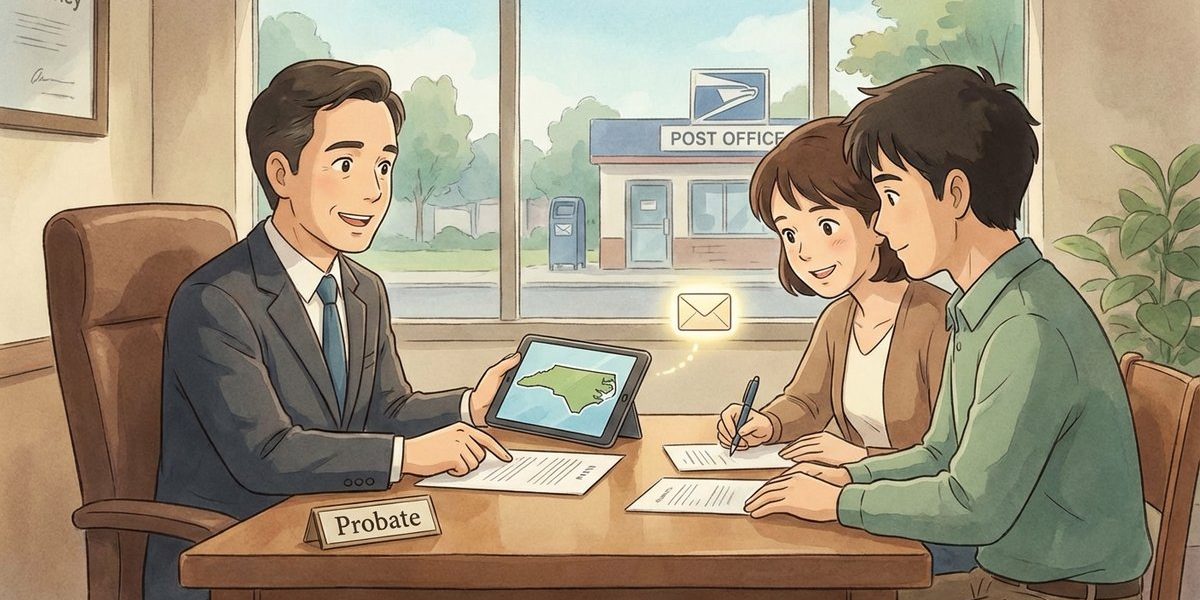
Can the deed and probate-related paperwork be handled remotely if I live out of state? – North Carolina
Short Answer
Often, yes. In North Carolina, most probate and deed-transfer steps can be handled from out of state by mailing original documents to the Clerk of Superior Court (Estates Division) and the county Register of Deeds, and by signing documents before a notary where the signer lives. However, the estate usually still must be opened (even years later) to move title out of the decedent’s name, and some clerks may require an in-person appearance for certain steps or if questions come up.
Understanding the Problem
When a person inherits a North Carolina house through a will but the deed still shows the decedent as the owner, the key question is whether the paperwork to open the estate and record the documents needed to update title can be completed while the heir or personal representative lives in another state. In North Carolina, the main decision point is whether the Clerk of Superior Court in the county where the decedent lived will accept the filings and qualification steps by mail and remote notarization, or whether an appearance is required to complete the estate opening and deed-related steps.
Apply the Law
North Carolina gives the Clerk of Superior Court (acting as the judge of probate) exclusive original jurisdiction over probate and estate administration. That means the estate process generally runs through the Clerk’s Estates Division, and the title-fixing documents then get recorded with the Register of Deeds in the county where the real estate is located. Even if the decedent died years ago, an estate can still be opened to probate the will and qualify a personal representative so the property can be transferred with clear authority.
Key Requirements
- Proper forum: The estate is handled through the Clerk of Superior Court (Estates) in the correct North Carolina county, and real estate documents are recorded with the Register of Deeds where the land is located.
- Authority to act: Someone must have legal authority (typically an executor named in the will who qualifies, or an administrator if needed) before signing deeds or other transfer documents on behalf of the estate.
- Recordable documents: Deeds and probate documents must be in recordable form (proper signatures, notarization/acknowledgment, and any clerk certifications required) before the Register of Deeds will record them.
What the Statutes Say
- N.C. Gen. Stat. § 7A-241 (Probate jurisdiction) – Gives the Clerk of Superior Court authority over probate and estate administration in North Carolina.
- N.C. Gen. Stat. § 47-6 (Acknowledgments/probates; officials may act) – Allows instruments to be acknowledged before authorized officials without regard to where the land is located or where the signer lives.
- N.C. Gen. Stat. § 47-44 (Clerk’s certificate for out-of-state acknowledgment) – Describes a clerk certification format that can apply when an instrument is acknowledged before certain out-of-state officials.
Analysis
Apply the Rule to the Facts: Here, a will left a North Carolina home to an out-of-state beneficiary, but the deed still shows the decedent as owner and no estate was opened. Under North Carolina practice, the usual path to fix title is to open the estate with the Clerk of Superior Court, qualify the appropriate personal representative, and then prepare and record the deed or other recordable estate documents with the Register of Deeds. Living out of state typically does not prevent these steps, but it increases the importance of getting the correct original documents, notarizations, and clerk certifications in the format the county offices will accept.
Process & Timing
- Who files: Typically the executor named in the will (or another qualified person if the named executor cannot serve). Where: Clerk of Superior Court (Estates Division) in the proper North Carolina county. What: An application to probate the will and qualify a personal representative, plus the original will (or the required certified copies if the will was previously probated elsewhere). When: As soon as clear title is needed for a transfer, refinance, or sale; delays can create practical problems even if the death occurred years ago.
- Remote handling: Many counties allow submission by mail and will issue letters/qualification documents after the clerk accepts the filing. Signatures on estate documents and deeds can usually be notarized in the state where the signer is located, but the notarial certificate must meet North Carolina recording requirements and the Register of Deeds may reject documents that do not.
- Title transfer step: After qualification, the personal representative typically signs the appropriate deed or other recordable instrument and records it with the Register of Deeds in the county where the property is located. If the decedent owned real estate in more than one North Carolina county, certified copies of key probate documents may need to be recorded in each county where land is located so the public record reflects the probate proceeding.
Exceptions & Pitfalls
- “No debts” still requires a process: Even when the home is paid off and debts appear unlikely, title usually cannot be cleaned up just by presenting a will to the Register of Deeds. A personal representative’s authority (and the clerk’s probate record) is commonly needed for a marketable title.
- County-by-county clerk requirements: Some clerks require an in-person qualification, a local surety/bond in certain situations, or additional documentation when the personal representative lives out of state. Local practice can change, so confirming the county’s Estates procedures early can prevent rejection and delays.
- Notary/acknowledgment problems: Out-of-state notarizations that do not match what the Register of Deeds expects can cause recording rejections. Using a deed form and notarial certificate prepared for North Carolina recording standards reduces the risk.
- Wrong county filing: Probate is filed with the Clerk of Superior Court, while deeds are recorded with the Register of Deeds. Mixing up offices (or recording in the wrong county) can waste weeks.
For more background on cross-border estate issues, see handle an estate without traveling back and forth and transfer or sell inherited real estate when the property is in a different county.
Conclusion
In North Carolina, deed and probate paperwork can often be handled remotely even when the beneficiary or personal representative lives out of state, as long as the estate is opened with the Clerk of Superior Court and the transfer documents are properly notarized and recorded with the Register of Deeds. The key practical requirement is getting the correct authority to act (qualification/letters) before attempting to change title. The most important next step is to file to open the estate with the Clerk of Superior Court in the proper county as soon as clear title is needed.
Talk to a Probate Attorney
If a North Carolina home was left in a will but the deed is still in the decedent’s name and the heir lives out of state, our firm has experienced attorneys who can help explain the probate steps, recording requirements, and timelines. Call us today at [919-341-7055].
Disclaimer: This article provides general information about North Carolina law based on the single question stated above. It is not legal advice for your specific situation and does not create an attorney-client relationship. Laws, procedures, and local practice can change and may vary by county. If you have a deadline, act promptly and speak with a licensed North Carolina attorney.

