
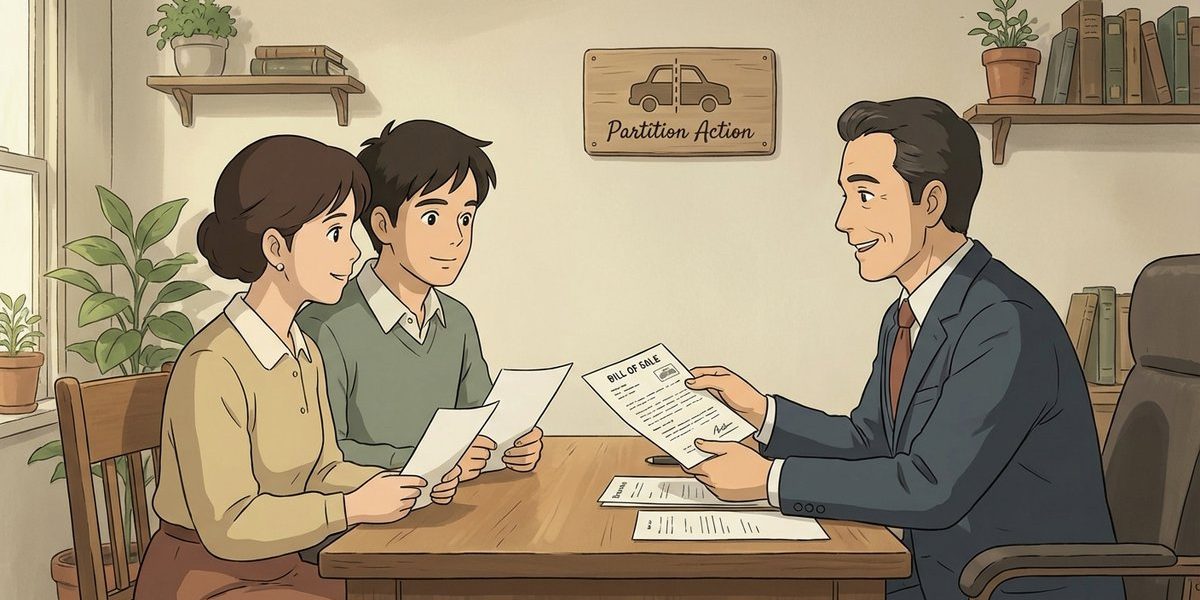
What proof do I need to show I have an ownership interest in the vehicle before filing? – North Carolina
Short Answer
In North Carolina, the cleanest proof of an ownership interest in a jointly owned vehicle is the vehicle’s certificate of title showing the owner’s name as a co-owner. If the title is missing, outdated, or disputed, other documents (like DMV records, a bill of sale, or a court order) can help show an ownership claim. A partition of personal property is filed in Superior Court, and the filing should include enough information and documentation to show a plausible co-ownership interest and identify all other claimed owners.
Understanding the Problem
In a North Carolina partition action involving a vehicle, the key question is what documentation shows that a person is a co-owner (or otherwise has an ownership interest) before filing in Superior Court. The issue usually comes up when the vehicle is titled in more than one name, when one person paid for the vehicle but the title does not match, or when the title cannot be located. The goal is to show a legitimate ownership interest so the court can address whether the vehicle should be divided or sold and the proceeds split.
Apply the Law
North Carolina law allows partition of personal property, which includes items like vehicles, when the property is owned jointly (for example, as joint tenants or tenants in common). A person seeking partition generally needs to show an ownership interest and identify the other co-owners so they can be made parties to the case. If the property cannot be fairly divided, the court can order a partition sale of the personal property instead of physically dividing it.
Key Requirements
- Proof of a co-ownership interest: Documents that show the person is an owner (or has a recognized ownership share), most commonly the North Carolina certificate of title listing the person as an owner.
- Identifying the other owners: Enough information to name and serve the other titled owners or other people claiming an ownership share.
- Showing partition is the proper remedy: A basis to ask the court to partition the vehicle, and if division is not practical, to request a court-ordered sale and division of proceeds.
What the Statutes Say
- N.C. Gen. Stat. § 46A-100 (Personal property may be partitioned) – Allows a joint tenant or tenant in common of personal property to file in Superior Court to partition the property.
- N.C. Gen. Stat. § 46A-102 (Partition sale of personal property) – Allows the court to order a sale of personal property when an actual division would injure one or more parties.
- N.C. Gen. Stat. § 20-52 (Application for certificate of title) – Describes the application process for a North Carolina certificate of title.
- N.C. Gen. Stat. § 20-72 (Transfer by owner) – Addresses how title or interests in a vehicle are transferred and the role of the certificate of title assignment.
Analysis
Apply the Rule to the Facts: The facts describe a partition sale/partition action involving a jointly owned vehicle in North Carolina. The most direct proof of ownership is a certificate of title listing the co-owners; that document usually resolves the “who owns what share” question at the start of the case. If the title does not list the person claiming an interest, the case often turns on whether there is other reliable evidence of a shared ownership agreement or a transfer of an interest that was never properly reflected on the title.
Process & Timing
- Who files: A co-owner (joint tenant or tenant in common) claiming an ownership interest in the vehicle. Where: The Clerk of Superior Court (filed in Superior Court) in the county with a proper venue for the parties/property. What: A petition/complaint seeking partition of personal property and, if appropriate, a request for a partition sale. Attach or be prepared to produce ownership documents such as the certificate of title and any supporting paperwork showing co-ownership. When: There is no single universal “file by” deadline for partition itself, but timing matters if the vehicle is being sold, repossessed, or moved, or if a dispute is escalating.
- Service and responses: The other co-owners (and sometimes lienholders, depending on the relief requested) must receive proper legal notice. The court process can slow down if an owner cannot be located or if the named owners on the title do not match the people claiming interests.
- Decision on division vs. sale: If the court determines the vehicle cannot be fairly divided, it can order a sale and then address distribution of proceeds consistent with the parties’ proven interests.
Exceptions & Pitfalls
- Title is strong evidence, but not the only evidence: The certificate of title is usually the starting point. When the title is missing, incorrect, or disputed, other proof may be needed, such as DMV title history/records, a signed bill of sale, a written co-ownership agreement, loan documents showing both parties as borrowers, insurance declarations listing both as named insureds, or communications showing an agreement to share ownership.
- “Paid for it” is not the same as “owns it”: Payment history (down payment, monthly payments, repairs) can support an argument about equitable sharing, but it may not override what the title shows without additional facts and claims. Partition focuses on ownership interests, not just who contributed money.
- Liens complicate the picture: If there is a lien, the lienholder’s interest can affect what can be sold and how proceeds are handled. A partition sale does not automatically erase a valid lien.
- Wrong names or missing parties: If the petition does not name the titled owners (or other people claiming an interest), the case can be delayed or dismissed until the proper parties are added and served.
- Missing title documents: If the original title cannot be located, it is often helpful to obtain DMV records or replacement title documentation before the case can move efficiently.
Conclusion
In North Carolina, the best proof of an ownership interest in a jointly owned vehicle before filing a partition action is the certificate of title showing co-ownership. If the title is missing or does not match the ownership claim, other reliable documents (like DMV records, a bill of sale, or a court order) may be needed to show a legitimate ownership share and to identify all other owners. The next step is to gather the title/DMV ownership records and file a petition in Superior Court naming and serving all co-owners.
Talk to a Partition Action Attorney
If you’re dealing with a dispute over a jointly owned vehicle and need to prove an ownership interest before filing, our firm has experienced attorneys who can help you understand your options and timelines. Call us today at [CONTACT NUMBER].
Disclaimer: This article provides general information about North Carolina law based on the single question stated above. It is not legal advice for your specific situation and does not create an attorney-client relationship. Laws, procedures, and local practice can change and may vary by county. If you have a deadline, act promptly and speak with a licensed North Carolina attorney.

