
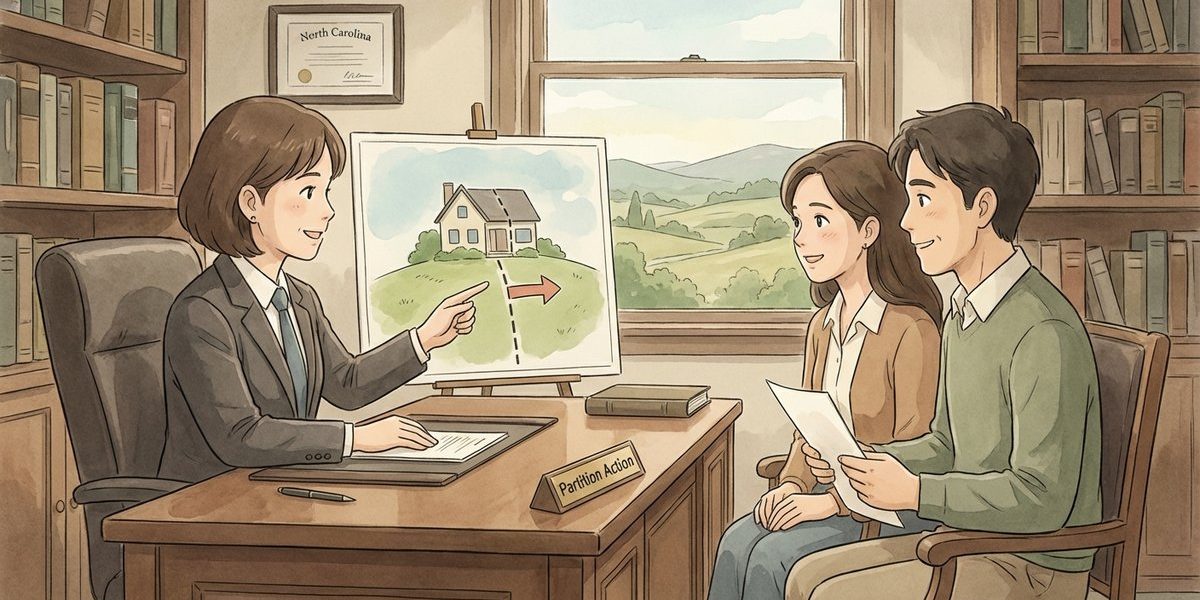
What happens if I live in a house that is jointly owned and the other owners want their share? – NC
Short Answer
In North Carolina, a co-owner of a house usually cannot be forced to stay in joint ownership forever. If the owners cannot agree, one or more co-owners can file a partition proceeding asking the court either to divide the property if that can be done fairly or, more often with a single house, to order a sale and divide the net proceeds by ownership share. The case is typically handled through the clerk of superior court, and a sale can stay open for upset bids after the initial report of sale.
Understanding the Problem
In North Carolina, the question is whether a person who lives in a jointly owned house can keep living there when the other co-owners want their share of the property’s value. The decision point is usually whether the co-owners can reach a voluntary buyout or sale agreement, or whether one of them must ask the court to partition the property. With a single inherited house owned by several heirs, the key issue is whether the property can be fairly divided or whether the law will require a sale instead.
Apply the Law
North Carolina law allows a cotenant, such as a joint owner or tenant in common, to ask for partition of real property. The court can order an actual partition, a partition sale, a mix of both, or partition only part of the property, but it cannot force a cotenant to remain in cotenancy over that cotenant’s objection. For a single house on one lot, actual division is often not practical, so the main forum is the clerk of superior court in the county where the property is located, and a sale may be ordered if actual partition would cause substantial injury to any of the parties.
Key Requirements
- Co-ownership interest: The person asking for relief must have an ownership share in the property, even if the share came through inheritance.
- Type of partition requested: The court first considers whether the property can be physically divided fairly before ordering a sale.
- Substantial injury showing for a sale: A co-owner seeking sale must prove that dividing the property in kind would materially harm one or more owners.
What the Statutes Say
- N.C. Gen. Stat. § 46A-26 (Methods of partition) – lets the court choose actual partition, sale, a combination, or partial partition, and bars forcing a cotenant to remain a co-owner over objection.
- N.C. Gen. Stat. § 46A-75 (Sale in lieu of actual partition) – allows a sale only if actual partition cannot be made without substantial injury, with the party seeking sale carrying that burden.
- N.C. Gen. Stat. § 46A-76 (Sale procedure) – applies the judicial sale rules to partition sales and requires mailed notice of a public sale at least 20 days before the sale.
- N.C. Gen. Stat. § 1-339.25 (Upset bids on real property) – keeps the sale open for a 10-day upset-bid period after the report of sale or last upset bid is filed.
Analysis
Apply the Rule to the Facts: Here, the house is co-owned by three people after a parent passed away, so each owner’s rights depend on the ownership shares shown by the title or estate records. If the property is a single house on one parcel, a court will often view physical division as impractical and may consider a sale if a co-owner proves that dividing the property would substantially injure the owners. From the occupant’s standpoint, living in the house does not by itself block partition, but it may support negotiation for a buyout, a sale timeline, or another arrangement before the court orders a sale. If the owners can agree on terms, they may avoid the cost and delay of a formal partition case; if not, one owner can ask the court to decide.
North Carolina procedure also matters because the court does not jump straight to sale just because one owner wants cash. The party asking for sale must show more than disagreement alone. The court looks at whether each owner would receive materially less value from a physical split, whether a split would impair ownership rights, and whether a balancing payment could reduce the harm. Those points often matter in inherited property disputes involving one residence rather than open land. For more on inherited co-owner disputes, see force the sale of inherited land and divide a jointly owned property into separate parcels.
Process & Timing
- Who files: any cotenant with an ownership share. Where: the Clerk of Superior Court in the North Carolina county where the real property is located. What: a partition petition asking for actual partition, sale in lieu of partition, or other appropriate relief. When: there is no single short filing deadline just to start a partition case, but once a public sale is reported, an upset bid must be filed by the 10th day after the report of sale or last upset bid, and notice of a public sale must be mailed at least 20 days before the sale.
- The other owners are served and may respond, dispute ownership shares, or argue for division instead of sale. The clerk or court considers whether the property can be fairly divided and, if sale is requested, whether actual partition would cause substantial injury. Timing varies by county and by whether title issues or valuation disputes must be resolved.
- If the court orders a sale, a commissioner handles the sale process. After the report of sale is filed, the property remains open for upset bids in successive 10-day periods until no new upset bid is filed, after which the sale can be confirmed and the net proceeds are distributed according to the parties’ interests.
Exceptions & Pitfalls
- Title disputes can complicate the case, but North Carolina law may allow the court to move forward with partition or sale before every ownership dispute is finally resolved.
- A person living in the house should not assume occupancy alone defeats a sale request; possession and ownership are related but not the same issue.
- Common mistakes include ignoring service papers, failing to gather deed and estate records, and missing the upset-bid window after a sale is reported.
Conclusion
In North Carolina, when a house is jointly owned and the other owners want their share, the law usually allows a partition proceeding so the property can be divided if that can be done fairly or sold if division would cause substantial injury. With a single inherited house, sale is often the practical result. The next step is to file a partition petition with the Clerk of Superior Court in the county where the property sits, and watch the 10-day upset-bid deadline if a sale is ordered.
Talk to a Partition Action Attorney
If a co-owned North Carolina house has reached a point where some owners want money out and another owner is still living there, our firm has experienced attorneys who can help explain the available options, the court process, and the timelines that may control the outcome. Call us today at 919-341-7055.
Disclaimer: This article provides general information about North Carolina law based on the single question stated above. It is not legal advice for your specific situation and does not create an attorney-client relationship. Laws, procedures, and local practice can change and may vary by county. If you have a deadline, act promptly and speak with a licensed North Carolina attorney.

