
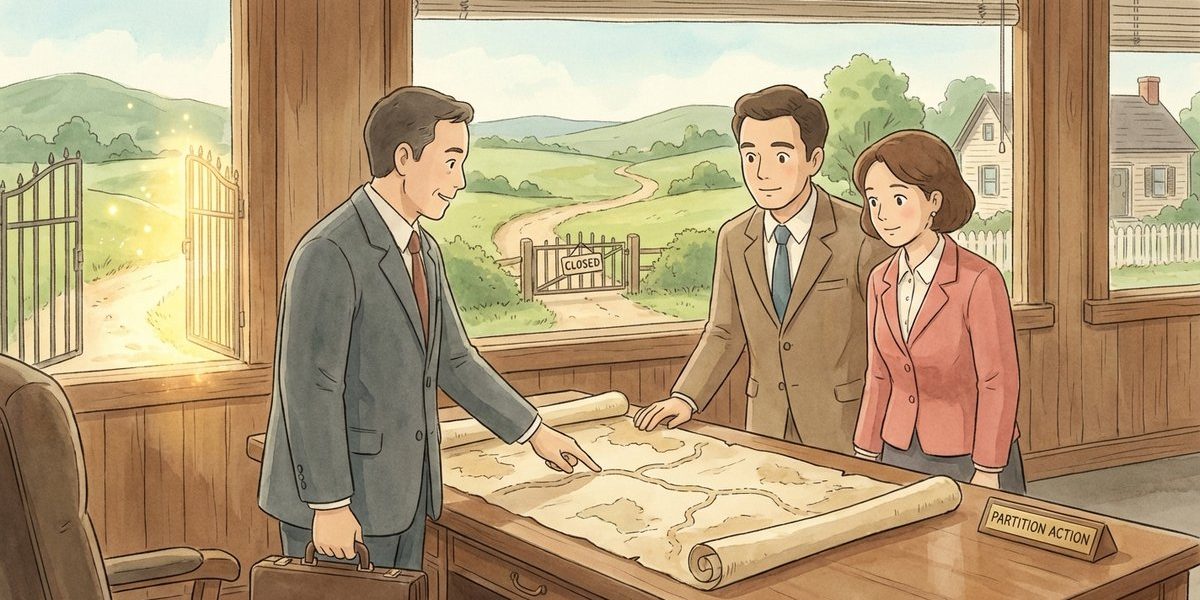
What can we do if the only way to access our land is by crossing a neighbor’s property and they are now blocking it? – North Carolina
Short Answer
In North Carolina, when land can only be reached by crossing a neighbor’s property, the usual legal options are (1) enforcing an existing recorded easement, (2) proving an easement based on long-term use (often called a prescriptive easement), (3) proving an implied easement by necessity, or (4) filing a “cartway” special proceeding to establish a private way to a public road in limited situations. Which option fits depends on the property’s deed history, how the access route has been used over time, and whether the land is truly landlocked.
Understanding the Problem
In North Carolina, can co-owners of family land keep using a long-used access route when the only practical way to reach the property is by crossing a neighbor’s parcel and the neighbor starts blocking the route? The decision point is whether North Carolina law recognizes a legal right to cross that neighboring land (an easement or a court-ordered private way), as opposed to a route that was used only by permission. This question often comes up when co-owners want to market or sell property, because buyers and lenders usually require reliable, legal access.
Apply the Law
North Carolina generally treats access rights as easements (a legal right to use part of someone else’s land for a specific purpose, like ingress and egress). The best-case scenario is a recorded easement in the chain of title. If there is no recorded easement, access may still be established by long-term qualifying use (a prescriptive easement), by necessity tied to how the property was originally divided (an implied easement by necessity), or—if the facts fit—through a statutory “cartway” special proceeding filed with the clerk of superior court. The correct forum and paperwork depend on which theory applies and whether immediate court relief is needed to stop a blockage.
Key Requirements
- Proof of a legal right (not just a favor): The access must be supported by a recorded document, or by facts that meet North Carolina’s requirements for a court-recognized easement or cartway.
- A defined route and scope: The claim must identify where the access runs (often by survey/plat) and what it is used for (typical “ingress/egress,” sometimes utilities).
- A proper court process to enforce it: When a neighbor blocks access, enforcement usually requires a civil action (often seeking an injunction) or, for cartways, a special proceeding before the clerk of superior court in the county where the land lies.
What the Statutes Say
- N.C. Gen. Stat. § 47-27 (Recording deeds of easements) – Explains that easement/right-of-way instruments should be recorded and that unrecorded easements may not be effective against certain third parties.
- N.C. Gen. Stat. § 1-40 (Twenty years adverse possession) – Provides the 20-year adverse period that often aligns with long-term use claims; courts commonly look to similar time concepts when evaluating prescriptive rights.
- N.C. Gen. Stat. § 136-68 (Cartway special proceeding; petition; appeal) – Authorizes a special proceeding before the clerk of superior court to establish a cartway/private way over another’s land in qualifying situations.
- N.C. Gen. Stat. § 136-69 (Cartway procedure; jury of view; width; damages) – Describes the process, including appointment of a jury of view, width limits, and payment of assessed damages and costs before rights attach.
Analysis
Apply the Rule to the Facts: The facts describe co-owned family land that requires crossing a neighboring parcel for access, and the neighbor is now disputing the long-used route. That pattern commonly calls for a title and survey review to confirm whether a recorded right-of-way exists and, if not, whether the historic use looks like a qualifying long-term use (not merely permission) or whether the parcel is landlocked in a way that supports an easement by necessity. Because the property is also being prepared for sale, it is important to convert “practical access” into “legal access” that can be insured and relied on during a closing.
Process & Timing
- Who files: The landowners (including co-owners) asserting access rights. Where: Typically the Superior Court in the county where the property is located; for a cartway, a special proceeding is filed with the Clerk of Superior Court in that county. What: A civil complaint to declare and enforce an easement and request an injunction, or a cartway petition under Chapter 136 if the facts qualify. When: As soon as access is blocked or a sale/inspection is being delayed, because delay can increase costs and complicate marketing.
- Early case steps: Gather deeds for both parcels, prior plats/surveys, and any written permissions or agreements; document the blockage and the historic route; and obtain a current survey showing the claimed route. In many cases, counsel also sends a formal demand letter and proposes a recorded access agreement as a faster solution than litigation.
- Resolution: If the neighbor will not agree, the court process can result in an order declaring the easement and prohibiting interference, or (in a cartway case) an order establishing a cartway with damages assessed and paid before the right becomes effective.
Exceptions & Pitfalls
- Permission vs. right: Long use does not automatically create an easement if the use started and continued only because the neighbor (or a prior owner) allowed it. Evidence of “permission” is a common defense to a prescriptive-easement claim.
- Wrong route or overuse: Even when an easement exists, disputes often arise because the route moved over time, widened, or began serving a different use than historically allowed. A survey and clear description matter.
- Cartway limits: A cartway is not a universal fix. The statutes focus on specific types of land use and require a showing that there is no public road or other adequate means of access, plus payment of assessed damages and costs before rights attach.
- Sale and co-ownership complications: If co-owners are also in conflict about selling, a separate court process may be needed to force a sale. For more on that issue, see force the sale of inherited land when some co-owners refuse to sell and sell a property when multiple relatives are on the deed.
Conclusion
In North Carolina, when the only access to land is across a neighbor’s property and that access is blocked, the main solutions are to enforce a recorded easement, prove an easement based on qualifying long-term use, prove an easement by necessity tied to the property’s history, or pursue a cartway special proceeding in limited situations. The most important next step is to obtain the deeds and a survey and then file the appropriate court action with the Clerk of Superior Court or Superior Court in the county where the land is located to establish and enforce the access right.
Talk to a Partition Action Attorney
If co-owned land cannot be accessed without crossing a neighbor’s property and the neighbor is blocking the route, our firm has experienced attorneys who can help evaluate easement and cartway options and coordinate that strategy with a partition sale plan. Call us today at (919) 341-7055.
Disclaimer: This article provides general information about North Carolina law based on the single question stated above. It is not legal advice for your specific situation and does not create an attorney-client relationship. Laws, procedures, and local practice can change and may vary by county. If you have a deadline, act promptly and speak with a licensed North Carolina attorney.

