
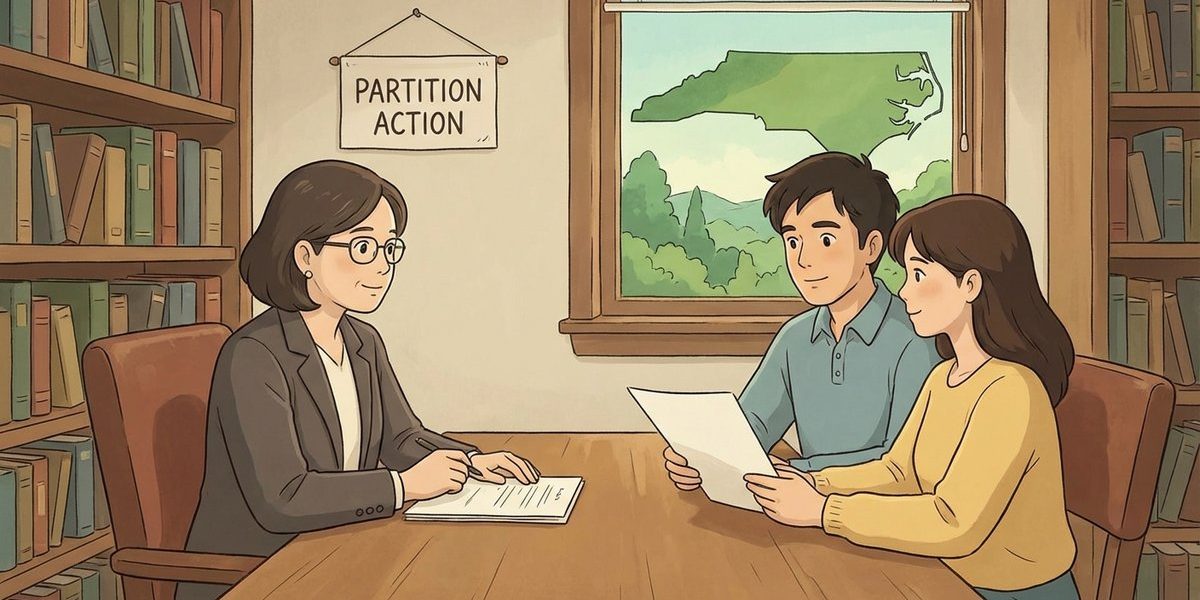
If the property gets ordered sold by the court, will it go to an auction or can it still be sold directly to an interested buyer like me? – North Carolina
Short Answer
In North Carolina, a court-ordered partition sale can be handled either as a public sale (an auction) or as a private sale (a direct sale to a buyer), depending on what the court orders and how the appointed commissioner is authorized to market the property. Even if the commissioner accepts a direct offer, the sale usually stays “open” for a statutory upset-bid period before it becomes final. That means an interested buyer can often still buy the property, but the price and timing can change if someone submits a higher upset bid.
Understanding the Problem
In a North Carolina partition action, when the Clerk of Superior Court (or a judge, depending on the case posture) orders the property sold, the key decision is whether the sale must be conducted as a public auction or whether the commissioner can pursue a private, direct sale to a ready buyer. The practical concern is whether a buyer who is already lined up can still purchase the property after the court gets involved, or whether the process automatically shifts to an auction-style sale with court-controlled bidding and timing.
Apply the Law
North Carolina partition sales are typically carried out by a court-appointed commissioner, and the sale procedure generally follows North Carolina’s judicial sale rules. The court can order a public sale (auction) or allow a private sale (direct sale), but either way the sale is not truly “final” until the commissioner reports the sale and the upset-bid period runs (and the court addresses any required confirmation steps). A buyer can often participate by making the initial offer (in a private sale) or by being the high bidder (in a public sale), and then must be prepared for the upset-bid process.
Key Requirements
- Court authority controls the method of sale: The order of sale and the commissioner’s authority determine whether the property is marketed as an auction or solicited through direct offers.
- A commissioner conducts the sale and reports it: The commissioner handles marketing, accepts the high bid/offer under the court’s authority, and files a report of sale with the Clerk of Superior Court.
- Upset-bid period can reopen the deal: Even after a bid/offer is accepted, North Carolina law generally allows a window for higher bids (upset bids), which can extend the timeline and change who ends up buying.
What the Statutes Say
- N.C. Gen. Stat. § 46A-76 (Partition sale procedure) – Provides that partition sale procedure generally follows North Carolina’s judicial sale procedures, with additional partition-specific requirements (including notice rules if the court orders a public sale).
- N.C. Gen. Stat. § 1-339.36 (Private sale; upset bid) – States that private sales are also subject to upset bids, similar to public sales.
- N.C. Gen. Stat. § 1-339.25 (Public sale; upset bid on real property) – Defines upset bids, sets the minimum increase, and explains the 10-day upset-bid timing and deposit requirements.
Analysis
Apply the Rule to the Facts: Here, a buyer put down earnest money and paid other deal-related costs, but a title company reported an heir lawsuit and possible ownership issues right before closing. If that lawsuit is (or becomes) a partition case that results in a court-ordered sale, the property does not necessarily have to be sold only by auction; it may be sold through a commissioner-run private sale depending on the court’s order. However, even a direct sale to an interested buyer can be exposed to upset bids, which can disrupt the original deal terms and timeline.
Process & Timing
- Who files: In a partition case, a co-owner typically files the partition petition. Where: The Clerk of Superior Court in the county where the property is located. What: After the court orders a sale, a commissioner is appointed to conduct it under the order. When: The sale timeline depends on the order, marketing period, and court scheduling.
- Sale happens (public or private): If the order requires a public sale, the commissioner conducts an auction after giving the required notice. If the order allows a private sale, the commissioner can solicit and accept an offer (often like a normal purchase contract), but still under court supervision and subject to later steps.
- Report of sale and upset-bid window: After the commissioner files the report of sale, the sale generally remains open for upset bids. Under the upset-bid statute, an upset bid must be filed by the close of business on the 10th day after the filing of the report of sale (or after the last upset bid notice), along with the required deposit. If an upset bid is filed, the process can repeat in additional 10-day windows until no further upset bids are filed.
Exceptions & Pitfalls
- “Private sale” does not mean “final sale”: A direct buyer can still lose the property to an upset bidder, even after signing paperwork with the commissioner.
- Title and party problems can slow everything down: If ownership among heirs is disputed, the court may need to resolve who has what interest before clean title can be conveyed at closing.
- Earnest money and pre-closing costs are risky during litigation: A buyer who spends money before the court sale becomes final can end up with delays or a failed closing if the sale is reopened by upset bids or if the court changes the sale terms.
Conclusion
In North Carolina, a court-ordered partition sale can be conducted as a public auction or as a private, direct sale, depending on what the court authorizes the commissioner to do. Even if the commissioner accepts a direct offer, the sale typically remains subject to the upset-bid process, which can change the buyer and extend the timeline. The most important next step is to confirm what the court’s sale order allows and track the 10-day upset-bid deadline that runs after the report of sale is filed.
Talk to a Partition Action Attorney
If a purchase is on hold because an heir lawsuit or ownership dispute triggered a court-supervised sale process, a partition action attorney can explain whether the property can be sold by private sale, how upset bids work, and what timelines to expect. Call us today at (919) 341-7055.
Disclaimer: This article provides general information about North Carolina law based on the single question stated above. It is not legal advice for your specific situation and does not create an attorney-client relationship. Laws, procedures, and local practice can change and may vary by county. If you have a deadline, act promptly and speak with a licensed North Carolina attorney.

