
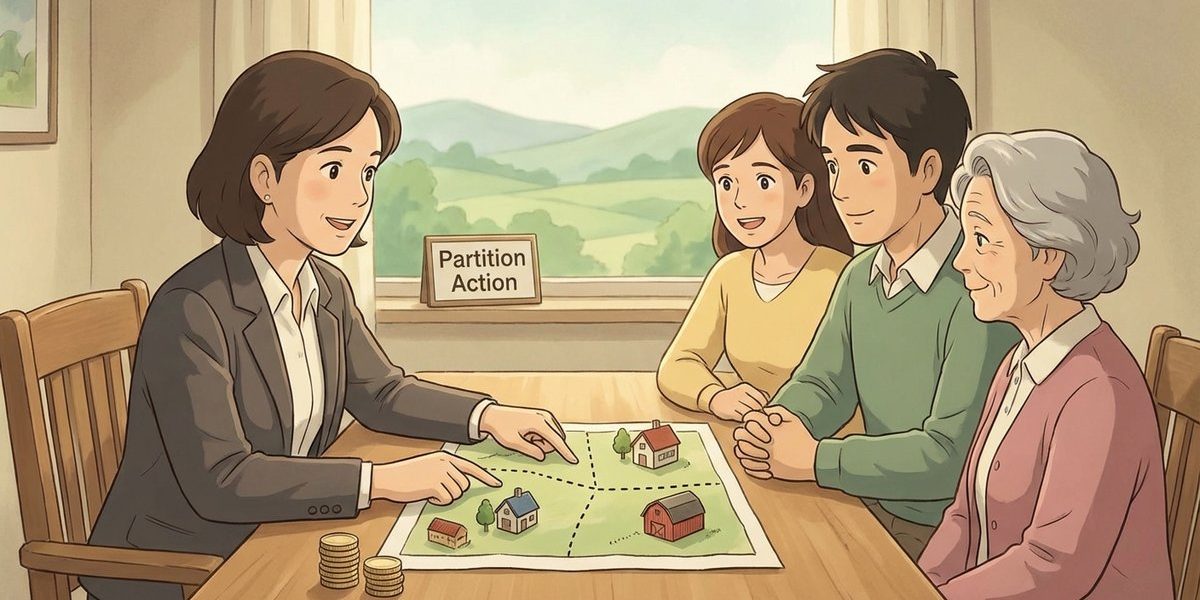
If the properties have homes or other buildings on them, does that make it more likely the court will order a sale instead of dividing the land? – North Carolina
Short Answer
Sometimes. In North Carolina, the court can order a sale (instead of physically dividing the land) only if dividing the property “in kind” would cause substantial injury to one or more co-owners, and the party asking for a sale must prove that. Homes, barns, and other improvements can make a clean split harder and can support a “substantial injury” finding, but buildings do not automatically guarantee a sale.
Understanding the Problem
In a North Carolina partition case, co-owners (often heirs) may disagree about whether inherited real estate should be physically divided into separate tracts or sold and the proceeds divided. The decision point is whether the court should order an actual division of the land or order a partition sale when the property includes a house or other buildings. The key trigger is whether an actual division can be made without causing substantial injury to any co-owner.
Apply the Law
North Carolina partition law allows different outcomes: the court can divide the property, sell it, or even divide part and sell part. When one party asks for a sale instead of a physical division, the court must decide whether an actual partition would cause “substantial injury” to any party. The court considers evidence on both sides, and the party seeking a sale has the burden of proof. Partition cases are typically handled through the Clerk of Superior Court in the county where the land is located, with the possibility of court review depending on the issue and procedure.
Key Requirements
- Co-ownership of the real estate: The parties must hold the property together (for example, as heirs who now own undivided interests).
- Substantial injury if divided: A sale can be ordered only if physically dividing the land would materially harm one or more co-owners compared to selling the whole.
- Proof and findings: The party asking for a sale must prove substantial injury, and the court must make specific findings to support ordering a sale.
What the Statutes Say
- N.C. Gen. Stat. § 46A-75 (Sale in lieu of actual partition) – A sale is allowed only if actual partition cannot be made without substantial injury; the party seeking sale has the burden; the court must make specific findings.
- N.C. Gen. Stat. § 46A-26 (Methods of partition) – The court may order an actual partition, a partition sale (if the statutory requirements are met), or a mixed approach (divide part/sell part).
Analysis
Apply the Rule to the Facts: The facts describe multiple parcels that appear to be inherited and now owned by more than one person, with at least one parcel producing rental income. If some parcels have homes or other buildings, that can support an argument that a physical split would reduce value or create practical problems (for example, one heir ends up with the only improved tract while others receive unimproved land). Even so, a North Carolina court generally still looks for proof that a division would cause substantial injury compared to selling the whole, rather than assuming “buildings = sale.”
Process & Timing
- Who files: Any co-owner. Where: Clerk of Superior Court in the North Carolina county where the property is located. What: A partition petition describing the property and the ownership interests, and stating whether actual partition or a sale is requested. When: Often filed after co-owners cannot agree on a voluntary sale or buyout; timing can also be affected by whether the estate administration is still determining who owns what.
- Evidence and decision point: If a sale is requested, the parties typically present evidence about whether a physical division would cause substantial injury (including valuation impacts, access issues, and how improvements would be allocated). The court can also consider whether “owelty” (a balancing payment) could reduce unfairness from a physical split.
- Outcome: The court orders an actual partition, a sale, or a mixed approach (divide some tracts and sell others). If a sale is ordered, the case proceeds into the sale process and then distribution of net proceeds among the co-owners, subject to proper credits/charges handled in the case.
Exceptions & Pitfalls
- Buildings can cut both ways: A house on one corner of a large tract might make division harder, but if the land can be divided so one party receives the improved portion and others receive equivalent value (possibly with owelty), the court may still order an actual partition.
- Access, utilities, and zoning issues: Even if the acreage divides neatly on paper, a split that creates landlocked parcels, violates setbacks, or requires new utility easements can support a substantial-injury argument.
- Multiple parcels may get different treatment: With several tracts, the court may divide one parcel and sell another, rather than choosing one method for everything.
- Estate vs. co-ownership confusion: If title is still in an estate or ownership shares are disputed, the partition strategy may need to account for the estate process first, even though a sale can sometimes be ordered without resolving every competing claim to the same interest.
- Rent and expense accounting: When one person has been collecting rent, the case often involves credits/charges so the final split reflects income received and necessary expenses paid. Missing records can create avoidable disputes and delay.
For more background on forcing a sale when co-owners will not agree, see force the sale of inherited land when some co-owners refuse to sell. For issues involving tenants or rental control during the case, see what happens in a partition case if one co-owner moved tenants into the property.
Conclusion
In North Carolina, the presence of homes or other buildings can make a partition sale more likely, but it does not automatically control the outcome. The court orders a sale only if an actual division would cause substantial injury, and the party asking for a sale must prove that with evidence (often focused on value, access, and whether a fair split is practical). The next step is to file a partition petition with the Clerk of Superior Court in the county where the property is located and clearly request the remedy sought.
Talk to a Partition Action Attorney
If you’re dealing with inherited property where co-owners cannot agree on a buyout, division, or sale—especially when one person is controlling the property or collecting rent—our firm has experienced attorneys who can help explain options and timelines under North Carolina partition law. Call us today at [CONTACT NUMBER].
Disclaimer: This article provides general information about North Carolina law based on the single question stated above. It is not legal advice for your specific situation and does not create an attorney-client relationship. Laws, procedures, and local practice can change and may vary by county. If you have a deadline, act promptly and speak with a licensed North Carolina attorney.

