
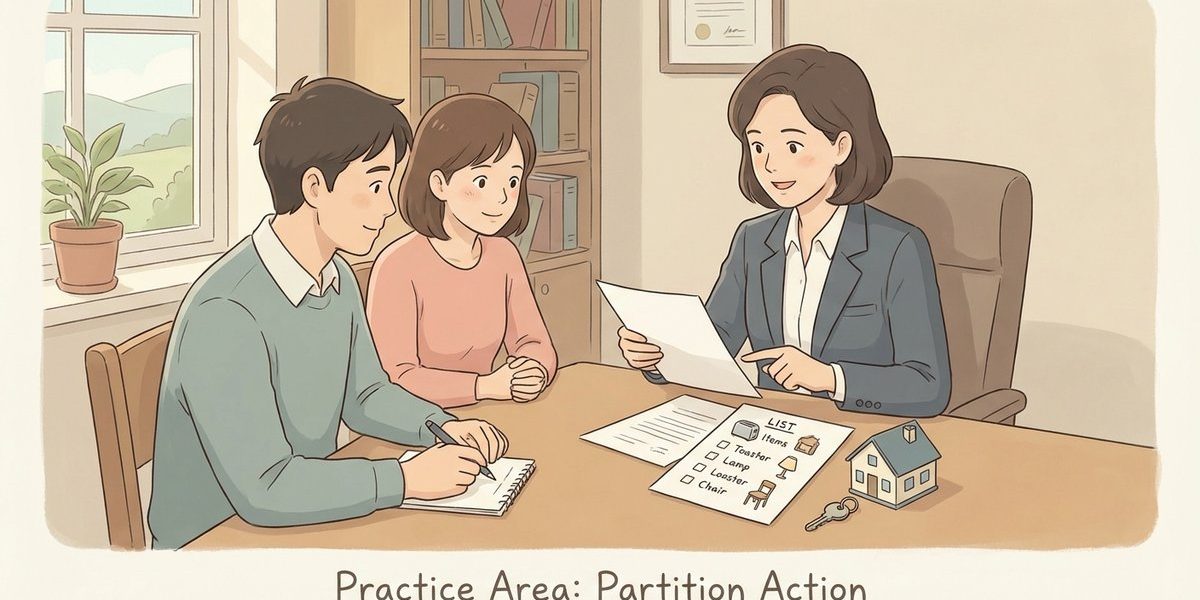
If the other co-owner claims certain household items or appliances, is that handled separately from the home buyout amount, and should we require a written list before closing? – North Carolina
Short Answer
Usually, yes. In North Carolina, a home buyout resolves ownership and value of the real estate, while household items and appliances are typically treated as personal property and should be addressed separately in the settlement terms. To avoid last-minute disputes at closing, it is smart to require a written, itemized list (and clear rules about what stays with the house) before signing and before the deed is released after the refinance rescission period.
Understanding the Problem
In North Carolina, when co-owners resolve a real estate dispute through a buyout funded by a refinance, a common follow-up question is whether one co-owner can also claim household items or appliances and whether that changes the buyout amount. The decision point is whether the settlement should treat household items and appliances as part of the real estate transfer or as separate personal property terms that must be agreed to before the closing attorney releases the deed after the rescission period.
Apply the Law
North Carolina law treats ownership of real property (the land and improvements) differently from personal property (movable items). A buyout and deed transfer typically address the real estate interest. If co-owners also dispute personal property, North Carolina allows partition of personal property through a separate superior court process, which underscores that personal property is not automatically resolved just because the real estate dispute is resolved. Practically, many buyout settlements handle personal property by agreement rather than by a separate court petition, but the agreement needs to be clear about what is included in the buyout and what is not.
Key Requirements
- Clear classification (real property vs. personal property): The settlement should say whether appliances and other items are treated as part of the house transfer or treated as separate personal property.
- Specific identification of disputed items: The settlement should list the items being claimed, who gets them, and whether any payment or credit affects the buyout amount.
- Written, closing-ready instructions: The settlement should give the closing attorney clear directions about what must happen before the deed is released (for example, confirmation that listed items were removed or left in place).
What the Statutes Say
- N.C. Gen. Stat. § 46A-100 (Partition of personal property) – Allows a tenant in common or joint tenant to petition in superior court to partition personal property, showing personal property disputes can be handled separately from the house.
- N.C. Gen. Stat. § 46A-26 (Methods of partition of real property) – Describes court-ordered methods for partitioning real property, which is distinct from dividing household goods.
- N.C. Gen. Stat. § 46A-102 (Partition sale of personal property) – Allows a court-ordered sale of personal property if dividing it would injure a party, reinforcing that personal property can require separate handling if there is no agreement.
Analysis
Apply the Rule to the Facts: The dispute is being resolved through a buyout of a jointly owned home, with the other side drafting a settlement agreement and a deed held by the closing attorney until the loan rescission period ends. That structure primarily resolves the real estate transfer and the buyout payment. If the other co-owner also claims household items or appliances, those items should be addressed as separate personal property terms in the settlement so the buyout amount and the deed release are not disrupted by a last-minute disagreement over what stays or goes.
Process & Timing
- Who files: No court filing is required if the parties agree in writing; otherwise, a co-owner may file a petition in North Carolina Superior Court to partition disputed property. Where: Superior Court in the county where the real property is located (for real estate issues) and the appropriate Superior Court for personal property partition. What: A settlement agreement that (a) states the buyout amount and deed transfer terms and (b) attaches an itemized personal property list as an exhibit. When: Before closing documents are finalized and before the deed is authorized for release after any refinance rescission period.
- Document the list and the rules: The agreement should state which appliances stay with the home, which items will be removed, a deadline for removal, and a condition that the deed will not be released until the parties confirm compliance (or until an agreed alternative is met, such as an escrow or written acknowledgment).
- Closing and deed release: The closing attorney disburses funds and holds or records the deed based on the settlement instructions and lender requirements. After the rescission period ends (if applicable), the deed is released/recorded as directed, ideally with no remaining dispute about personal property.
Exceptions & Pitfalls
- Assuming “appliances automatically convey”: Some appliances may be treated like part of the home in everyday practice, but disputes happen when the settlement does not clearly say what stays. The safest approach is to list each disputed appliance and state whether it stays or goes.
- No written inventory: Vague terms like “all household items” or “personal belongings” often lead to conflict. A written, itemized list attached to the settlement reduces arguments about what was intended.
- Changing the buyout math without saying so: If one side claims items with meaningful value, the settlement should clearly state whether the buyout amount already accounts for those items or whether there is a separate credit/payment. Otherwise, one side may later argue the buyout was based on different assumptions.
- Conditioning deed release on unclear events: If the deed is held pending the rescission period, the agreement should give the closing attorney objective, easy-to-follow instructions (for example, a signed acknowledgment from both parties, a dated walk-through confirmation, or an agreed escrow). Unclear conditions can delay recording and create new leverage disputes.
- Forgetting the “no agreement” backstop: If the parties cannot agree on personal property, North Carolina law allows partition of personal property through Superior Court, including a possible sale if division would cause injury. That is usually slower and more expensive than settling the list up front.
Conclusion
In North Carolina, a home buyout typically resolves the real estate transfer and the buyout amount, while household items and appliances are usually treated as personal property that should be addressed separately in the settlement terms. To prevent closing delays and post-closing disputes, the settlement should attach a written, itemized list stating who gets each disputed item and whether any credit affects the buyout. Next step: require the other side to provide an itemized list as an exhibit to the settlement agreement before closing and before the deed is released after the rescission period.
Talk to a Partition Action Attorney
If a co-owner is claiming household items or appliances as part of a North Carolina home buyout, an attorney can help tighten the settlement language, define what is included in the buyout, and reduce the risk of closing delays. Call us today at (919) 341-7055.
Disclaimer: This article provides general information about North Carolina law based on the single question stated above. It is not legal advice for your specific situation and does not create an attorney-client relationship. Laws, procedures, and local practice can change and may vary by county. If you have a deadline, act promptly and speak with a licensed North Carolina attorney.

