
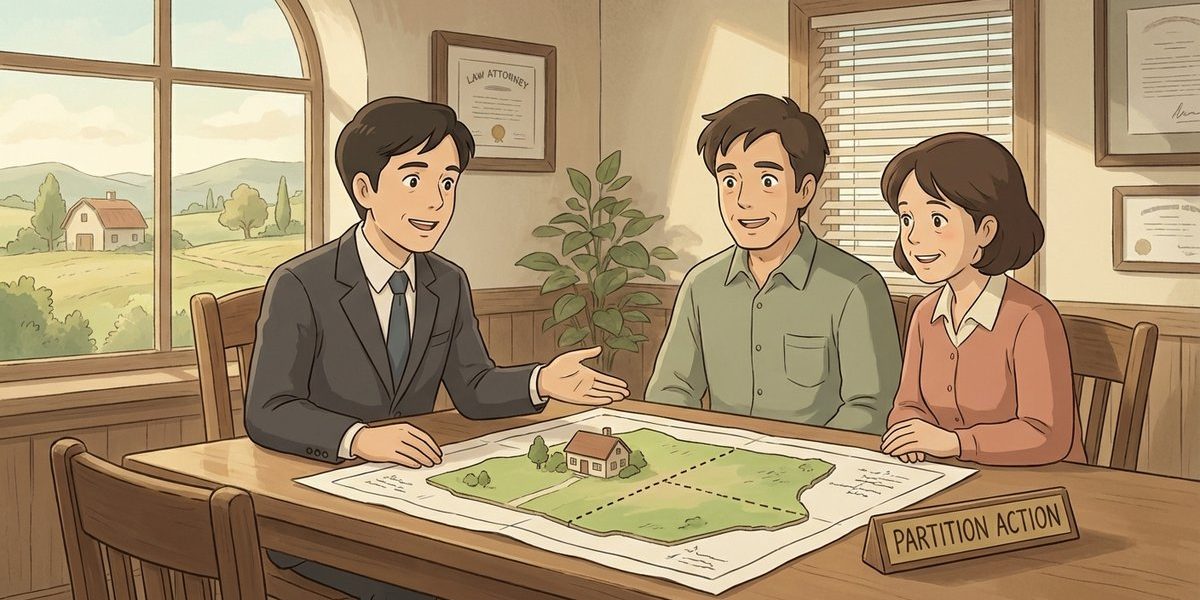
If I’m a respondent in a partition case, how do I fight a forced sale and ask the court to divide the property instead? – North Carolina
Short Answer
In North Carolina, a court should order a physical division of jointly owned real estate (an “actual partition”) unless the party pushing for a sale proves that dividing the property cannot be done without substantial injury to one or more co-owners. A respondent can fight a forced sale by timely asking for actual partition, presenting evidence that the land can be fairly divided, and showing that any fairness issues can be addressed through a cash equalization payment (owelty) instead of selling. If the court orders a sale, it must make specific findings explaining why an actual division would cause substantial injury.
Understanding the Problem
In a North Carolina partition case, the key question is whether the jointly owned house or land must be sold, or whether the court can divide the property into separate pieces so each co-owner receives a portion. The decision usually turns on whether the property can be divided fairly and practically, or whether a division would harm one or more owners enough that a sale is the better legal remedy. The respondent’s goal is to ask the Clerk of Superior Court to order an actual partition instead of a partition sale.
Apply the Law
North Carolina’s partition statutes allow several outcomes, including an actual partition (a physical division), a sale, or a combination. When one side asks for a sale and the other side asks for a physical division, the court must focus on whether an actual partition can be done without “substantial injury.” The party seeking a sale carries the burden to prove substantial injury by a preponderance of the evidence, and the court must consider evidence on both sides before deciding.
Key Requirements
- Request actual partition clearly and early: The respondent should take a clear position in the case that a physical division is requested and should be ordered.
- Show the property can be divided without substantial injury: Evidence should address whether a fair split is possible and whether each owner’s share would keep reasonable value compared to a sale of the whole.
- Address fairness with owelty when needed: If one side of the property is worth more (road frontage, improvements, utilities), the court can consider a cash equalization payment to reduce or eliminate injury rather than ordering a sale.
What the Statutes Say
- N.C. Gen. Stat. § 46A-26 (Methods of partition) – Allows actual partition, a partition sale (if statutory requirements are met), or mixed outcomes depending on what fits the property and the parties’ rights.
- N.C. Gen. Stat. § 46A-75 (Sale in lieu of actual partition) – A sale may be ordered only if the court finds that actual partition cannot be made without substantial injury; the party seeking sale has the burden of proof; the court must make specific findings if it orders a sale.
- N.C. Gen. Stat. § 46A-76 (Sale procedure) – If a sale is ordered, it proceeds under the statutory sale process and includes specific notice requirements.
Analysis
Apply the Rule to the Facts: Here, the other co-owners are pushing for a sale, while the respondent wants the house/land divided. Under North Carolina law, the sale side must prove that a physical division would cause substantial injury, and the court must consider evidence supporting an actual partition before ordering a sale. A strong respondent strategy is to present a workable division plan (or at least credible evidence that one exists) and to address value differences with an owelty-style equalization approach rather than selling the whole property.
Process & Timing
- Who files: The respondent typically files an answer and/or motions in the partition proceeding. Where: The partition case is generally handled through the Clerk of Superior Court in the county where the real property is located. What: A written request for actual partition (and opposition to a sale), supported by evidence. When: As early as possible in the case schedule set by the clerk/court; waiting can reduce practical options and increase costs.
- Evidence stage: The respondent should be prepared to present practical proof that a fair division can be done (for example, a survey concept, access/utility considerations, and a valuation approach comparing “split value” versus “whole value”). The court must weigh this against the sale side’s evidence of substantial injury under N.C. Gen. Stat. § 46A-75.
- Decision: The clerk/court will order an actual partition, a sale, or a mixed remedy. If the court orders a sale, the order should include specific findings explaining why actual partition would cause substantial injury, and the sale then follows the statutory sale procedure.
Exceptions & Pitfalls
- “Substantial injury” is the pivot point: If the property is a single homesite on a small lot, has one workable access point, or cannot be split without destroying value, the sale side may have stronger arguments. The respondent should focus on facts that preserve value and access for each share.
- Ignoring owelty options: When one portion is worth more, a court may consider an equalization payment to reduce injury. Failing to propose a realistic equalization approach can make a sale seem like the only “fair” option.
- Not offering a workable division plan: Simply preferring to keep the property is usually not enough. The respondent should be ready with concrete, property-specific details (boundaries, access, utilities, improvements) showing how a division could work.
- Procedural missteps after a sale order: If a sale is ordered, the process has formal notice and procedure requirements. Understanding the sale mechanics matters, including what happens after an offer is accepted and whether later bids can be submitted. For more detail, see who handles the listing and sale process and the upset-bid process.
Conclusion
In North Carolina, a respondent can fight a forced sale in a partition case by requesting an actual partition and focusing the case on whether a physical division can be done without substantial injury. The co-owner seeking a sale must prove substantial injury, and the court must consider evidence supporting a fair division, including whether a cash equalization payment could reduce any unfairness. The next step is to file a written request for actual partition with the Clerk of Superior Court where the property is located and be ready to present evidence supporting a workable division plan.
Talk to a Partition Action Attorney
If you’re dealing with a partition case where other co-owners want a forced sale but an actual division may be possible, our firm has experienced attorneys who can help explain options, evidence to gather, and likely timelines. Call us today at [CONTACT NUMBER].
Disclaimer: This article provides general information about North Carolina law based on the single question stated above. It is not legal advice for your specific situation and does not create an attorney-client relationship. Laws, procedures, and local practice can change and may vary by county. If you have a deadline, act promptly and speak with a licensed North Carolina attorney.

