
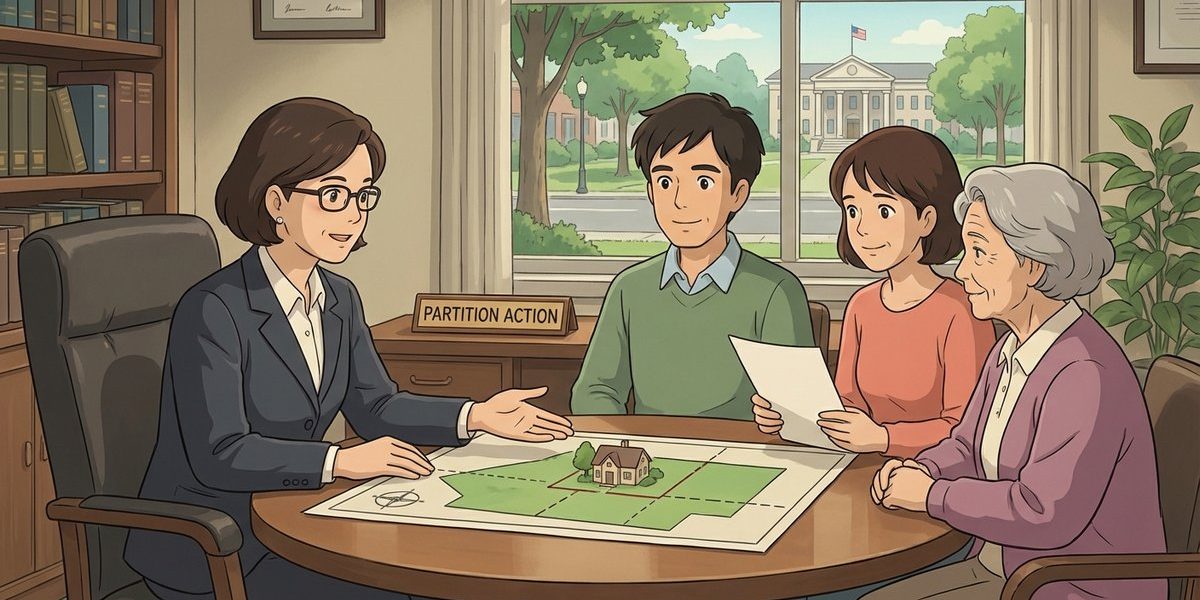
How do I sell a property when multiple relatives are on the deed for the land? – North Carolina
Short Answer
In North Carolina, a property generally cannot be sold on the open market unless all owners on the deed sign the sale documents (or someone has legal authority to sign for them). If one or more relatives will not cooperate, a co-owner can file a partition action in Superior Court to force a division of the property or a court-ordered sale. A partition case can also move forward even if some ownership shares are disputed, with the court sorting out the disputed shares later.
Understanding the Problem
When multiple relatives are listed on a North Carolina deed, the key decision point is whether every person who holds title will sign the documents needed to sell the land and the house. If all owners agree, the sale usually proceeds through a normal closing. If even one owner refuses to sign, cannot be found, or claims a different share than what others believe, the sale can stall and the next step often becomes a court process to break the deadlock.
Apply the Law
North Carolina treats most “multiple names on the deed” situations as cotenancy (often tenants in common or joint tenants). Each cotenant has rights in the whole property, and a buyer and closing attorney typically need all cotenants to convey clear title. If agreement is not possible, North Carolina law allows a cotenant to file a partition proceeding in Superior Court. The court can order an actual partition (a physical division), a partition sale (sale of the whole property with proceeds divided), or a combination approach depending on what fits the property and the parties’ rights.
Key Requirements
- Cotenancy interest: The person pushing the process must claim an ownership interest as a tenant in common or joint tenant (or act through a deceased owner’s estate in certain situations).
- All owners joined and served: The partition case must include all cotenants as parties, and they must be properly served so the court can enter enforceable orders affecting the property.
- Right remedy (divide vs. sell): The court chooses among partition methods. A court-ordered sale requires proof that a physical division cannot be done without “substantial injury” to one or more parties, and the party asking for a sale must prove that.
What the Statutes Say
- N.C. Gen. Stat. § 46A-21 (Who may file; required parties) – Allows a cotenant to petition for partition in Superior Court and requires joining and serving all cotenants; spouses are not required unless also cotenants.
- N.C. Gen. Stat. § 46A-26 (Methods of partition) – Lists the court’s options, including actual partition, partition sale, or a mixed approach; the court cannot force a cotenant to remain in cotenancy over objection.
- N.C. Gen. Stat. § 46A-75 (Sale in lieu of actual partition) – Allows a partition sale only if actual partition would cause substantial injury; requires specific findings; puts the burden on the party seeking sale.
- N.C. Gen. Stat. § 46A-52 (Unknown cotenants or disputed title) – Lets the court proceed with partition even if some cotenants are unknown or ownership shares are disputed, with disputed shares grouped and resolved later.
Analysis
Apply the Rule to the Facts: The facts describe multiple relatives on the deed, a house on the land, and a stalled sale because at least one relative is trying to sell but cannot get the matter across the finish line. That usually means either (1) not all deeded owners are willing/able to sign, or (2) there is a title or share dispute that the closing process will not accept. Under North Carolina law, a cotenant can file a partition action in Superior Court, join all relatives on title, and ask the court to order a workable outcome—often a sale if dividing the land and house would cause substantial injury.
Process & Timing
- Who files: Any cotenant listed on the deed (and, in some situations, a deceased cotenant’s personal representative). Where: Superior Court in the county where the real property is located. What: A partition petition/complaint that identifies the property, the claimed owners and shares, and the requested method (actual partition, sale, or mixed). When: There is no single universal “file by” date for partition; timing usually turns on practical needs like a pending sale, a dispute, or carrying costs.
- Service and responses: All cotenants (and often lienholders such as deed of trust holders) must be joined and served. If someone cannot be located or the ownership shares are disputed, the case can still move forward, but the court will require proper procedures to protect those interests.
- Court decision on method: The court decides the partition method. If a party requests a sale, that party must prove substantial injury from a physical division, and the court must make specific findings supporting a sale order.
Exceptions & Pitfalls
- Assuming one relative can sell for everyone: A co-owner generally cannot sign a deed for other owners without legal authority (such as a valid power of attorney or court authority). A closing can fail if even one owner is missing.
- Title problems and disputed shares: Families often disagree about who inherited what, whether a deed was recorded correctly, or whether an estate step was completed. North Carolina partition law can allow the court to order partition or sale without resolving every share dispute first, but the dispute still must be addressed to distribute proceeds correctly.
- Not joining all necessary parties: Leaving out an owner, a lienholder, or another person with a recorded interest can delay the case or create an order that does not fully clear the path to sale.
- Sale vs. division confusion: A court does not automatically order a sale just because relatives disagree. A sale requires proof that dividing the property would cause substantial injury, and the court must enter detailed findings to support that result.
Conclusion
In North Carolina, selling land and a house with multiple relatives on the deed usually requires all deeded owners to sign at closing (or a legally authorized person to sign for them). If the sale is stalled because owners will not cooperate or shares are disputed, a cotenant can file a partition action in Superior Court in the county where the property sits and ask the court to order a division or, if substantial injury would result from dividing it, a court-ordered sale. The next step is to file the partition petition in Superior Court as soon as a sale timeline is at risk.
Talk to a Partition Action Attorney
If multiple relatives are on the deed and a sale is stalled because not everyone will sign or ownership shares are disputed, our firm has experienced attorneys who can help explain the partition process, required parties, and likely timelines. Call us today at (919) 341-7055.
Disclaimer: This article provides general information about North Carolina law based on the single question stated above. It is not legal advice for your specific situation and does not create an attorney-client relationship. Laws, procedures, and local practice can change and may vary by county. If you have a deadline, act promptly and speak with a licensed North Carolina attorney.

