
How do I figure out who all the co-owners or heirs are for the property before filing a partition case? – North Carolina
Short Answer
In North Carolina, a partition case should name and serve all current co-owners (and often other people with an interest, like lienholders). The practical way to identify everyone is to start with the deed and probate records, then build a family tree for any deceased owner and confirm how that owner’s share passed. If some co-owners cannot be identified or located after reasonable effort, North Carolina law still allows the case to move forward, but the petition must handle “unknown” interests correctly.
Understanding the Problem
In a North Carolina partition action, the key question is: “Who must be named as parties as co-owners or heirs before filing in Superior Court?” This issue usually comes up when title shows multiple owners, one or more owners have died, or family members disagree about who inherited an interest. The goal is to identify every person who may own an undivided share so the petition can be drafted correctly and served on the right parties.
Apply the Law
Partition in North Carolina is handled as a special proceeding in the Superior Court. A person seeking partition must join and serve all tenants in common and joint tenants (the co-owners shown by title and any later transfers). If an owner has died, the “co-owner” may now be that person’s heirs or devisees, depending on whether the interest passed through an estate (by will) or by intestate succession (no will). North Carolina law also anticipates situations where some co-owners are unknown, unlocatable, or where ownership shares are disputed, and it provides ways for the case to proceed while protecting those interests.
Key Requirements
- Identify the current title holders: Determine who holds record title now (including any transfers after the last deed, such as estate distributions or later deeds).
- Join and serve necessary parties: Name and serve all co-owners; consider joining others with an interest (for example, lienholders or lessees) so the court can address the property cleanly.
- Address unknown, unlocatable, or disputed interests: If a co-owner cannot be identified or located, or if multiple people claim the same share, the petition must account for that so the court can still order partition or a sale.
What the Statutes Say
- N.C. Gen. Stat. § 46A-1 (Partition is a special proceeding) – Partition cases follow special proceeding rules in Superior Court, with Chapter 46A modifications.
- N.C. Gen. Stat. § 46A-21 (Necessary and proper parties) – The petitioner must join and serve all tenants in common and joint tenants; other interest-holders may also be joined.
- N.C. Gen. Stat. § 46A-52 (Unknown cotenants; title disputed) – Allows partition to proceed even if some cotenants are unknown or ownership shares are disputed, with those shares handled together for purposes of partition.
- N.C. Gen. Stat. § 46A-25 (Unknown/unlocatable parties; guardian ad litem in certain cases) – Provides for representation (including by guardian ad litem) for certain parties such as unknown or unlocatable parties in cases involving contingent future interests.
Analysis
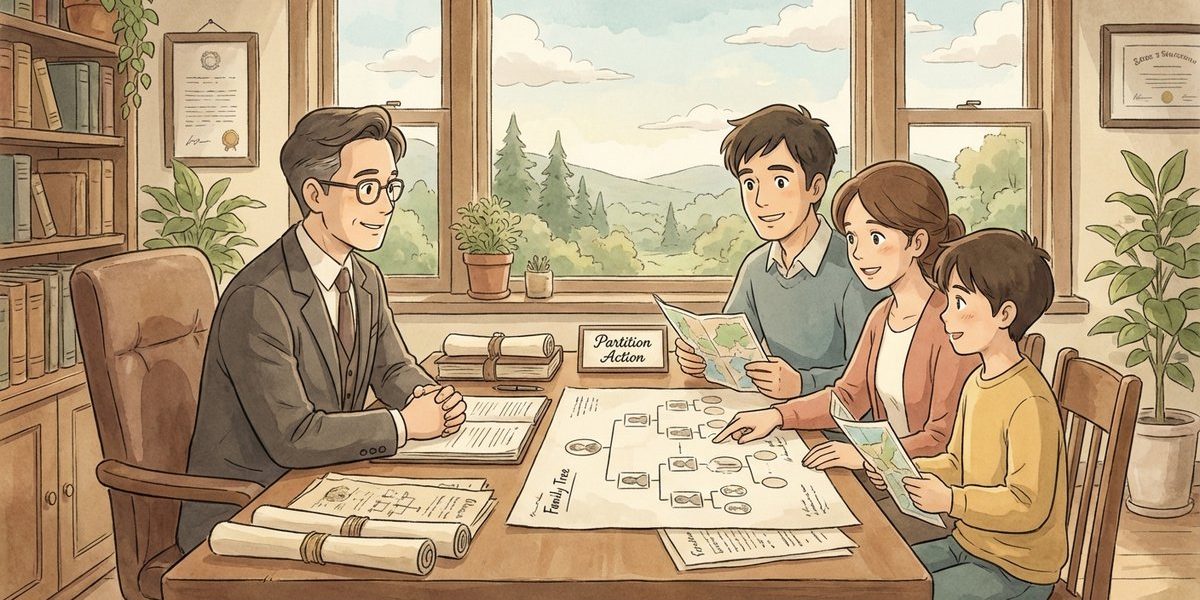
Apply the Rule to the Facts: The matter involves preparing a North Carolina partition petition for co-owned property, and the petition must name and serve all co-owners. If any record owner is deceased, the current co-owners may include heirs or devisees, which is why the firm needs family-relationship details (a family tree) to identify who inherited the deceased owner’s share. If some potential co-owners cannot be confirmed by records, North Carolina law can still allow the case to proceed, but the petition must address unknown or disputed interests in a way the court can manage.
Process & Timing
- Who files: A co-owner (tenant in common or joint tenant), and sometimes a personal representative in limited situations. Where: North Carolina Superior Court (as a special proceeding) in the county where the property is located. What: A verified petition to partition that lists all known co-owners and their claimed interests, plus other interest-holders the petitioner chooses to join. When: Before filing, gather enough information to name and serve the necessary parties; timing can change if an estate is still open or if heirs are hard to locate.
- Build the ownership list (practical steps): (a) Pull the most recent recorded deed and any later recorded deeds affecting the property; (b) check the Register of Deeds index for each owner’s name to see if they conveyed their interest; (c) check for recorded estate documents that affect title (for example, an executor’s deed or a deed from heirs); (d) identify liens or deeds of trust that may indicate additional interest-holders worth joining.
- Confirm heirs when an owner is deceased: Use probate records (estate file, will if any, and filings that identify heirs) and a family tree to identify the people who likely inherited. If the records do not clearly show who inherited, the petition may need to name the competing claimants and allow the court to proceed while ownership disputes get resolved later as permitted by statute.
Exceptions & Pitfalls
- Assuming “the family knows” equals legal ownership: In partition, the court focuses on legal interests. A family understanding may not match what deeds and probate records show.
- Missing an heir because the family tree is incomplete: Common gaps include children from earlier relationships, adopted children, or heirs who live out of state. An incomplete heir list can lead to service problems and delays.
- Confusing estate status and authority: If an estate is open, the personal representative’s actions and probate filings may affect who should be named and what documents prove ownership.
- Unknown or unlocatable parties: North Carolina law provides tools to proceed when some cotenants are unknown or cannot be found, but the petition must describe the issue accurately and follow the court’s requirements for protecting those interests.
Conclusion
In North Carolina, a partition petition should name and serve all current co-owners, and that often requires confirming heirs when a record owner has died. The usual approach is to start with the recorded deed, trace later transfers in the Register of Deeds, and use probate records plus a family tree to identify who inherited each deceased owner’s share. If some co-owners are unknown or ownership shares are disputed, North Carolina law can still allow the case to proceed, but the petition must address those interests correctly when filing in Superior Court.
Talk to a Partition Action Attorney
If a co-owned property has deceased owners, missing heirs, or unclear shares, a partition filing can stall unless the parties are identified and served correctly. Our firm has experienced attorneys who can help sort out the ownership picture, prepare the petition, and keep the case moving. Call us today at (919) 341-7055.
Disclaimer: This article provides general information about North Carolina law based on the single question stated above. It is not legal advice for your specific situation and does not create an attorney-client relationship. Laws, procedures, and local practice can change and may vary by county. If you have a deadline, act promptly and speak with a licensed North Carolina attorney.

