
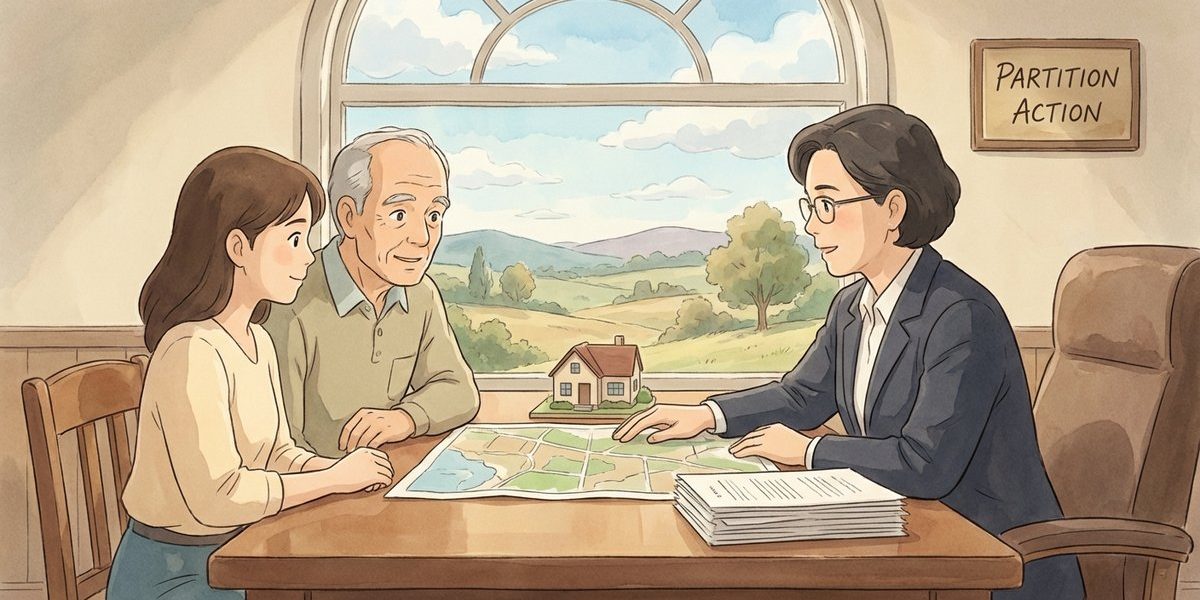
How do co-owners divide inherited property fairly if one person wants to keep it and others want money? – North Carolina
Short Answer
In North Carolina, co-owners of inherited real estate usually resolve this by either (1) a voluntary buyout (one co-owner keeps the property and pays the others their shares) or (2) a court partition case in Superior Court. In a partition case, the court can order an actual division of the land if it can be split fairly, or it can order a sale and divide the proceeds if a split would cause “substantial injury.” The “fair” outcome typically turns on ownership shares, a reliable value, and a clean accounting for expenses and any unequal use of the property.
Understanding the Problem
In North Carolina heir property situations, multiple family members often end up owning the same piece of real estate together as tenants in common. The decision point is simple: can one co-owner keep the inherited property by paying the other co-owners cash for their shares, instead of forcing everyone into a sale. If the co-owners cannot agree on a price and terms, the question becomes whether a North Carolina Superior Court partition case can create a fair result by dividing the property or converting it to cash.
Apply the Law
North Carolina law allows a tenant in common or joint tenant to file a partition petition in the Superior Court where the property is located. The court must choose a method of partition, which can include physically dividing the property (actual partition), ordering a sale (partition sale) if the legal requirements are met, or using a combination approach. If a party asks for a sale, that party generally must prove that dividing the property would cause “substantial injury,” and the court considers factors like whether the value of divided pieces would be materially less than selling the whole property.
Key Requirements
- Cotenancy (shared ownership): The property must be owned together (common with inherited property), and at least one co-owner must have standing to ask the court to partition it.
- All owners and interest-holders are brought into the case: The petition must name and serve all co-owners, and it often includes others with interests such as lienholders or lessees so the court can enter workable orders.
- Proper method (divide vs. sell): The court can order an actual division, but a sale is typically ordered only when an actual division cannot be done without substantial injury, based on evidence presented to the judge.
What the Statutes Say
- N.C. Gen. Stat. § 46A-21 (Who may petition; required parties) – Allows a cotenant to petition for partition in Superior Court and requires joining/serving all cotenants (and permits joining other interest-holders).
- N.C. Gen. Stat. § 46A-26 (Methods of partition) – Lists the methods the court may order, including actual partition, partition sale, or a combination, and states a cotenant cannot be forced to remain in cotenancy over objection.
- N.C. Gen. Stat. § 46A-75 (Sale in lieu of actual partition; “substantial injury”) – Sets the standard and factors the court considers when deciding whether to order a sale instead of a physical division.
- N.C. Gen. Stat. § 46A-52 (Unknown cotenants; title disputes) – Addresses how the case can proceed even when some cotenants are unknown or some ownership shares are disputed.
Analysis
Apply the Rule to the Facts: The facts describe “heir property,” which commonly means inherited real estate owned by multiple family members as cotenants. If one cotenant wants to keep the property and others want money, the cleanest “fair” solution is usually a voluntary buyout based on an agreed value and a written transfer. If agreement fails, North Carolina partition law provides a court process to either divide the land or sell it and distribute the proceeds according to each person’s ownership share, with the sale remedy generally requiring proof that a physical split would cause substantial injury.
In practice, “fairness” often depends on (1) confirming who the co-owners are and what percentage each owns, (2) establishing a defensible fair market value, and (3) accounting for property costs (taxes, insurance, necessary repairs) and any unequal possession or benefit. Those issues can be negotiated in a buyout, or addressed through the partition case so the final distribution matches the legal ownership and the court’s orders.
For readers dealing with related title problems (for example, missing heirs or deceased co-owners), it may help to review clear ownership when multiple people are on the deed and how to identify all co-owners or heirs before filing.
Process & Timing
- Who files: A cotenant (co-owner), and sometimes a personal representative in limited situations. Where: Superior Court in the North Carolina county where the property is located. What: A petition/complaint for partition that identifies the property, the co-owners, and the requested method (actual partition, sale, or a combination). When: There is not one universal “partition deadline,” but timing matters if there are related pressures like foreclosure, unpaid taxes, or a pending estate administration.
- Valuation and method decision: The parties present evidence about whether the property can be divided fairly or whether a sale is necessary to avoid substantial injury. If the case involves unknown owners or disputed shares, the court can still move the partition process forward while those disputes are resolved under the statute.
- Outcome: The court orders an actual partition (each owner receives a tract) or orders a partition sale and then distributes the net proceeds according to ownership interests, subject to the court’s rulings on costs and any adjustments the law allows.
Exceptions & Pitfalls
- Unclear title or missing heirs: Heir property often has gaps in the chain of title. A partition case can sometimes proceed even with unknown cotenants or disputed shares, but missing parties and title defects can slow down settlement and closing.
- Assuming “keep it” means “no court”: A buyout still needs a reliable value and a proper deed transfer. Without paperwork, the ownership problem usually remains.
- Fighting over “fair” without evidence: In court, the sale-versus-division decision turns on proof. Unsupported opinions about value or whether the land can be split often lead to worse outcomes and higher costs.
- Cost and use disputes: Taxes, insurance, repairs, and exclusive use can become major conflict points. Addressing these early (in negotiation or pleadings) helps avoid surprises when proceeds are distributed.
Conclusion
In North Carolina, inherited property co-owners usually divide the property fairly by negotiating a buyout (one co-owner keeps the property and pays the others for their shares) or by filing a partition case in Superior Court. The court can order an actual division when it can be done without substantial injury, or order a sale and divide the proceeds when a split would materially harm value or rights. A practical next step is to file a partition petition in the county where the property is located if a written buyout agreement cannot be reached.
Talk to a Partition Action Attorney
If you’re dealing with heir property where one co-owner wants to keep the real estate and others want money, our firm has experienced attorneys who can help explain the partition process, valuation issues, and likely timelines under North Carolina law. Call us today at 919-341-7055.
Disclaimer: This article provides general information about North Carolina law based on the single question stated above. It is not legal advice for your specific situation and does not create an attorney-client relationship. Laws, procedures, and local practice can change and may vary by county. If you have a deadline, act promptly and speak with a licensed North Carolina attorney.

