
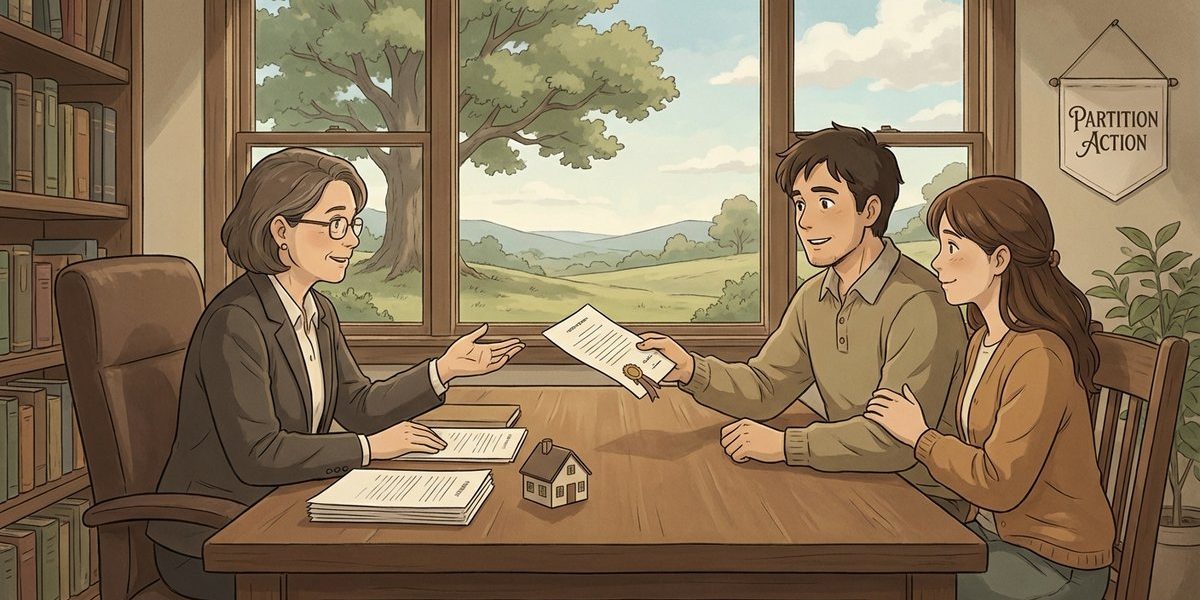
How can we buy out the person who filed the partition request instead of having the property sold? – North Carolina
Short Answer
In North Carolina, co-owners can often avoid a forced sale by reaching a voluntary settlement where the other side sells their ownership interest (a “buyout”) and dismisses the partition case. If no agreement happens, a co-owner can still ask the court to order an actual partition (dividing the land) instead of a sale, and the party pushing for a sale must prove that dividing the property would cause “substantial injury.” Because partition cases move on court deadlines after service, it is important to confirm whether proper notice was served and respond on time.
Understanding the Problem
In a North Carolina partition action involving inherited real estate, a co-owner (or someone claiming to stand in a co-owner’s shoes) asks the clerk of superior court to divide the property or sell it and split the proceeds. The decision point is whether the property must be sold through the partition case, or whether the co-owners can keep the property by buying out the petitioner’s claimed share instead. Timing matters because partition cases have response and hearing deadlines once the petition and summons are served, and public notices may appear after the case is already moving forward.
Apply the Law
North Carolina partition cases are special proceedings handled before the clerk of superior court. The court must choose a method of partition, which can include an actual partition (a physical division), a partition sale, a mix of both, or partitioning part while leaving part in co-ownership (but the court cannot force a co-owner to stay in co-ownership over that co-owner’s objection). When a sale is requested, the court should not order a sale unless the party seeking the sale proves that an actual partition cannot be done without “substantial injury” to one or more parties. The court may also order mediation before deciding whether to order a sale when a sale is requested.
Key Requirements
- Proper party status (standing): The person pushing partition generally must be a co-owner of record or someone legally authorized to act for an owner’s interest (for example, through an estate). If ownership is disputed, the case can still move forward, so the dispute should be raised early and clearly.
- Method of partition decision: The court must select among the allowed partition methods, including actual partition or a sale, based on the facts and the statutory standards.
- Sale requires proof of “substantial injury”: If someone wants a sale instead of dividing the land, that party carries the burden to show that dividing the property would cause substantial injury, including that the divided shares would be worth materially less than selling the whole, or that division would materially impair a co-owner’s rights.
What the Statutes Say
- N.C. Gen. Stat. § 46A-26 (Methods of partition) – Requires the court to choose an authorized partition method (actual partition, sale, mixed approach, or partitioning part and leaving part in cotenancy, with limits).
- N.C. Gen. Stat. § 46A-75 (Sale in lieu of actual partition) – Allows a sale only if actual partition cannot be made without substantial injury, and places the burden on the party seeking the sale.
- N.C. Gen. Stat. § 46A-29 (Mediation) – Allows the parties to mediate and permits the court to order mediation before deciding whether to order a sale when a sale is requested.
Analysis
Apply the Rule to the Facts: The facts describe inherited real property owned by multiple relatives, with a partition filing made by someone who claims to be an heir or estate administrator. A buyout is usually possible only if the parties can agree on (1) whether the petitioner actually owns an interest (or has authority to act) and (2) a price and closing terms for that interest. If the petitioner insists on a court-ordered sale, the co-owners who want to keep the property can push for an actual partition and require the petitioner to prove “substantial injury” before the court orders a sale.
Process & Timing
- Who files: The co-owner(s) who want to keep the property typically file an Answer (and sometimes counterclaims or motions) responding to the partition petition and stating the requested outcome (for example, actual partition instead of sale, and/or mediation). Where: North Carolina clerk of superior court in the county where the land is located. What: A written response and any motion requesting mediation or challenging the petitioner’s claimed interest/authority. When: The response deadline usually runs from formal service of the summons and petition, so confirming the service date and method is critical.
- Negotiate a buyout in parallel: Even while the case is pending, the co-owners can propose a written settlement: the petitioner conveys their interest by deed in exchange for an agreed payment, and the parties file a dismissal or consent order. If the petitioner’s ownership is unclear, parties often address that first (for example, by requiring proof of heirship/authority as a settlement condition).
- Ask the court to avoid a sale: If no deal is reached and a sale is requested, the court can order mediation and must apply the “substantial injury” test before ordering a sale. If the court orders a sale, the case proceeds under court supervision toward a sale process and later distribution of proceeds.
Exceptions & Pitfalls
- Public notice is not the same as proper service: Learning about the case from notices does not always mean the court has personal jurisdiction over every owner. Confirming whether, when, and how service occurred can affect deadlines and available defenses.
- Ownership disputes may not stop a sale order: North Carolina law allows the court, in some situations, to proceed toward a partition sale even if two or more parties claim the same undivided interest. That makes it important to raise heirship/authority issues early and seek court direction on how the claimed interest will be handled.
- “Buyout” is usually a settlement, not an automatic right: Chapter 46A focuses on actual partition versus sale, and mediation; it does not guarantee a forced buyout at a set formula. Without agreement, the practical alternative is often to litigate for actual partition and against a sale under the “substantial injury” standard.
- Valuation fights: Buyout negotiations often stall over value, condition, access, and whether the petitioner’s share is clear. A clear paper trail (deeds, estate documents, and a defensible valuation approach) reduces delay.
- Co-owner coordination problems: When multiple relatives co-own property, inconsistent positions can weaken the push for actual partition or settlement. Aligning the co-owners’ goals early can matter.
Conclusion
In North Carolina, the cleanest way to avoid a partition sale is a voluntary buyout settlement where the petitioner transfers the claimed ownership interest and the partition case is dismissed. If the petitioner pushes for a court-ordered sale, the co-owners can ask the clerk of superior court for actual partition and hold the petitioner to the burden of proving “substantial injury” before any sale is ordered. The next step is to file a timely written response after formal service of the petition and summons.
Talk to a Partition Action Attorney
If a partition filing threatens a family property and the goal is to keep the land by buying out the petitioner or pushing for actual partition instead of a sale, our firm has experienced attorneys who can help explain options and timelines. Call us today at (919) 341-7055.
Disclaimer: This article provides general information about North Carolina law based on the single question stated above. It is not legal advice for your specific situation and does not create an attorney-client relationship. Laws, procedures, and local practice can change and may vary by county. If you have a deadline, act promptly and speak with a licensed North Carolina attorney.

