
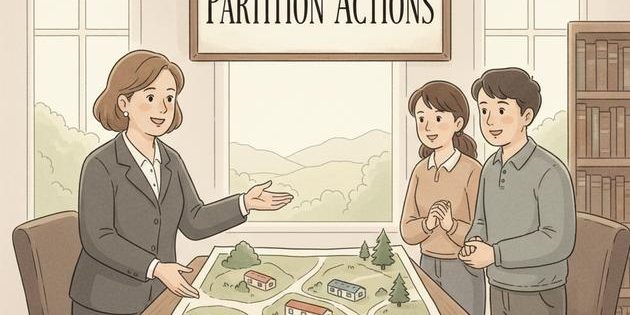
How can I proceed with a partition when the land is split into separate nearby parcels and includes mobile homes? – North Carolina
Short Answer
In North Carolina, a co-owner may file a partition action in superior court even when the land consists of several nearby tracts and includes mobile or manufactured homes. The court can partition all tracts together, either by physically dividing them or ordering a sale, and must also decide whether each mobile home is legally part of the real estate or separate personal property. How the homes are titled and recorded usually determines whether they are included in the real-property partition or handled as personal property.
Understanding the Problem
The question is whether and how a co-owner in North Carolina can bring a partition case when the shared property is not one single farm or lot, but several nearby parcels, and some or all parcels have mobile homes on them. The concern is how the court will treat multiple tracts in one proceeding and whether the mobile homes are part of the land or separate assets. The decision point is what kind of partition the court can order and how it will match specific tracts and mobile homes to each co-owner’s share.
Apply the Law
Under North Carolina law, any joint tenant or tenant in common of real property may ask the superior court to partition the property, including situations with multiple tracts. The court decides whether to divide the land in kind, to order a sale, or to use a mix of both. For mobile homes, the key question is whether each home has been legally “affixed” to the land and treated as real property, or remains personal property that might require a separate partition of personal property.
Key Requirements
- Co-ownership of the property: At least two people must hold undivided interests in the same real estate, whether it is one tract or several nearby parcels.
- Proper court and county: The partition case must be filed in the superior court of a county where some or all of the land lies, with notice filed in any other county where part of the land is located.
- Classification of the mobile homes: Each mobile or manufactured home must be classified as either real property attached to the land or personal property, which affects whether it is included in the real-property partition or handled separately.
What the Statutes Say
- N.C. Gen. Stat. § 46A-20 (Venue in partition) – A partition case for real property must be started in a county where the property is located, and special filing rules apply if the property spans more than one county.
- N.C. Gen. Stat. § 46A-26 (Methods of partition) – The court may order actual partition, a partition sale, or a combination, and may treat different portions of the property differently.
- N.C. Gen. Stat. § 46A-53 (Apportionment of shares in common) – Commissioners may, with court approval, group certain co-owners’ shares into a single parcel when that does not harm other owners.
- N.C. Gen. Stat. § 46A-100 (Partition of personal property) – Co-owners may also seek partition of personal property, which can apply if a mobile home is not legally part of the real estate.
- N.C. Gen. Stat. § 47-20.6 (Affixing manufactured homes) – A manufactured home can become an improvement to real property when a proper declaration and related documents are recorded, causing the home to be treated as part of the land.
Analysis
Apply the Rule to the Facts: With no specific facts given, consider two simple variations. In one scenario, several nearby tracts are titled in the same co-owners’ names, and recorded documents show that the mobile homes have been affixed to the land; a single real-property partition could be brought in superior court, and the homes would normally be treated as improvements included with their respective tracts. In another scenario, the land is jointly owned but the mobile homes still have Division of Motor Vehicles certificates of title and no recorded affixation documents; the court may treat the land as one partition case and require separate treatment or a separate partition of the mobile homes as personal property.
Process & Timing
- Who files: Any co-owner (tenant in common or joint tenant). Where: In the Superior Court of a North Carolina county where any of the tracts are located. What: A petition identifying each tract, all known co-owners and their interests, and stating whether a division in kind or sale is requested; if personal-property partition of mobile homes is also needed, that should be clearly stated. When: There is no general statute of limitations for the right to seek partition, but related claims (such as for reimbursement of improvements or accounting) may have deadlines.
- The court reviews the petition, ensures all co-owners receive proper service, and determines whether the property (including multiple tracts) should be divided in kind, sold, or partly divided and partly sold. If a division in kind is ordered, the court appoints commissioners to inspect the property, consider access, value, improvements such as mobile homes, and recommend an allotment.
- After the commissioners report back, the court may confirm, modify, or reject the report. A confirmed division results in a final order and, if applicable, new descriptions for each parcel to be recorded. If a sale is ordered, the court oversees the sale process and later confirms the sale and orders distribution of proceeds among co-owners according to their interests and any adjustments.
Exceptions & Pitfalls
- Mobile or manufactured homes that have not been properly affixed and recorded may remain personal property, so failing to address their titles can leave ownership of the homes unresolved even after the land is partitioned.
- Multiple nearby tracts can be partitioned together, but not identifying every tract, every co-owner, or disputed interests can delay the proceeding or result in a partial, unsatisfactory order.
- Access and utilities to tracts with mobile homes are critical; a division that leaves a parcel landlocked or without reasonable access can be challenged as unfair.
- Co-owners who have made substantial improvements (such as installing a mobile home, well, or septic system) often raise claims for credits or owelty; failing to present these clearly can affect how the court allocates tracts or sale proceeds.
Conclusion
In North Carolina, a co-owner can pursue a partition even when the shared property consists of several nearby tracts and includes mobile or manufactured homes. The case is filed in superior court in a county where some or all of the land lies, and the court decides whether to divide, sell, or partly divide and partly sell the property. A key step is determining whether each mobile home is legally affixed as real property or remains personal property, then clearly describing all tracts and homes in a single, well-drafted partition petition.
Talk to a Partition Action Attorney
If co-owned North Carolina land is spread over several nearby parcels and includes mobile or manufactured homes, our firm has experienced attorneys who can help explain how a partition would work and what to expect. Call us today at (919) 341-7055.
Disclaimer: This article provides general information about North Carolina law based on the single question stated above. It is not legal advice for any specific situation and does not create an attorney-client relationship. Laws, procedures, and local practice can change and may vary by county. If there is a deadline, act promptly and speak with a licensed North Carolina attorney.

