
Do I need receipts and statements to prove carrying costs and repairs, or can we settle using reasonable totals and estimates? – North Carolina
Short Answer
In North Carolina partition cases, a co-owner who wants credit for mortgage payments, taxes, insurance, and repairs should expect to prove the amounts with documents whenever possible. Parties can still settle using reasonable totals and estimates, but estimates are a negotiation tool—not a guaranteed way to obtain a court-ordered credit. If the case must be decided by the court, clear records usually make the claim easier to support and harder to dispute.
Understanding the Problem
In a North Carolina partition action, can a co-owner who has been paying the mortgage and other property expenses obtain a credit or reimbursement without producing receipts and account statements, or must the claim be supported with documentation? The decision point is whether the goal is a private settlement between co-owners versus asking the clerk or court to enter an order that adjusts the parties’ shares based on “carrying costs” and repairs.
Apply the Law
North Carolina law allows a cotenant to seek contribution in a partition proceeding for certain expenses that preserve the property and the cotenants’ interests. The statute focuses on “actual costs” for carrying costs (which include repairs and loan payments) and sets specific limits for some items, like a lookback period for property taxes. In practice, when a party asks the clerk or court to award a credit, the party typically needs to show what was paid, when it was paid, and that it fits within the statutory categories.
Key Requirements
- Qualifying expense: The claimed items must fit within “carrying costs” (such as property taxes, homeowner’s insurance, repairs, and payments on the loan used to acquire the property) or another recognized reimbursement category in a partition accounting.
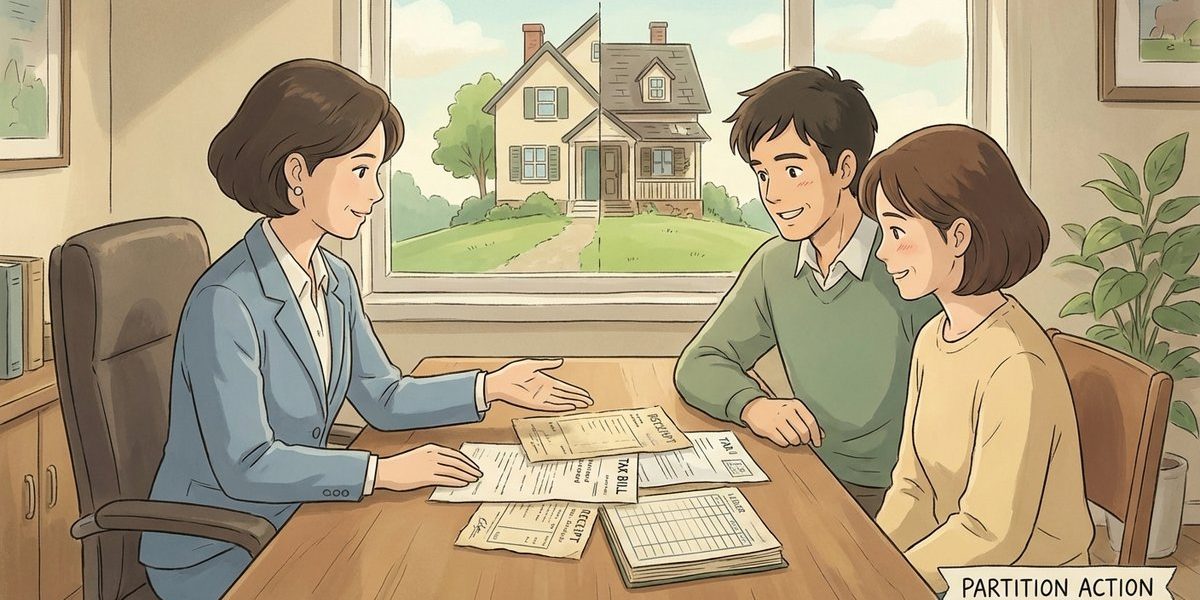
- Actual amounts paid: The claim generally needs a reliable way to show the actual dollars paid (for example, mortgage statements, tax bills, insurance declarations, invoices, canceled checks, or bank records).
- Timing and limits: The request must be raised during the partition proceeding, and some items have statutory limits (for example, property taxes are limited to amounts paid during the 10 years before the partition petition, plus interest at the legal rate).
What the Statutes Say
- N.C. Gen. Stat. § 46A-27 (Carrying costs; improvements; right to contribution) – Defines “carrying costs” and provides a right to contribution in a partition proceeding, with a 10-year limit for property tax contribution.
- N.C. Gen. Stat. § 41-86 (Reimbursement of a cotenant) – Addresses contribution for necessary repairs and reimbursement for taxes and certain encumbrance payments, with important limitations tied to exclusive possession.
- N.C. Gen. Stat. § 105-363 (Remedies of cotenants and joint owners of real property) – Provides remedies and lien rights when one cotenant pays more than their share of property taxes that are a lien on the property.
Analysis
Apply the Rule to the Facts: Here, the majority co-owner has been paying the mortgage and other carrying costs while the property is being sold through a partition matter. Those items commonly fall within “carrying costs” under North Carolina’s partition statute, but the statute is built around actual costs paid. If the other co-owner disputes the totals, the strongest way to support a credit is to tie each claimed category (mortgage, taxes, insurance, repairs) to statements, invoices, and proof of payment rather than a rounded estimate.
Process & Timing
- Who files: The co-owner seeking credit/contribution. Where: The partition case file (a special proceeding) handled through the Clerk of Superior Court in the county where the property is located. What: An application/motion in the partition proceeding requesting contribution/credits for carrying costs and repairs, supported by a summary and backup documentation. When: In a partition sale, the statute allows the request to be asserted at any time during the partition proceeding; waiting until late in the case can create avoidable disputes and delay distributions.
- Exchange and review: The parties typically exchange spreadsheets and supporting records (mortgage statements, tax bills, insurance bills, repair invoices, bank records). Disputed items often narrow to whether an item is a “repair” versus an “improvement,” whether it was necessary, and whether it was paid during a period that triggers an exclusive-possession limitation.
- Resolution: If the parties settle, they can agree to reasonable totals (including estimates) and build that agreement into a consent order or settlement paperwork. If the parties do not settle, the clerk or court may decide what credits apply and then adjust the distribution (or adjust shares/owelty in an actual partition) based on the proven amounts.
Exceptions & Pitfalls
- Estimates can settle a case, but they do not “prove” a claim: A negotiated number may be acceptable for settlement, but a contested hearing usually turns on what can be shown with reliable records.
- Repairs vs. improvements: North Carolina treats necessary repairs differently from improvements. Improvements are often limited to the lesser of cost or value added, which can require more than receipts (for example, evidence of value added as of the start of the proceeding).
- Exclusive possession issues: Some reimbursement rights can be limited when the paying cotenant had exclusive possession during the period of the expense. This can change how mortgage interest, repairs, or other items are treated, depending on the facts.
- Mixing personal expenses with property expenses: Utilities, personal labor, and “general upkeep” can be disputed if they are not clearly tied to preserving the property’s value and the cotenants’ interests. Clean categories and documentation reduce the fight.
- Late or incomplete accounting: Waiting until the end to assemble totals can lead to missing records, disagreements about time periods, and delays in distribution after a sale.
For more background on how credits and reimbursements can affect the final split in a partition sale, see how the equity is divided and when a co-owner can get credit for expenses paid.
Conclusion
North Carolina partition law allows a co-owner to seek contribution for “carrying costs” like mortgage payments, property taxes, insurance, and repairs, but the claim is strongest when supported by documents showing the actual amounts paid. Parties can agree to reasonable totals and estimates to settle, but a court-ordered credit usually depends on proof. A practical next step is to file an application in the partition proceeding and attach a clear spreadsheet supported by mortgage statements, tax bills, insurance records, and repair invoices.
Talk to a Partition Action Attorney
If a co-owner has been paying the mortgage, taxes, insurance, or repairs during a North Carolina partition case and a credit or reimbursement is being requested, our firm has experienced attorneys who can help organize the proof, frame the request, and evaluate settlement options. Call us today at (919) 341-7055.
Disclaimer: This article provides general information about North Carolina law based on the single question stated above. It is not legal advice for your specific situation and does not create an attorney-client relationship. Laws, procedures, and local practice can change and may vary by county. If you have a deadline, act promptly and speak with a licensed North Carolina attorney.

