
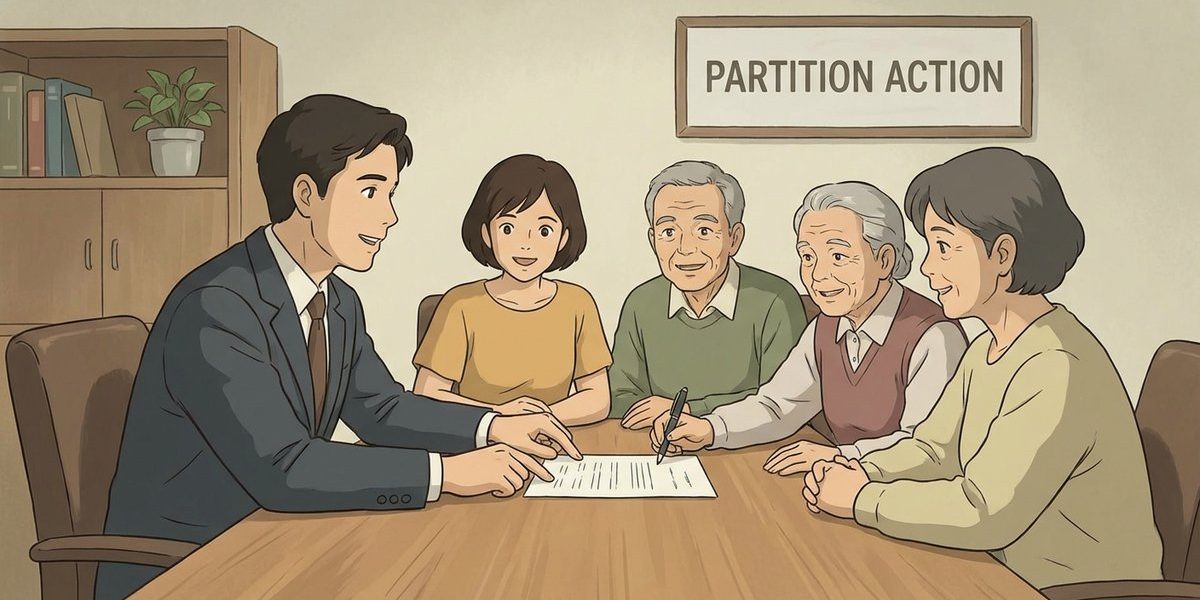
Can a partition case be avoided if the family reaches an agreement, and what should that agreement include? – NC
Short Answer
Yes. In North Carolina, a family can often avoid a partition case if all co-owners with an interest in the land reach a clear agreement and sign the documents needed to carry it out, usually a deed and any supporting settlement terms. The agreement should identify every owner, state exactly who keeps or gives up each ownership share, explain any payment terms, and address title, signatures, recording, and what happens if someone does not follow through.
Understanding the Problem
In North Carolina, the single issue is whether co-owners of family land can resolve a jointly owned property dispute by agreement instead of asking the clerk of superior court to divide or sell the property in a partition proceeding. The key point is whether every person whose ownership interest must change agrees to the same transfer terms and signs the papers needed to complete that transfer. If the family wants to keep the land in the family, the agreement must do more than express a general intent to cooperate.
Apply the Law
North Carolina partition matters are special proceedings, and the clerk of superior court handles them unless the case moves to a judge on a disputed issue. The law allows actual partition, a sale, or a mixed result, but a court-ordered sale is not automatic. A sale in lieu of partition requires proof by a preponderance of the evidence that dividing the property without a sale would cause substantial injury to a party, and the party asking for a sale has that burden. Because of that structure, families often avoid litigation by settling ownership privately before or during a case, including through mediation, and then signing and recording the documents that match the settlement.
Key Requirements
- All necessary owners must agree: A private deal works only if each co-owner whose interest is being transferred or released agrees to the same terms and signs the needed papers.
- The transfer terms must be definite: The agreement should state the property description, each person’s ownership share, who will own the land after the deal, and whether anyone will be paid for giving up a share.
- The agreement must be completed properly: The family should use a deed that is signed, acknowledged, and recorded, and should resolve title problems such as deceased owners, unknown heirs, or disputed shares before relying on the deal to stop a partition fight.
What the Statutes Say
- N.C. Gen. Stat. § 46A-1 (Partition is a special proceeding) – Partition cases begin as special proceedings under North Carolina procedure.
- N.C. Gen. Stat. § 46A-26 (Methods of partition) – The court may order actual partition, a partition sale, or a mixed approach depending on the circumstances.
- N.C. Gen. Stat. § 46A-29 (Mediation) – Interested parties may agree to mediation at any time, and the court may order mediation when a sale is requested.
- N.C. Gen. Stat. § 46A-75 (Sale in lieu of actual partition) – A sale requires proof by a preponderance of the evidence that actual partition cannot be made without substantial injury, and the party seeking sale must prove it.
- N.C. Gen. Stat. § 46A-52 (Unknown cotenants or disputed title) – Unknown owners or disputed shares can complicate the case and may be handled together until the dispute is resolved.
Analysis
Apply the Rule to the Facts: Here, the family is trying to keep long-held land in the family by getting extended relatives to sign a deed instead of filing or continuing a partition case. That can work if the relatives who actually hold record or inherited interests all agree on who will own the property after the transfer and sign documents that match that agreement. If even one necessary owner refuses, cannot be found, or has an unresolved title issue, the agreement may not fully prevent a partition proceeding.
The practical lesson is that a workable settlement needs both consensus and clean execution. In many family land disputes, the hardest part is not the idea of settlement but identifying every person who must sign, confirming each share, and dealing with owners who have died or whose interests are unclear. That is why a strong agreement usually includes a title review, a plan for probate or heirship issues if needed, and a recorded deed so the public record matches the family’s deal. Families dealing with title uncertainty may also need to address related ownership problems before relying on the deed alone, as discussed in clear ownership when multiple people are on the deed and some co-owners have passed away.
Process & Timing
- Who files: If there is no case yet, no one has to file a partition action if all needed co-owners can settle. If a case is already pending, a party can ask to pause the matter for settlement or mediation. Where: The clerk of superior court in the North Carolina county where the land lies handles the special proceeding. What: A written settlement agreement, a deed signed by the needed co-owners, and recording with the register of deeds; if a case exists, the parties may also file a dismissal or other closing papers. When: As early as possible, before a petition for partition is filed or before the court enters orders moving the case toward division or sale.
- Next, the family should confirm title, identify every owner, settle any buyout amount or reimbursement terms, and decide who pays recording costs, taxes, and any lien-related expenses. If there is disagreement but settlement still seems possible, mediation can occur during the proceeding.
- Final step and expected outcome/document: the deed is recorded in the county register of deeds, ownership changes appear in the land records, and any pending partition matter can be dismissed or closed if the agreement resolves the dispute completely. Families considering whether division is possible may also find it helpful to review how a family can legally divide a jointly owned property into separate parcels.
Exceptions & Pitfalls
- A family agreement may fail if one co-owner is missing, lacks authority to sign, disputes the ownership percentages, or if an estate issue leaves the true owners unresolved.
- A common mistake is using a vague promise to “keep the land in the family” without stating the legal description, exact grantees, ownership percentages, payment terms, and who signs on behalf of estates or other interest holders.
- Notice and title problems can derail settlement. If a partition case has already started, parties still need to track service, hearing dates, and any mediation or court deadlines while the settlement documents are being prepared. Families facing pressure to sell may also want to compare the settlement option with selling a property when multiple relatives are on the deed.
Conclusion
Yes, a partition case can often be avoided in North Carolina if all necessary co-owners reach a definite agreement and complete the transfer with a properly signed and recorded deed. The key threshold is full agreement by the owners whose interests must change, plus clear terms covering ownership shares, payment, title issues, and recording. The most important next step is to prepare and record the deed with the county register of deeds before the partition matter moves forward in the clerk’s office.
Talk to a Partition Action Attorney
If a family is dealing with a dispute over jointly owned land and wants to keep the property in the family instead of risking a court-ordered sale, our firm has experienced attorneys who can help explain the available options, documents, and timelines. Call us today at [919-341-7055].
Disclaimer: This article provides general information about North Carolina law based on the single question stated above. It is not legal advice for your specific situation and does not create an attorney-client relationship. Laws, procedures, and local practice can change and may vary by county. If you have a deadline, act promptly and speak with a licensed North Carolina attorney.

