
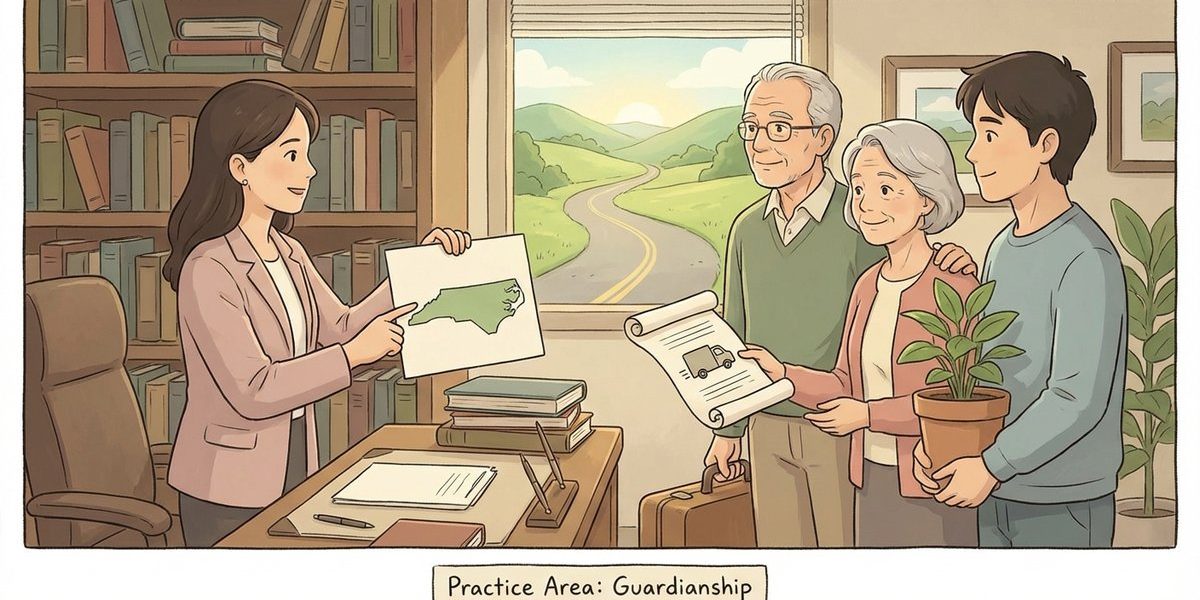
Can I start a temporary guardianship in the state where my adult child is located and then transfer it after I move them? – North Carolina
Short Answer
Sometimes, yes—but it depends on where the adult child is physically located when the emergency petition is filed and which state qualifies as the “home state” for a longer-term guardianship. Under North Carolina’s adult guardianship jurisdiction rules, North Carolina can appoint an emergency guardian for up to 90 days only if the respondent is physically present in North Carolina at the time of the emergency filing. If a longer-term guardianship is opened in North Carolina, North Carolina law also provides a formal process to transfer the guardianship to another state after a move, but the receiving state must accept the case.
Understanding the Problem
In North Carolina adult guardianship cases, the key decision is whether a court can start a short-term, emergency (temporary) guardianship in the state where an adult child is currently staying and then later move the case to a different state after a relocation. The question usually comes up when an adult child leaves a structured setting, loses stable housing, and needs immediate help with safe placement, medical decisions, or basic support while a longer-term plan is put in place. The issue turns on which state’s court has authority to act right now based on physical presence and which state should handle the longer-term guardianship once the adult child is moved.
Apply the Law
North Carolina follows a uniform set of rules for interstate adult guardianship jurisdiction and transfers. In general, a North Carolina clerk of superior court (estates division) handles incompetency and guardianship matters. North Carolina can act on an emergency basis in limited situations even when North Carolina is not the long-term “home state,” but North Carolina’s emergency authority is tied to the respondent being physically present in North Carolina. Separately, if a North Carolina guardianship is in place, North Carolina law allows a structured transfer to another state through provisional and final orders, with notice and (often) a hearing.
Key Requirements
- Physical presence for an NC emergency appointment: North Carolina can appoint an emergency guardian of the person only when the respondent is physically present in North Carolina at the time of the emergency petition.
- Emergency appointments are short and limited: An emergency guardian of the person in North Carolina is time-limited (up to 90 days) and is meant to stabilize an urgent situation, not replace a full guardianship case.
- Transfer requires acceptance by the other state: A North Carolina guardianship can be transferred to another state only through a court-to-court process where the receiving state issues an order accepting the case, followed by a North Carolina final order confirming the transfer.
What the Statutes Say
- N.C. Gen. Stat. § 35B-18 (Special jurisdiction) – Allows North Carolina to appoint an emergency guardian of the person for up to 90 days when the respondent is physically present in North Carolina.
- N.C. Gen. Stat. § 35B-30 (Transfer to another state) – Sets the process for transferring a North Carolina guardianship to another state through provisional and final orders, with notice and a hearing if requested.
- N.C. Gen. Stat. § 35B-23 (Proceedings in more than one state) – Addresses what happens when guardianship-related petitions are filed in multiple states and requires coordination between courts.
- N.C. Gen. Stat. § 35A-1205 (Transfer to different county) – Allows an existing North Carolina guardianship/incompetency matter to be transferred between North Carolina counties for good cause.
Analysis
Apply the Rule to the Facts: The adult child is currently staying in a hotel with limited support after leaving an assisted living facility. If the adult child is physically located outside North Carolina, a North Carolina clerk generally cannot start an emergency (temporary) guardianship under North Carolina’s emergency-jurisdiction statute, because that emergency authority depends on physical presence in North Carolina. If the adult child is moved into North Carolina first (and the situation is urgent), North Carolina may be able to appoint an emergency guardian for up to 90 days while longer-term jurisdiction and next steps are sorted out.
Process & Timing
- Who files: Typically a parent or other interested person. Where: In North Carolina, the clerk of superior court (estates division) in the proper county. What: A petition/application seeking an emergency guardian of the person (if the respondent is physically present in North Carolina) and/or a petition to transfer an existing North Carolina guardianship to another state (if a North Carolina guardianship already exists). When: Emergency filings are used when immediate action is needed; an emergency appointment in North Carolina is limited to no more than 90 days.
- Short-term stabilization: If North Carolina grants an emergency appointment, the order is designed to cover urgent personal decisions (such as safe placement and immediate care) while the parties determine which state should handle the longer-term guardianship and whether a full incompetency/guardianship case must be filed.
- Transfer after a move: If a North Carolina guardianship is in place and the plan is for the adult child to move permanently to another state, the guardian can petition the North Carolina court for a transfer. North Carolina can issue a provisional transfer order and direct the guardian to file in the receiving state; once the receiving state issues a provisional acceptance order, North Carolina can enter a final order confirming the transfer and terminating the North Carolina case.
Exceptions & Pitfalls
- Filing in the “wrong” state first: Starting a temporary guardianship in the state where the adult child is located may be possible under that state’s emergency rules, but it does not guarantee that North Carolina (or any other state) will later accept a transfer. Transfers are court-to-court and depend on the receiving state’s acceptance.
- Emergency jurisdiction is not a shortcut to permanent jurisdiction: Even when a state can act in an emergency, that does not automatically make it the best or proper forum for a long-term guardianship. Courts can require coordination when more than one state is involved.
- Moving the adult child before authority is clear: Relocating an adult who may lack capacity can raise practical and legal problems (consent, safety planning, medical access, and potential objections). A plan that documents why the move is necessary and what care/services will be in place can matter during a transfer request.
- Notice and objections: North Carolina’s transfer statute requires notice to the people who would be entitled to notice in an incompetency/guardianship case, and objections can affect timing and outcomes.
For more on the interstate transfer process, see how to transfer an existing out-of-state guardianship and what paperwork and court steps are usually required.
Conclusion
Starting a temporary guardianship in the state where an adult child is currently located can be possible, but North Carolina can only issue an emergency guardianship order when the respondent is physically present in North Carolina, and that emergency authority is limited to 90 days. If a North Carolina guardianship is opened and the adult child is expected to move permanently, North Carolina law allows a transfer to another state through provisional orders and acceptance by the receiving court. The next step is to file the appropriate emergency or transfer petition with the clerk of superior court in the correct forum as soon as the relocation plan is clear.
Talk to a Guardianship Attorney
If you’re dealing with an adult child who is without stable housing and immediate decisions need to be made, our firm has experienced attorneys who can help explain which state can act now and how a transfer may work after a move. Call us today at (919) 341-7055.
Disclaimer: This article provides general information about North Carolina law based on the single question stated above. It is not legal advice for your specific situation and does not create an attorney-client relationship. Laws, procedures, and local practice can change and may vary by county. If you have a deadline, act promptly and speak with a licensed North Carolina attorney.

