
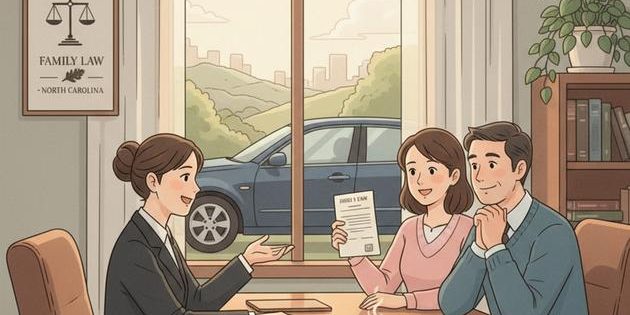
How do I get back a car that’s titled only in my name if my spouse refuses to return it? – North Carolina
Short Answer
Under North Carolina law, a vehicle titled only in one spouse’s name is not necessarily that spouse’s separate property, but possession during separation can still be disputed. The titled owner can first try to resolve it informally or through a separation agreement, and if that fails, may ask the district court for relief—either through a motion for return of separate property within an equitable distribution case or through a civil action to recover the vehicle. The court can order the non‑owner spouse to return the car and may award limited attorney’s fees tied to the car’s value.
Understanding the Problem
The narrow question here is: under North Carolina family law, how can a spouse regain possession of a car that is titled only in that spouse’s name when the other spouse refuses to return it during separation or divorce? This focuses on ownership versus possession, and how courts handle separate property when spouses are splitting up. Common concerns include whether taking back the vehicle could be treated as abandonment, how the car fits into equitable distribution, and what specific legal tools a court can use to order the vehicle returned.
Apply the Law
North Carolina law distinguishes between who owns property and who physically possesses it, especially in a separation. A car titled in one spouse’s sole name is not necessarily that spouse’s separate property; classification depends on when and how it was acquired, although title is relevant evidence of ownership. When the non‑owner spouse is holding that car and will not return it, North Carolina law provides both a specific motion within an equitable distribution case and a separate civil action to recover possession of separate personal property.
Key Requirements
- Separate ownership: The vehicle must qualify as the titled spouse’s “separate property,” or at least be treated that way for purposes of a return order, even if the car will later be valued and considered in equitable distribution.
- Removal or retention by the non‑owner spouse: The other spouse must have taken the vehicle from the owner’s possession or be refusing to surrender it, creating a dispute over possession.
- Proper court filing and procedure: The titled spouse must file the correct request in district court—either a motion for return of separate property inside an equitable distribution case or a separate civil action (often with a claim and delivery request) to recover the car.
What the Statutes Say
- N.C. Gen. Stat. § 52-1 (Property of married persons secured) – States that a married person’s real and personal property remains that person’s sole and separate estate, subject to equitable distribution rules.
- N.C. Gen. Stat. § 50-20 (Equitable distribution) – Defines “marital” and “separate” property and, in subsection (i), allows a party to seek relief when a spouse removes or holds separate property and authorizes limited fee awards to regain possession.
- N.C. Gen. Stat. § 20-77 (Transfer by operation of law) – Governs retitling vehicles when ownership changes by law (not the main remedy here, but relevant to title issues).
Analysis
Apply the Rule to the Facts: In the described situation, the car is titled only in one spouse’s name, which supports that spouse’s ownership claim for possession purposes, but does not by itself make the car separate property if it was purchased during the marriage. The other spouse’s refusal to return it creates a clear possession dispute. Under North Carolina law, the titled spouse can raise equitable distribution in district court and file a motion for return of separate property, asking the court to order the car returned if the vehicle is in fact separate property. If an equitable distribution case is not yet filed or if broader relief is needed, that spouse could also consider a civil action to recover personal property with a claim and delivery request to regain the vehicle sooner.
Process & Timing
- Who files: The titled owner spouse. Where: In the North Carolina District Court in the county with proper venue (commonly where either spouse resides). What: A complaint that includes an equitable distribution claim plus a motion for return of separate property, or a separate civil complaint for recovery of personal property with an ancillary claim and delivery request. When: Typically soon after separation, and no later than the time equitable distribution claims must be asserted in the divorce case.
- The court schedules a hearing on the motion or claim. Timeframes vary by county and docket load, but interim hearings on possession can often be set sooner than a full equitable distribution trial. At the hearing, the titled spouse presents the title, evidence of separate ownership, and proof that the other spouse is holding the car and refusing to return it.
- The court may enter an order requiring the non‑owner spouse to return the vehicle by a set date, possibly addressing temporary use or insurance responsibilities. In an equitable distribution case, the court may also award reasonable attorney’s fees and costs limited to the fair market value of the car at the time it was taken, and will later classify and value the car for the overall property division.
Exceptions & Pitfalls
- If the vehicle is not truly separate property—because it was effectively gifted to the other spouse or retitled—classification and the remedy can change, and the court may handle it as marital property instead of ordering an immediate return.
- Failing to file an equitable distribution claim before entry of the divorce judgment can waive the right to have the court divide property and to use the specific motion for return of separate property within that framework.
- Service and notice problems can delay or undermine relief; proper service of the complaint and any claim and delivery paperwork on the spouse in possession is required.
- Using self‑help (for example, taking the car back without warning) can trigger safety concerns, domestic complaints, or protective order issues; courts generally prefer that possession disputes be resolved through formal orders.
- If claim and delivery is used, failing to follow the statutory bond and affidavit requirements can result in denial of immediate possession even if the titled spouse ultimately wins.
Conclusion
Under North Carolina law, a car titled only in one spouse’s name is not automatically that spouse’s separate property, but courts still control how and when it is physically returned when the other spouse refuses to give it back. The titled spouse can seek relief in district court through an equitable distribution case with a motion for return of separate property, or through a civil action to recover personal property, and may obtain an order compelling the car’s return if the vehicle is separate property or if the titled spouse otherwise proves the superior right to possession. The next step is to file the appropriate claim and motion in district court before the divorce becomes final.
Talk to a Family Law Attorney
If a spouse is refusing to return a vehicle that is titled only in one name during a North Carolina separation or divorce, our firm has experienced family law attorneys who can help explain options, timing, and the best strategy to regain possession. Call us today at (919) 341-7055.
Disclaimer: This article provides general information about North Carolina law based on the single question stated above. It is not legal advice for any specific situation and does not create an attorney-client relationship. Laws, procedures, and local practice can change and may vary by county. If there is a deadline, act promptly and speak with a licensed North Carolina attorney.

