
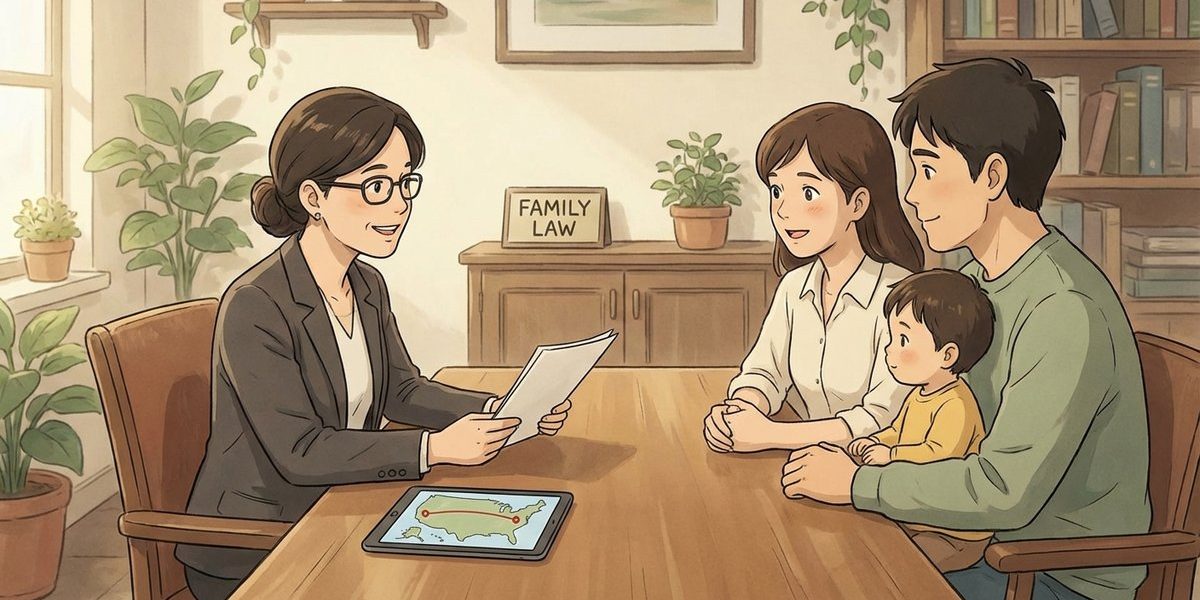
Can a family law attorney handle my case if they are located far from where I live? – North Carolina
Short Answer
Yes—under North Carolina law, a family law attorney can often handle a case even if the attorney’s office is far away, as long as the case is filed in the correct county and the attorney is licensed in North Carolina. The practical question is whether the case will require in-person court appearances, local filing practices, or frequent meetings that make distance inefficient. For many matters, much of the work can be done remotely, but venue rules still control where the case must be filed.
Understanding the Problem
In North Carolina family law, the key question is not where the attorney’s office is located, but where the case must be filed and heard. Can a North Carolina family law attorney represent a person in a divorce, custody, or support case when the person lives far away from the attorney’s office? The decision point is whether the case will be handled in a county and court that makes a long-distance attorney practical, given the likely need for court dates, filings, and local procedures in the District Court.
Apply the Law
North Carolina family law cases are generally handled in District Court, and venue rules determine which county is proper for filing. An attorney’s physical location does not change those venue rules. A case can be filed in a county allowed by statute, and the attorney can appear in that county’s District Court, but distance can affect cost, scheduling, and strategy—especially if the case is contested and requires multiple court appearances or live testimony.
Key Requirements
- Proper court division: Most divorce, custody, child support, alimony, and equitable distribution matters are heard in North Carolina District Court (not Small Claims or Superior Court in the ordinary course).
- Proper county (venue): The case must be filed in a county permitted by the venue statute for that type of family law claim (for example, divorce venue differs from custody/support venue).
- Practical ability to litigate at a distance: Even when venue is proper, the case may still require in-person hearings, local filing preferences, and witness logistics that make a far-away attorney less efficient.
What the Statutes Say
- N.C. Gen. Stat. § 7A-244 (Domestic relations in District Court) – Establishes District Court as the proper division for divorce, custody, child support, alimony, and equitable distribution matters.
- N.C. Gen. Stat. § 50-3 (Divorce venue) – Provides that divorce proceedings are generally filed in the county where either spouse resides (with additional rules that can affect removal/transfer in certain situations).
- N.C. Gen. Stat. § 50-13.5(f) (Venue for child custody and child support) – Allows custody/support actions in the county where the child resides or is physically present, or where a parent resides, with special rules when another Chapter 50 case is already pending.
Analysis
Apply the Rule to the Facts: The situation described involves a caller in North Carolina who reached the wrong office and wants guidance on finding a nearby family law practice. Under North Carolina law, the attorney’s office location does not control whether representation is legally possible; the controlling issue is where the case must be filed (venue) and whether the attorney can efficiently handle hearings and local procedures in that county. If the matter is a divorce, venue often ties to where either spouse resides; if it is custody/support, venue often ties to where the child or a parent resides (or where a related case is already pending).
Process & Timing
- Who files: The spouse or parent (or another proper party in a custody/support case). Where: North Carolina District Court in the proper county under the venue statute for the claim. What: A complaint (or, in some situations, a motion in an existing case). When: Timing depends on the type of case and whether there is already a pending Chapter 50 case; venue objections also need to be raised early in the case if a party believes the case was filed in the wrong county.
- Early case steps: Service of process, initial filings, and scheduling of any temporary hearings. Many conferences and document exchanges can often be handled remotely, but hearings may be in person depending on the county and the judge’s practices.
- Resolution: The court enters orders (for custody/support) or a judgment (for divorce), and any enforcement or modification typically stays in the same court file unless a statute allows transfer.
Exceptions & Pitfalls
- Wrong-county filings can become “stuck”: Venue problems are often fixable by a timely request to move the case, but a late challenge can be treated as waived, meaning the case proceeds where it was filed.
- Existing cases can control where new issues must be raised: If there is already a pending divorce or related Chapter 50 case, custody/support issues may need to be joined in that case rather than filed somewhere else.
- Distance can increase friction in contested cases: Even when representation is allowed, repeated in-person hearings, local scheduling practices, and witness convenience can make a far-away attorney less practical than a nearby one.
Conclusion
In North Carolina, a family law attorney can often handle a case even if the attorney’s office is far away, because the controlling issue is proper venue and the District Court where the case must be filed and heard. Divorce venue is generally tied to where either spouse resides, and custody/support venue is often tied to where the child or a parent resides (or where a related case is already pending). The next step is to confirm the correct county for filing and then retain counsel who can appear in that county’s District Court.
Talk to a Family Law Attorney
If confusing online listings led to the wrong office and the goal is finding a nearby North Carolina family law practice, our firm has experienced attorneys who can help explain venue, court location, and practical next steps for getting the case filed in the right county. Call us today at [919-341-7055].
Disclaimer: This article provides general information about North Carolina law based on the single question stated above. It is not legal advice for your specific situation and does not create an attorney-client relationship. Laws, procedures, and local practice can change and may vary by county. If you have a deadline, act promptly and speak with a licensed North Carolina attorney.

