
North Carolina Estate Planning Lawyer Guide to the New Electronically Stored Will
Short answer: A North Carolina estate planning lawyer can now help you keep a traditional written will in a secure electronic format, so it can be offered for probate later even if the original paper document is lost.
If you want your wishes to be clear and enforceable under the new law, now is a good time to review your documents. Contact Pierce Law Group today by emailing intake@piercelaw.com or calling (919) 341-7055 to speak with an experienced North Carolina estate planning lawyer about your will.
Big Change in North Carolina: A New Way to Store Wills
North Carolina has authorized a new way to protect wills from being lost or destroyed.
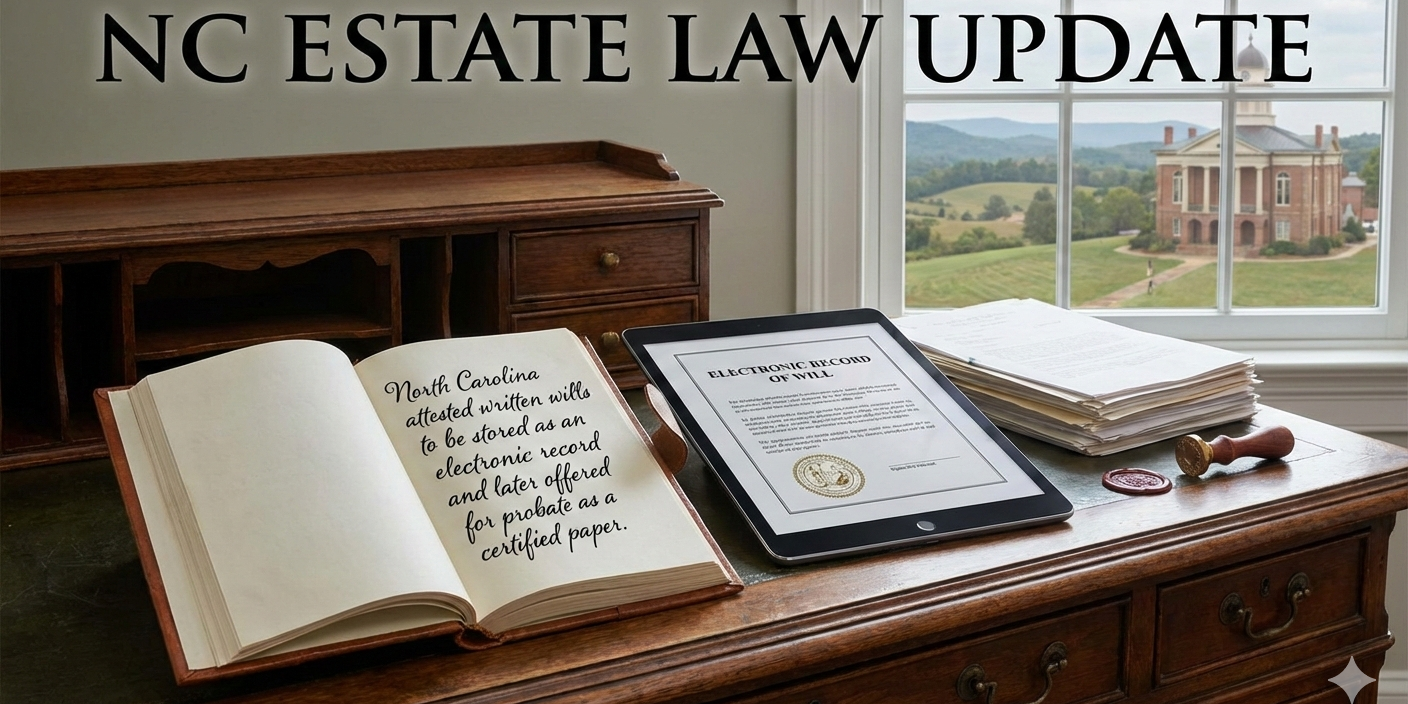
Starting January 1, 2026, an attested written will can be stored as an electronic record and later offered for probate as a certified paper copy.
This new option comes from a change to Chapter 31 of the North Carolina General Statutes and adds an entire Article that focuses on electronically stored wills.
In practical terms, this means that instead of relying only on a single paper original, you can choose to have your attorney create an electronic record of your attested written will.
That record can later be “papered out” into a certified paper copy that the court can accept when it is time to administer your estate.
Because this new law changes how revocation and probate can work, it is wise to talk with a North Carolina estate planning lawyer who understands both traditional wills and this new electronic storage system.
Pierce Law Group can walk you through how this law fits into your overall plan.
To schedule a consultation, email intake@piercelaw.com or call
(919) 341-7055.
What Is an Attested Written Will in North Carolina?
North Carolina recognizes two main types of written wills: attested written wills and holographic (handwritten) wills.
The new electronic storage law applies only to attested written wills, so it helps to understand what that means.
An attested written will can be typed or handwritten, but it must follow specific rules:
- The person making the will (the testator) must sign the document.
- At least two competent witnesses must sign the will.
- The testator must intend to sign the will and either sign personally or direct someone else to sign in the testator’s presence.
- The testator must clearly indicate to the witnesses that the document is the testator’s will, either by signing in front of them or acknowledging an earlier signature.
- The witnesses must sign in the presence of the testator, but they do not have to sign in front of each other.
These formal steps may feel strict, but they exist for a reason: they make it easier to prove the will is genuine after the testator dies.
Sometimes an attested written will also includes a self-proving affidavit.
That affidavit can simplify the probate process because it helps show that the will was properly signed and witnessed.
A North Carolina estate planning lawyer can draft an attested written will that meets these formal requirements while still using plain language that reflects your wishes.
The same lawyer can also help decide whether an electronically stored version of that will is a good fit for you.
The Real-World Problem: Lost Wills and Family Stress
In many families, the greatest threat to a carefully planned will is not a dispute about the wording.
It is the simple fact that paper can be lost, misplaced, or destroyed.
People move, downsize, or experience natural disasters.
Over time, the original will might end up in a box, a drawer, or a storage unit that no one can find.
Under long-standing North Carolina law, when a will was last known to be in the testator’s possession but cannot be found after death, a presumption could arise that the testator intended to revoke it.
In other words, the missing document might be treated as if it had been intentionally destroyed, even when that is not what happened.
Sometimes a photocopy exists, or a description of the will can be provided.
In those situations, it may be possible to pursue probate of a “lost will.”
But the process can become more complex and require additional proof.
That may also increase stress on family members at a difficult time.
This is the gap that the new electronically stored will is designed to fill.
By allowing a secure electronic record of the attested written will, the law gives your North Carolina estate planning lawyer another tool to protect your wishes from the risk of a missing paper original.
If you already have a will, a lawyer at Pierce Law Group can help you decide whether it makes sense to create an electronic record under the new statute.
Reach out at intake@piercelaw.com or call
(919) 341-7055 to review your current documents.
What Is an Electronically Stored Will?
The new law introduces the concept of an attested written will that is stored as an electronic record.
This does not replace the traditional paper will.
Instead, it creates a legally recognized electronic version that can later be converted back into a certified paper copy for probate.
The statute defines “electronic” broadly.
It includes technology with digital, magnetic, wireless, optical, or similar capabilities.
An electronic record is information stored in an electronic or other medium that can be retrieved in a form people can read.
In everyday terms, this could be a PDF, a scanned image, or another digital file type that shows the full content of the signed attested written will.
Importantly, this electronic record is not a standalone “electronic will” created and executed entirely online.
North Carolina still does not have a law that allows you to make a will from start to finish in purely electronic form.
Instead, the electronically stored will starts as a traditional, paper, attested written will that you sign with witnesses.
Only then can an electronic record of that paper document be created under the new rules.
How a North Carolina Estate Planning Lawyer Creates an Electronically Stored Will
Under the new law, only an attorney licensed in North Carolina can create an electronically stored will.
The process revolves around both your decisions and specific steps your lawyer must take.
Step 1: You Execute a Traditional Attested Written Will
First, you and your North Carolina estate planning lawyer work together to draft a will that reflects your wishes.
You sign it with the required witnesses.
This document must meet the formal requirements for an attested written will under North Carolina law.
Step 2: Your Attorney Creates the Electronic Record
At your direction, your attorney then creates an electronic record of that attested written will.
The record must be a complete, true, and accurate copy of the original.
For example, your lawyer may scan the signed will and save it as a secure digital file.
Your attorney must then add a sworn statement (an affidavit) to that electronic record.
In this affidavit, the attorney confirms three key points:
- The electronic record is a complete, true, and accurate copy of your attested written will.
- You gave clear permission to create the electronic record of your will.
- You were advised that creating this electronic record removes your ability to revoke the will by physically destroying the paper original.
That last point is crucial.
Before the new law, destroying the original paper will with the intent to revoke it could serve as a valid revocation.
Once your attested written will is stored electronically under Article 11, simply tearing up the paper copy no longer revokes it.
You must use another valid method of revocation.
A North Carolina estate planning lawyer must explain this consequence to you before creating the electronic record.
This conversation helps you make an informed choice about whether electronic storage is appropriate for your situation.
Step 3: Converting the Electronic Record into a Certified Paper Copy
At some point in the future, the electronic record may need to be offered for probate.
To do that, an attorney licensed in North Carolina must create what the law calls a “certified paper copy of an attested written will stored as an electronic record.”
The attorney follows these steps:
- Prints a paper copy of the electronic record, including the earlier attorney affidavit.
- Adds a new sworn statement that the printed document is a complete, true, and accurate copy of the electronically stored will.
- Attaches this new certification to the printed copy.
The result is a certified paper copy that can be presented to the court in probate.
It may include multiple affidavits: one from the original self-proving will (if used), one from the attorney who created the electronic record, and one from the attorney who certified the paper copy.
Because this process involves several legal steps and sworn statements, it is important to work with a North Carolina estate planning lawyer who is comfortable with the new statute and can keep accurate records over time.
Will the New Law Cover Older Wills Too?
Yes.
The new statute applies to any attested written will, even if you signed it before the law took effect.
For example, if you signed a valid attested written will in 2018 and kept the original, you may choose on or after the effective date to have an attorney create an electronic record of that existing will.
You can also use the new process for a will you sign after the law comes into force.
In that case, you might sign the attested written will and then immediately direct your North Carolina estate planning lawyer to create an electronically stored version.
There is no requirement that the electronic record be created right away.
It just has to be created during your lifetime and at your direction.
That flexibility allows you and your attorney to decide when electronic storage makes the most sense.
If you have an older will and want to know whether it can be safely converted to an electronically stored will, contact Pierce Law Group.
A North Carolina estate planning lawyer can review your current documents and recommend a plan.
Email intake@piercelaw.com or call
(919) 341-7055 to get started.
Probating an Electronically Stored Will in North Carolina
When someone passes away, their will must be admitted to probate before the estate can be administered.
The new statute allows either the original paper attested written will or a certified paper copy of an electronically stored will to be offered for probate.
For a traditional paper attested written will, North Carolina law describes several ways to prove that the will is valid.
These methods may involve testimony from witnesses, proof of handwriting in certain situations, or reliance on a self-proving affidavit.
For a certified paper copy of an electronically stored will, the probate process looks very similar.
The statute adds a new subsection that explains how the certified paper copy can be proved.
The main difference is that, when only one witness or no witnesses are available, the focus shifts away from handwriting and toward other circumstances that satisfy the clerk of superior court that the will is genuine and properly executed.
Because the certified paper copy carries multiple layers of sworn statements from attorneys, it can provide strong evidence of authenticity.
But every estate is unique, and the details of probate can vary.
A North Carolina estate planning lawyer can guide your family through the process and work with the clerk’s office to present the right proof.
How the New Law Changes Revocation by Physical Act
Before the new statute, one way to revoke a written will in North Carolina was to physically destroy it with the intent to revoke.
Tearing, burning, or otherwise destroying the original document could serve as a valid revocation if done with the proper intent and under the right conditions.
The new law keeps that general rule but adds an important exception for electronically stored wills.
Once your attested written will is stored as an electronic record under Article 11, the presumption that a missing will was revoked no longer applies to that will.
If you later tear up or misplace the paper original, that act does not revoke the will that has been stored electronically.
This protection is one of the reasons your attorney must warn you that you cannot revoke the will by physical act after it has been stored electronically.
If you decide you no longer want the will to control your estate, you will need to revoke it by another legally recognized method, such as executing a new will that clearly revokes the old one or signing a proper written revocation.
A North Carolina estate planning lawyer can help you understand how these revocation rules apply to your situation and can design a strategy that fits your long-term goals.
Benefits of an Electronically Stored Will for North Carolina Families
The new electronically stored will is not right for everyone, but it offers several potential benefits when used carefully with legal guidance.
Reduced Risk of Lost or Misplaced Wills
When your attested written will exists both as a paper original and as an electronic record, there is less chance that all evidence of it will disappear.
Even if the original paper is lost in a move or destroyed in a disaster, the electronic record can be used to create a certified paper copy for probate.
Clear Proof of Authenticity
The electronic record includes sworn statements from a North Carolina attorney that it is a complete and accurate copy of your attested written will.
When a certified paper copy is created, another sworn statement confirms that the printed document matches the electronic record.
These layers of proof can help support the will’s validity if questions arise in probate.
Flexibility for Existing and Future Wills
You do not need to draft an entirely new will to use electronic storage.
As long as your current will is an attested written will, you can direct a North Carolina estate planning lawyer to store it electronically, even if you signed it years ago.
You can also choose to create an electronic record at the same time you sign a new will.
Support for Long-Term Planning
Many people keep their wills for many years without changing them.
Over that time, paper is vulnerable to loss and damage.
Electronic storage, when done under the statute’s safeguards, can support long-term stability and reduce worry about whether your will can be located when it is needed.
To learn whether these benefits fit your goals, you can consult a North Carolina estate planning lawyer at Pierce Law Group.
Email intake@piercelaw.com or call
(919) 341-7055 to discuss your options.
Important Limits of Electronically Stored Wills
While the new law provides helpful tools, it also has clear limits that you should understand before deciding to store your will electronically.
- The law applies only to attested written wills, not holographic (fully handwritten) wills.
- Only an attorney licensed in North Carolina may create the electronic record and the later certified paper copy.
- Once your will is stored electronically, you cannot revoke it by physically destroying the paper original.
- An electronically stored will is not the same as a fully electronic will created and signed online; North Carolina still requires a paper attested written will as the starting point.
These limits mean that electronic storage is not a casual scan you make at home.
It is a formal legal process, with sworn statements and statutory requirements.
A North Carolina estate planning lawyer must guide each step, from your decision to proceed through the creation of the electronic record and any future certified paper copy.
How a North Carolina Estate Planning Lawyer Uses This Law in Your Plan
Estate planning is more than filling out forms.
It involves careful decisions about your assets, your family, and the future.
The new electronically stored will law becomes one more tool your lawyer can use to support those decisions.
A North Carolina estate planning lawyer can help you:
- Review your existing will to determine whether it qualifies as an attested written will.
- Discuss the pros and cons of electronic storage in light of your goals and family situation.
- Explain how revocation works once a will is stored electronically and help you avoid unwanted results.
- Coordinate your will with other planning documents, such as trusts, powers of attorney, and health care directives.
- Keep records of the electronic storage process and any future certified paper copies.
Because the new statute interacts with existing probate rules, you benefit from working with a firm that handles estate planning and estate administration on a regular basis.
Pierce Law Group has attorneys with the knowledge and experience to guide you through these choices in a clear and practical way.
If you want to update your documents or explore electronic storage, reach out to a North Carolina estate planning lawyer at Pierce Law Group today.
Email intake@piercelaw.com or call
(919) 341-7055.
Frequently Asked Questions About Electronically Stored Wills in North Carolina
Is an electronically stored will the same as doing my will online?
No.
An electronically stored will in North Carolina begins as a traditional paper attested written will that you sign in front of witnesses.
Only after that signing can an attorney create an electronic record under the statute.
A fully online “electronic will,” where everything happens in digital form from start to finish, is not currently authorized by North Carolina law.
Can my old will from years ago become an electronically stored will?
Yes, as long as your old will is a valid attested written will.
On or after the effective date of the new law, you can direct a North Carolina estate planning lawyer to create an electronic record of that will and follow the required steps.
The key is that you are still living and able to give that instruction.
What happens if the original paper will is lost after it is stored electronically?
Once your attested written will is stored as an electronic record under Article 11, the presumption that a missing will was revoked no longer applies to that will.
Even if the paper original cannot be found, a North Carolina estate planning lawyer can use the electronic record to create a certified paper copy that may be offered for probate.
Does electronic storage affect my other estate planning documents?
The new law focuses on attested written wills.
It does not automatically change how other documents, such as powers of attorney or health care directives, are handled.
However, a North Carolina estate planning lawyer may recommend reviewing those documents at the same time to ensure everything works together.
Do I have to store my will electronically?
No.
Electronic storage is an option, not a requirement.
You can keep using a traditional paper attested written will without creating an electronic record.
A North Carolina estate planning lawyer can help you weigh the benefits and limits of electronic storage based on your comfort level and goals.
Planning Your Next Step With a North Carolina Estate Planning Lawyer
The new electronically stored will law in North Carolina offers a valuable opportunity to strengthen your estate plan.
It gives you a way to protect your attested written will from being lost or destroyed while preserving the formal safeguards that make probate smoother for your loved ones.
By working with a North Carolina estate planning lawyer, you can:
- Confirm that your current will is valid and up to date.
- Decide whether electronic storage is appropriate for your situation.
- Understand how revocation and probate will work under the new statute.
- Coordinate your will with your broader estate planning strategy.
Pierce Law Group stands ready to help you take advantage of these developments in a thoughtful and practical way.
The firm’s attorneys handle estate planning and estate administration for individuals and families throughout North Carolina.
They can explain your options in clear terms and design a plan that reflects your wishes.
Take action today.
Your will should do more than exist on paper; it should be secure, clear, and ready to be enforced when it matters most.
To discuss how the new electronically stored will law affects you, contact Pierce Law Group by emailing
intake@piercelaw.com or calling
(919) 341-7055 to speak with a North Carolina estate planning lawyer about your next steps.

