
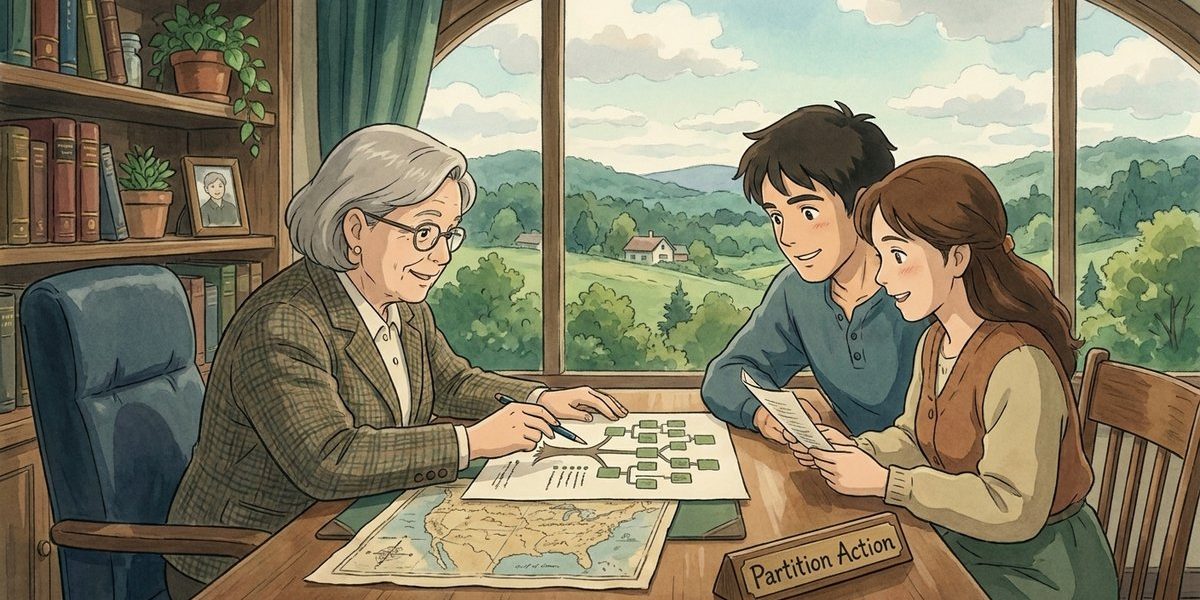
What happens to a deceased grandparent’s share of property if there was no will and some of the heirs have also passed away? – NC
Short Answer
In North Carolina, a deceased grandparent’s share does not automatically go to the family member who is living on the property. If there was no will, that share passes under North Carolina intestacy law to the grandparent’s heirs, and if one of those heirs already died, that heir’s share usually passes down that heir’s own line or estate. Before anyone can confirm current ownership or force a sale or division, the family usually needs to trace the chain of heirs, confirm whether the home and land are titled separately, and decide whether an estate, title-clearing step, or partition case is needed.
Understanding the Problem
In North Carolina, the question is whether a deceased grandparent’s ownership share in family property passes only to one child who remains in possession, or instead passes to the grandparent’s legal heirs when there was no will and some heirs later died. In a partition action setting, the key issue is identifying who now owns the deceased grandparent’s share before the property can be divided, sold, or retitled. If title still shows older owners and later deaths were never addressed, the ownership picture may be incomplete even though the family has continued using the property.
Apply the Law
Under North Carolina law, property owned by a person who dies without a will passes by intestate succession. The first step is to determine whether the deceased grandparent left a surviving spouse, children, or descendants of deceased children, because those relationships control who inherits. If an heir died before the grandparent, that heir’s descendants may take that branch’s share by representation; if an heir survived the grandparent but later died, that heir’s vested share usually becomes part of that heir’s own estate. For real property held with others as tenants in common, the deceased owner’s fractional interest remains a separate share that can later be the subject of a title action or partition proceeding in superior court. Probate and estate administration issues are handled through the clerk of superior court, while partition of real property is filed in superior court in the county where the land lies.
Key Requirements
- Identify the deceased owner’s exact share: The deed must be reviewed to confirm whether the grandparent owned an undivided tenant-in-common interest and whether other named owners are still living or also deceased.
- Trace the heirs in order: North Carolina intestacy rules follow family lines. A deceased child’s branch does not disappear just because that child died; descendants may step into that branch, or the share may pass through that heir’s own estate if the heir outlived the grandparent.
- Match the process to the asset: Land, a manufactured home, and other property may not be titled the same way. The land may require heirship and partition analysis, while a manufactured home may require a separate title review if it was not legally converted into part of the real property.
What the Statutes Say
- N.C. Gen. Stat. § 29-13 (Descent and distribution upon intestacy) – Property of a person who dies without a will passes under North Carolina intestacy law.
- N.C. Gen. Stat. § 29-14 (Share of surviving spouse) – A surviving spouse may take all or part of the intestate estate depending on whether the decedent left descendants or parents.
- N.C. Gen. Stat. § 29-15 (Shares of others than surviving spouse) – If there is no surviving spouse share controlling the whole estate, children, descendants of deceased children, parents, siblings, and more remote kin inherit in statutory order.
- N.C. Gen. Stat. § 29-16 (Distribution among classes) – Descendants of a deceased child generally take that family branch’s share by representation.
- N.C. Gen. Stat. § 46A-21 (Petition by cotenant; necessary parties) – A tenant in common may file a partition case, and all cotenants must be joined and served.
- N.C. Gen. Stat. § 46A-52 (Partition where cotenants unknown or title disputed) – A partition case can still move forward even when some cotenants are unknown or ownership shares are disputed.
- N.C. Gen. Stat. § 46A-75 (Sale in lieu of actual partition) – The court may order a sale only if dividing the property in kind would cause substantial injury.
- N.C. Gen. Stat. § 7A-241 (Probate and estate administration jurisdiction) – Probate and estate administration are handled through the superior court division and clerk of superior court.
Analysis
Apply the Rule to the Facts: Here, title appears to show a deceased grandparent and two other relatives as tenants in common, so the grandparent’s share likely remained a separate fractional interest rather than passing automatically to the relative living there. If the grandparent died without a will, North Carolina intestacy law controls who inherited that share, and the answer depends on whether the grandparent left a surviving spouse, living children, or descendants of children who had already died. If some heirs later passed away, their interests may now belong to their own estates or descendants, which means the current ownership list may be larger than the family first assumed.
The uncertainty about the manufactured home matters because the land and home may not follow the same title path. If the manufactured home still has its own title, ownership of the home may need to be traced separately from ownership of the land. That can affect who must be included in any settlement, title-clearing effort, or partition case.
The fact that one child lives on the property does not by itself give that person the entire ownership interest. Possession and inheritance are different issues. Unless there was a valid deed, survivorship feature, or another legal transfer, the living occupant usually owns only the share that can be proven through the deed and the intestate succession chain.
If the family cannot agree on ownership or what to do next, a partition case may still be available even before every internal heirship dispute is fully resolved. North Carolina’s partition statutes allow the court to proceed when some cotenants are unknown or when multiple people claim the same undivided interest, but all known interested parties still need to be identified and served as carefully as possible.
Process & Timing
- Who files: an heir, cotenant, or in some situations a personal representative. Where: the clerk of superior court for estate administration issues, and superior court in the North Carolina county where the land is located for partition. What: first gather the recorded deed, death certificates, any estate file numbers, and title records for any manufactured home; then file the needed estate or partition pleadings. When: there is often no single short deadline to determine heirs, but action should be taken promptly before more heirs die, records go missing, or a sale becomes harder to complete.
- Next, trace each deceased owner’s line of succession in order. That usually means confirming who survived whom, whether any estates were opened, and whether each deceased heir left descendants. If the home may have separate title, that title should be checked at the same time rather than assuming it follows the land.
- Final step: once the ownership picture is clear enough, the family can pursue a deed solution, an estate-based title correction, or a partition action seeking either actual division or sale. The result is usually a court order, deed, or sale process that identifies each party’s share more clearly than the old record title did.
Exceptions & Pitfalls
- A surviving spouse’s share can change the ownership calculation, so the family should not assume the property passed only through the children.
- A later-deceased heir may have received a vested share that now belongs to that heir’s own estate, not automatically to that heir’s siblings.
- The manufactured home may have separate title from the land, and treating both as one asset can create mistakes in notice, ownership analysis, and settlement.
- Families often overlook unknown heirs, descendants of deceased children, or heirs who live out of state. Missing parties can delay title work and partition.
- Living on the property, paying taxes, or maintaining the home does not automatically erase the ownership rights of other heirs.
Conclusion
In North Carolina, a deceased grandparent’s share of property does not pass only to the family member in possession just because there was no will. That share usually passes under intestacy law to the grandparent’s heirs, and if an heir also died, that branch’s interest may pass to descendants or through that heir’s estate. The next step is to trace the heirship chain and file the needed estate or partition matter in the county where the land is located as soon as the title records are gathered.
Talk to a Partition Action Attorney
If a family is dealing with inherited North Carolina property, unclear heirship, or disagreement over whether land or a manufactured home must be divided or sold, our firm has experienced attorneys who can help sort out ownership, process, and timing. Call us today at 919-341-7055. For related issues, see clear ownership of a property when multiple people are on the deed and some co-owners have passed away and whether a manufactured home has a separate title from the land.
Disclaimer: This article provides general information about North Carolina law based on the single question stated above. It is not legal advice for your specific situation and does not create an attorney-client relationship. Laws, procedures, and local practice can change and may vary by county. If you have a deadline, act promptly and speak with a licensed North Carolina attorney.

