
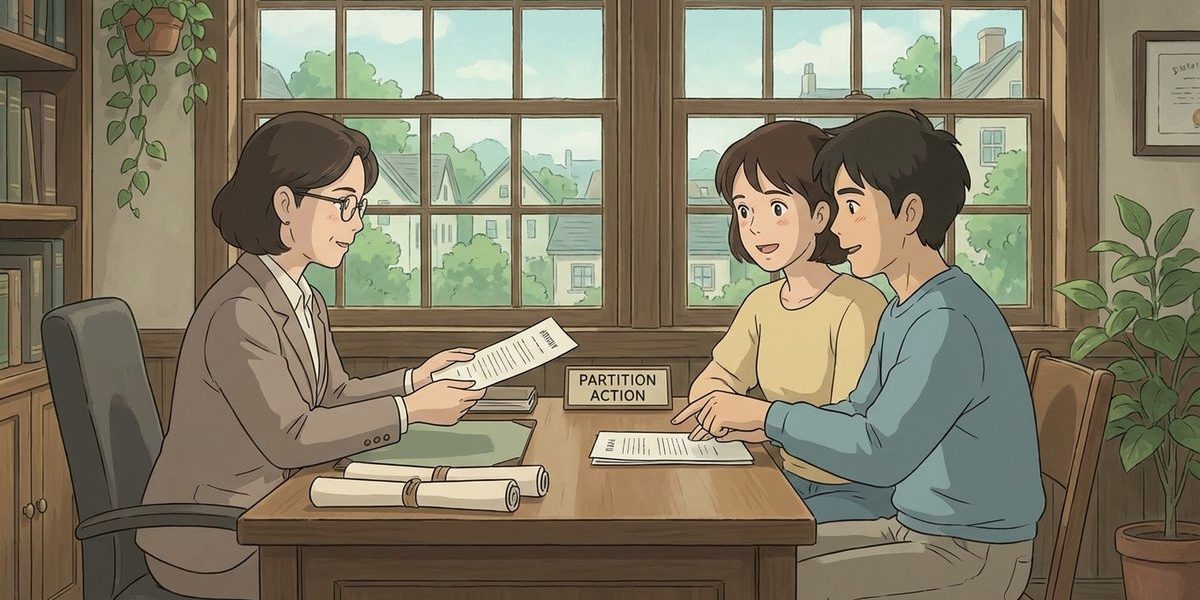
Can a partition case be resolved if the co-owner decides to refinance, assume the mortgage, or buy everyone else out? – NC
Short Answer
Yes. In North Carolina, a partition case can often end without a forced public sale if the co-owners reach a workable agreement and one owner can refinance, assume the debt if the lender allows it, or buy out the others for an agreed amount. But a private resolution only works if it fully addresses title, the mortgage, and each owner’s share; otherwise, the court can still move forward with a partition sale if dividing the property would cause substantial injury.
Understanding the Problem
In North Carolina, the single issue is whether a co-owner can stop or resolve a partition case by taking over the home financially instead of letting the case end in a court-ordered sale. The key decision point is whether one owner can remove the others from the property arrangement in a way that also deals with the existing loan, ownership interests, and the timing of the court case. In a family home with several people on title but fewer people on the mortgage, that question usually turns on whether the proposed buyout is complete, documented, and realistic enough to replace the need for partition.
Apply the Law
North Carolina partition law gives the court several options. The court may order an actual division, a sale, a mix of both, or another arrangement for part of the property, but it cannot force a cotenant to remain in cotenancy over objection. If a sale is requested, the party seeking sale must show by a preponderance of the evidence that an actual partition cannot be made without substantial injury. In practice, a single-family home is often not suitable for physical division, so the real question becomes whether the case can be settled before the court completes the sale process through the clerk of superior court and any appointed commissioner.
Key Requirements
- All ownership interests must be addressed: Every person on title must either stay on title by agreement or sign a deed transferring that person’s share as part of the settlement.
- The mortgage must be dealt with separately: A deed alone does not remove a borrower from the loan. A refinance or lender-approved assumption is usually needed if the goal is to release someone from mortgage liability.
- The buyout must account for credits and costs: North Carolina law allows claims for carrying costs, certain repairs, taxes, insurance, and some improvements during the partition proceeding, which can change how sale proceeds or a buyout amount are divided.
What the Statutes Say
- N.C. Gen. Stat. § 46A-26 (Methods of partition) – the court may order actual partition, partition sale, or a combination, but cannot force a cotenant to stay in cotenancy over objection.
- N.C. Gen. Stat. § 46A-75 (Sale in lieu of actual partition) – a sale may be ordered if actual partition would cause substantial injury, and the party seeking sale has that burden.
- N.C. Gen. Stat. § 46A-76 (Sale procedure) – partition sales follow North Carolina judicial sale procedures, including mailed notice before a public sale.
- N.C. Gen. Stat. § 46A-77 (Cotenant credit) – a cotenant who is the high bidder at sale gets credit for the share already owned, which can make a buyout through the sale process more practical.
- N.C. Gen. Stat. § 46A-27 (Carrying costs, improvements, contribution) – a cotenant may seek contribution for carrying costs such as taxes, insurance, repairs, and loan payments made to preserve the property.
- N.C. Gen. Stat. § 1-536 (Action by tenant against cotenant for waste) – a cotenant may sue another cotenant for waste if that person damages the property.
Analysis
Apply the Rule to the Facts: Here, four people are on title, but only two are on the loan. That means a partition case can still move forward because title ownership controls the right to seek partition, while the mortgage affects payoff and liability. If one co-owner wants to keep the house, the cleanest resolution is usually a written settlement in which the remaining owner buys out the others and also completes a refinance or lender-approved assumption so the departing borrower is not left on the debt.
If that does not happen, the case does not automatically stop just because someone says a refinance may be possible later. North Carolina courts focus on whether the property should remain co-owned or be partitioned, and a single-family home often ends in a sale if physical division would materially reduce value or impair ownership rights. If a co-owner can actually fund a buyout, that can resolve the dispute before sale; if not, the court can continue toward a partition sale, and a cotenant may still bid at that sale with a statutory credit for the share already owned.
The facts also raise a separate property-protection issue. A threat not to pay the mortgage does not by itself transfer ownership rights, but missed payments can increase arrears, fees, and foreclosure risk, and those amounts may later matter in contribution claims. If an occupant is damaging the home, North Carolina law recognizes a claim for waste by one cotenant against another, and the payment history for taxes, insurance, repairs, and loan costs may also affect the final accounting in the partition case. For related issues, see not paying utilities and the property is losing value and force a sale or buy out the other co-owners.
Process & Timing
- Who files: any cotenant or cotenants with a title interest. Where: the Clerk of Superior Court in the North Carolina county where the real property is located. What: a partition petition describing the property, the ownership interests, and whether actual partition or sale is requested. When: there is no single statewide filing deadline to bring a partition claim, but contribution claims for property taxes in the partition proceeding are limited to taxes paid during the 10 years before the petition.
- After service on all parties, the court decides the ownership interests and whether actual partition is possible or whether sale is necessary because actual division would cause substantial injury. If the parties negotiate a refinance, assumption, or buyout early enough, they can often ask the court to approve a consent resolution or dismiss the case once deeds, payoff terms, and releases are ready.
- If the case proceeds to sale, the clerk or court appoints a commissioner, notice of sale must be mailed at least 20 days before a public sale, and the property is sold under North Carolina judicial sale procedures. The sale proceeds are then applied to costs, liens, and each owner’s adjusted share, including any court-approved contribution credits.
Exceptions & Pitfalls
- A deed transfer does not remove a borrower from the mortgage. If a co-owner signs over title without a refinance or approved assumption, that person may still remain liable on the loan.
- One owner’s promise to refinance is not enough. The safer approach is a signed settlement with firm deadlines, payoff terms, deed delivery terms, and a backup plan if financing fails.
- Damage to the property, missed mortgage payments, unpaid taxes, or unpaid insurance can change the accounting. Keep records, photos, repair invoices, and payment proof because those issues may support claims for waste, contribution, or credits in the partition case. If access is being blocked, this related article may help: changed the locks and won’t let the others enter.
Conclusion
Yes, a North Carolina partition case can be resolved if a co-owner actually completes a refinance, obtains a lender-approved assumption, or buys out the other owners on terms that clear title and address the mortgage. If that does not happen, the court may order a sale when actual partition would cause substantial injury. The key next step is to file or respond in the partition proceeding before the Clerk of Superior Court and set a firm deadline for any buyout or refinance before the sale process moves forward.
Talk to a Partition Action Attorney
If a co-owned home is tied up by a breakup, mortgage risk, or an occupant who refuses to leave, our firm has experienced attorneys who can help explain the partition process, property-protection options, and the timelines that matter. Call us today at 919-341-7055.
Disclaimer: This article provides general information about North Carolina law based on the single question stated above. It is not legal advice for your specific situation and does not create an attorney-client relationship. Laws, procedures, and local practice can change and may vary by county. If you have a deadline, act promptly and speak with a licensed North Carolina attorney.

