
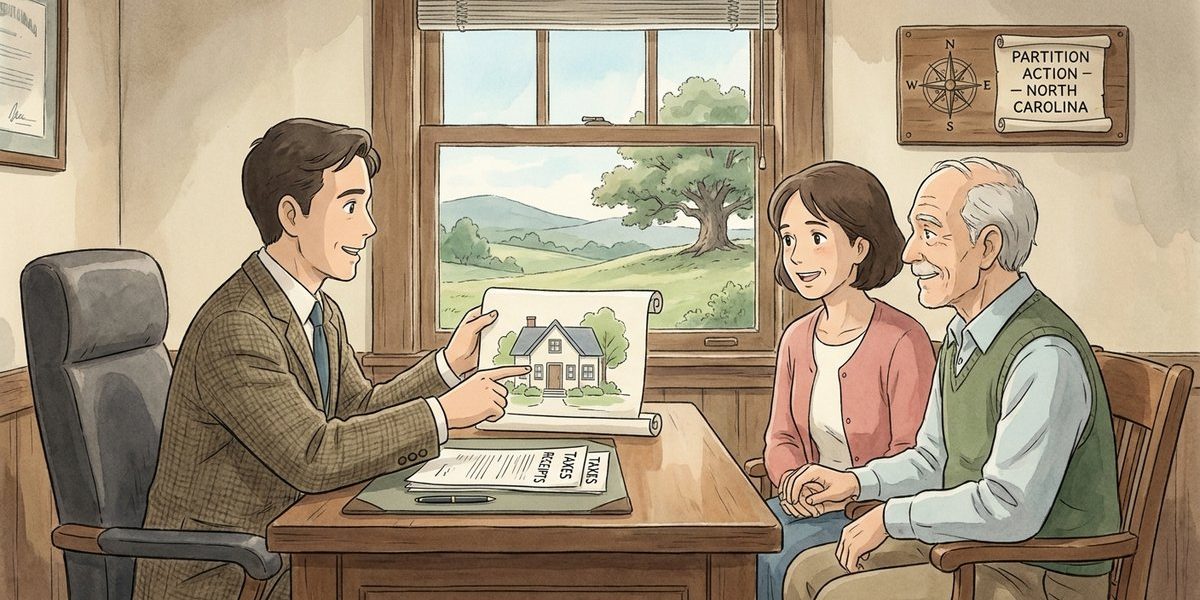
Can I recover part of the money I spent maintaining inherited property after my parent died if the property is sold? – NC
Short Answer
Yes. In North Carolina, a cotenant in a partition case can ask the court to reimburse certain property expenses from the sale proceeds, including carrying costs such as property taxes, insurance, repairs, and some loan payments. The claim must be raised in the partition proceeding, and reimbursement for improvements is usually limited to the lesser of the cost of the work or the value it added to the property.
Understanding the Problem
In North Carolina, the main question is whether a person who inherited a partial interest in real property and paid to preserve it after a parent’s death can recover part of those costs when the property is sold in a partition case. The issue usually turns on whether the person is a cotenant, whether the payments were true preservation costs rather than optional upgrades, and whether the reimbursement request is properly presented during the partition proceeding. When the property’s legal description, acreage, or boundaries are unclear, the court may also need the title and boundary issues addressed so the correct property is identified before the sale and accounting move forward.
Apply the Law
North Carolina partition law allows a cotenant to seek contribution for carrying costs and certain improvements in the same case where the property is divided or sold. The usual forum is the clerk of superior court in the county where the real property lies, although some contested issues can require transfer to a superior court judge. A contribution request in a partition sale may be asserted during the partition proceeding, and property-tax reimbursement is limited to taxes paid during the 10 years before the partition petition was filed, plus legal-rate interest.
Key Requirements
- Cotenant status: The person seeking reimbursement must have a recognized ownership interest in the property, such as an inherited undivided share.
- Qualifying expenses: North Carolina law treats carrying costs as the actual costs of preserving the property’s value and the owners’ interests, including property taxes, homeowner’s insurance, repairs, and payments on a loan used to acquire the property.
- Proper request in the case: The reimbursement claim should be raised in the partition proceeding so the court can adjust each owner’s share of the sale proceeds or, in an actual partition, account for the contribution through the division itself.
What the Statutes Say
- N.C. Gen. Stat. § 46A-27 (Carrying costs, improvements, and contribution) – lets a cotenant seek contribution for carrying costs and for improvements, with limits on how improvements are measured and a 10-year lookback for property taxes.
- N.C. Gen. Stat. § 41-86 (Reimbursement of a cotenant) – addresses contribution for necessary repairs, improvements in partition actions, and reimbursement for taxes and interest on an existing encumbrance, with limits tied to exclusive possession.
- N.C. Gen. Stat. § 105-363 (Tax payments by cotenants) – provides that a cotenant who pays more than that cotenant’s share of property taxes may have a lien enforceable in a partition sale or other court proceeding.
- N.C. Gen. Stat. § 46A-51 (Adjustments in partition) – allows the court’s partition process to account for contribution orders when shares are adjusted.
Analysis
Apply the Rule to the Facts: The stated facts suggest a claimed one-half inherited interest, ongoing payment of property expenses after the parent’s death, and a likely request for partition by sale. If that ownership interest is confirmed, North Carolina law generally allows a cotenant to ask for contribution for taxes, insurance, repairs, and other carrying costs that preserved the property, with any approved amount typically addressed from the sale proceeds. If some of the spending was for improvements rather than basic upkeep, the claim is usually capped at the lesser of the actual cost or the value added to the property when the partition case began.
The incomplete legal description, mismatch in acreage, and possible boundary dispute matter because the court needs to know what parcel is actually being partitioned and sold. If a neighboring owner disputes the line or a prior survey was blocked, the partition case may slow down while the property description, title issues, or boundary questions are sorted out. That does not erase a reimbursement claim, but it can affect timing, proof, and whether survey evidence or additional court rulings are needed before sale proceeds can be distributed.
North Carolina’s current partition statutes also matter because they treat reimbursement as part of the partition proceeding itself, rather than forcing a separate lawsuit in many situations. That is important here because the claimed expenses appear tied to preserving inherited property after death, and the court can adjust the owners’ shares as part of the final accounting. Related issues often overlap with carrying costs like taxes, insurance, and maintenance and with whether credit or reimbursement for repairs and upkeep is available before the property is divided or sold.
Process & Timing
- Who files: a cotenant claiming an ownership share. Where: usually the Clerk of Superior Court in the North Carolina county where the land is located. What: a partition petition identifying the property and ownership interests, plus an application or claim for contribution for carrying costs, repairs, taxes, or qualifying improvements. When: in a partition sale, the contribution claim may be asserted during the partition proceeding; for property taxes, reimbursement is limited to amounts paid during the 10 years before the partition petition was filed, plus interest at the legal rate.
- Next step with realistic timeframes; note county variation if applicable.
- If the property is sold, the court can direct how net proceeds are distributed after costs of sale and any approved contribution adjustments. If title, survey, or boundary issues remain disputed, the court may require those issues to be resolved before final distribution.
Exceptions & Pitfalls
- Exclusive possession can limit reimbursement for some items, especially where one cotenant had sole use of the property during the period when expenses were paid.
- Not every dollar spent counts as a reimbursable improvement; optional upgrades are treated differently from necessary repairs, and improvement claims are capped by the lesser-value rule.
- Poor records create problems. Missing tax receipts, insurance statements, repair invoices, loan records, or proof of payment can weaken the accounting claim.
- An incomplete legal description, disputed acreage, or blocked survey can delay the case because the court must identify the correct parcel before sale and distribution.
- Service and notice problems can slow the proceeding, especially when heirs, cotenants, or neighboring owners with boundary claims are not properly identified or brought into the case.
Conclusion
Yes. In North Carolina, a cotenant who paid to preserve inherited property can often recover a share of those costs from partition sale proceeds, but the claim must fit the statutory rules for carrying costs, repairs, taxes, or improvements. The key limits are that improvements are capped by added value and property-tax claims generally reach back only 10 years before filing. The next step is to file the partition matter and assert the contribution claim in that proceeding as early as possible.
Talk to a Partition Action Attorney
If a cotenant has been paying taxes, insurance, repairs, or other upkeep on inherited property and a sale may be needed, our firm has experienced attorneys who can help explain the partition process, title issues, and reimbursement timelines. Call us today at [919-341-7055].
Disclaimer: This article provides general information about North Carolina law based on the single question stated above. It is not legal advice for your specific situation and does not create an attorney-client relationship. Laws, procedures, and local practice can change and may vary by county. If you have a deadline, act promptly and speak with a licensed North Carolina attorney.

