
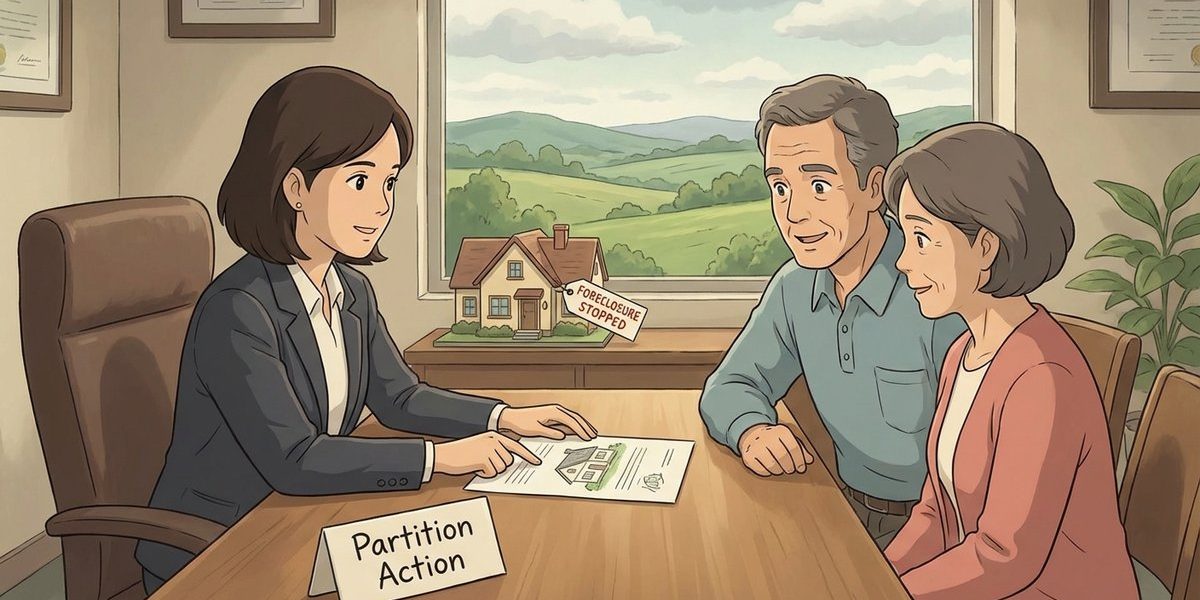
How can I stop a co-owned inherited house from going into foreclosure if one heir refuses to sign? – NC
Short Answer
In North Carolina, one heir usually cannot force a new loan or loan modification on co-owned inherited property if another owner refuses to sign the lender’s documents. But a co-owner can often still act quickly by working with the lender on loss-mitigation options, curing the default if allowed, or filing a partition case in superior court to break the deadlock and seek a court-ordered path forward. If a foreclosure sale has already occurred, the 10-day upset-bid period can be a critical deadline.
Understanding the Problem
In North Carolina, the single issue is whether a co-owner of an inherited house can stop foreclosure when another heir will not sign documents needed to refinance, modify, or sell the property. The key decision point is whether the property can be saved through lender action before the foreclosure moves forward, or whether court action is needed because the co-owners cannot act together. Timing matters because foreclosure steps and sale deadlines can move faster than family disputes.
Apply the Law
Under North Carolina law, heirs who inherit real estate together often hold title as tenants in common unless the deed or estate documents say otherwise. That means each co-owner has an undivided interest in the whole property, but one co-owner usually cannot unilaterally mortgage the entire property, transfer full title, or bind the other owners to a new FHA-related loan. When co-owners are deadlocked, a partition proceeding in superior court is the main forum for resolving the ownership impasse, and all cotenants must be joined. If foreclosure is already underway or a sale has occurred, the clerk of superior court also becomes important because foreclosure sales and upset bids run through that office, and the upset-bid window is generally 10 days after the report of sale or last notice of upset bid is filed.
Key Requirements
- Co-ownership status: The house must be owned by two or more heirs or other cotenants, each with a legal interest that the lender and court must recognize.
- Authority to act: A single heir may be able to pay arrears or negotiate, but usually cannot close a full refinance, modification, or sale of the entire property without the signatures or legal participation of the other owners.
- Proper court procedure: If cooperation breaks down, a partition case must be filed in the superior court, and all known cotenants and other interested parties should be joined so the court can address the property as a whole.
What the Statutes Say
- N.C. Gen. Stat. § 46A-21 (Petition by cotenant; necessary parties) – allows a tenant in common or joint tenant to petition for partition in superior court and requires joinder of all cotenants.
- N.C. Gen. Stat. § 46A-52 (Unknown cotenants or disputed title) – lets a partition case move forward even if some ownership interests are disputed or not fully resolved at the start.
- N.C. Gen. Stat. § 45-21.27 (Upset bid on real property) – gives the usual 10-day upset-bid period after a foreclosure sale or last notice of upset bid is filed with the clerk.
Analysis
Apply the Rule to the Facts: Here, the inherited house is co-owned by multiple heirs, and the lender says all heirs must sign the FHA-related loan documents. That usually means one heir cannot complete the new loan alone because the lender wants all record owners to consent to encumber the entire property. If one sibling refuses to cooperate, the immediate legal problem is not just the foreclosure itself but the title deadlock that prevents a refinance or negotiated resolution from closing in time.
The first rule element is co-ownership. Because multiple heirs hold interests in the same house, the lender is treating the property as jointly owned collateral and wants signatures from all owners with record title. The second rule element is authority to act. Even if one heir is ready to save the property, that heir may still need either unanimous cooperation, a narrower lender-approved option that does not require every signature, or a court process that changes how the property is handled.
The third rule element is proper court procedure. If the noncooperating heir will not sign and informal efforts fail, a partition action may be the practical way to move the matter into court and ask for a structured resolution rather than waiting for foreclosure to overtake the property. As discussed in my sibling refuses to agree to sell the inherited house, North Carolina law gives a cotenant a path to address a family ownership stalemate even when one heir blocks progress.
Process & Timing
- Who files: a cotenant heir, usually through counsel. Where: the superior court in the North Carolina county where the property is located, with foreclosure-related filings and sale matters often handled through the clerk of superior court. What: a partition petition naming all cotenants and, where appropriate, other parties with recorded interests. When: as soon as it becomes clear that one heir will not sign and the foreclosure timeline will not wait; if a foreclosure sale has already occurred, the upset-bid period is typically 10 days after the report of sale or last notice of upset bid is filed.
- Next, counsel can contact the lender, trustee, loan servicer, and other heirs to confirm the exact default amount, whether reinstatement is still available, whether any loss-mitigation review is open, and whether a short pause is possible while ownership issues are addressed. County practice and lender response times vary, so speed matters.
- Finally, the matter usually ends in one of two ways: the default is cured or another lender-approved resolution is completed before the sale becomes final, or the court moves the property dispute forward through partition so the deadlock does not continue indefinitely.
Exceptions & Pitfalls
- A lender may still refuse a refinance or modification unless every record owner signs, even when one heir is willing and financially able to pay.
- A common mistake is waiting for family agreement after the foreclosure file is already moving; delay can eliminate options that were available earlier.
- Title problems, missing heirs, estate administration issues, and service problems can slow a partition case, although North Carolina law allows some disputed ownership issues to be addressed without stopping the case entirely. For a broader look at that issue, see force the sale of inherited land when some co-owners refuse to sell.
Conclusion
In North Carolina, one heir usually cannot stop foreclosure by closing a new loan on a co-owned inherited house if another heir refuses to sign, because all owners’ interests must be addressed. The practical options are to cure the default if the lender allows it, press for a lender-approved workout, or file a partition action in superior court to break the ownership deadlock. If a foreclosure sale has already occurred, file the needed court action or sale response with the clerk before the 10-day upset-bid period expires.
Talk to a Partition Action Attorney
If you’re dealing with a co-owned inherited house that is heading toward foreclosure and one heir will not cooperate, our firm has experienced attorneys who can help you understand your options and timelines. Call us today at 919-341-7055.
Disclaimer: This article provides general information about North Carolina law based on the single question stated above. It is not legal advice for your specific situation and does not create an attorney-client relationship. Laws, procedures, and local practice can change and may vary by county. If you have a deadline, act promptly and speak with a licensed North Carolina attorney.

