
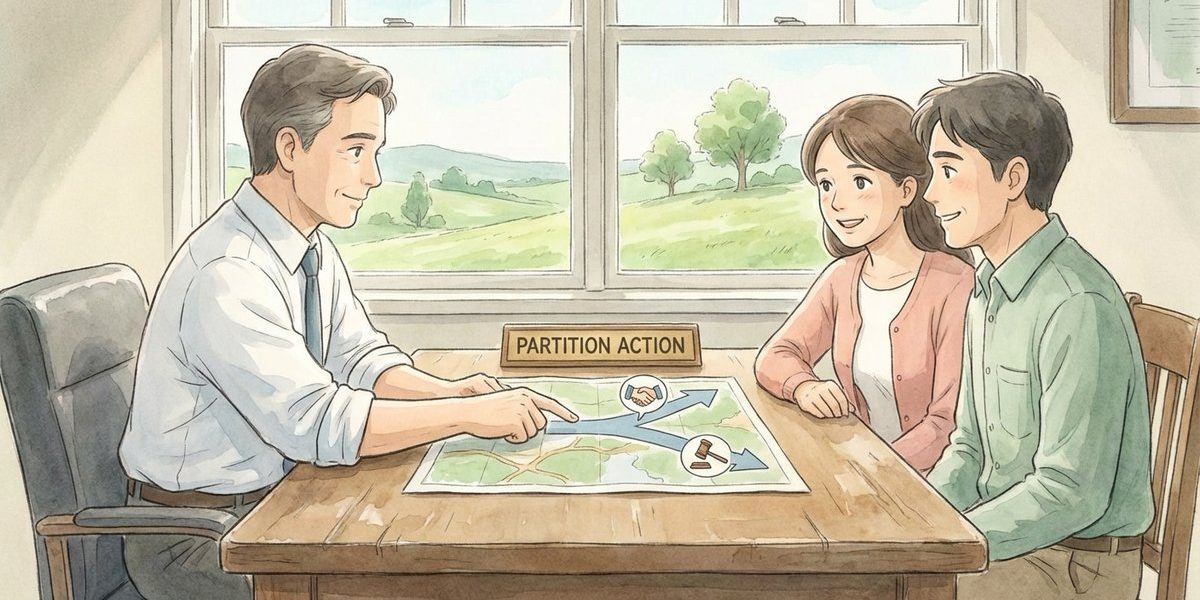
What are my options to either reach a new settlement or move forward with the partition case when negotiations break down? – NC
Short Answer
In North Carolina, co-owners can still resolve a partition dispute by signing a new settlement, but if negotiations fail, the case can move forward in superior court toward either an actual division of the property or a court-ordered sale. The court will order a sale only if actual partition cannot be made without substantial injury to a party. When a trust holds an ownership interest, the trust must be properly joined through its trustee, and the case cannot move cleanly until the correct parties are before the court.
Understanding the Problem
In a North Carolina partition action, the main question is whether co-owners of real property can resolve the case through a new agreement or must continue the court proceeding to divide or sell the property after settlement talks collapse. The decision usually turns on who currently owns the property interests, whether all necessary parties are in the case, and whether the property can be fairly divided instead of sold. This issue often becomes more complicated when a family trust now holds an ownership share and the trustee must act for that interest in the pending matter.
Apply the Law
North Carolina partition cases are filed in superior court, usually through the clerk of superior court as a special proceeding. A cotenant may petition to partition real property, and all cotenants must be served and joined. The court starts with the idea of actual partition if that can be done fairly, but it may order a sale in lieu of partition if the party seeking a sale proves by a preponderance of the evidence that dividing the property would cause substantial injury. If the court orders a sale, the sale follows North Carolina judicial sale procedures, including notice and upset-bid rules that can extend the timeline.
Key Requirements
- All necessary owners must be in the case: Every current tenant in common or joint tenant should be joined and served, including a trust interest acting through its trustee.
- The court prefers division before sale: A sale is not automatic. The party asking for a sale must show that physically dividing the property would materially harm one or more parties.
- Procedure matters after talks fail: Once settlement breaks down, the case usually returns to motions, hearings, commissioner appointments, sale procedures, or exceptions deadlines depending on where the file stands.
What the Statutes Say
- N.C. Gen. Stat. § 46A-21 (Petition by cotenant) – allows a cotenant to seek partition in superior court.
- N.C. Gen. Stat. § 46A-75 (Sale in lieu of actual partition) – permits a sale only if actual partition cannot be made without substantial injury, and the party seeking sale has that burden.
- N.C. Gen. Stat. § 46A-52 (Disputed shares or title issues) – allows the court to move forward with partition or sale even if parties dispute who owns the same undivided interest.
- N.C. Gen. Stat. § 46A-76 (Sale procedure) – makes partition sales follow North Carolina judicial sale procedures and requires mailed notice before a public sale.
- N.C. Gen. Stat. § 1-339.25 (Upset bids on real property) – gives parties and third parties a 10-day upset-bid period after a reported sale or last upset bid, with a required minimum increase and deposit.
Analysis
Apply the Rule to the Facts: Here, the earlier settlement appears to have partially performed and then fallen apart, so the parties usually have two practical paths: negotiate and document a new settlement, or reactivate the partition case based on the current ownership picture. Because a family trust now holds an interest, the trustee must be properly represented and brought into the case in the correct capacity before the court can reliably approve a final resolution or move toward partition relief. If the property cannot be fairly divided into separate shares without materially reducing value or impairing ownership rights, a sale in lieu of partition becomes the likely litigation path.
If the parties can still agree, they may be able to replace the failed deal with a written settlement that covers payment terms, deadlines, dismissal terms, deed transfers, and what happens if someone defaults. That approach may avoid the delay and uncertainty of commissioners, sale notice, and upset-bid procedures. For a related discussion of negotiated resolutions, see private sale or settlement agreement with the other co-owner.
If no new agreement is reached, the court does not simply enforce a sale because talks failed. The case still follows North Carolina partition rules. That means the court must identify the proper parties, decide whether the petitioner is entitled to partition relief, and then determine whether actual partition is workable or whether a sale is justified by substantial injury. In many family-property disputes, the practical question becomes whether dividing the land into separate parcels would leave each share worth materially less than a sale of the whole.
Process & Timing
- Who files: a cotenant, or a party already in the case through counsel, may file the needed motion, amended pleading, or request to move the partition matter forward. Where: the Clerk of Superior Court in the North Carolina county where the partition proceeding is pending. What: typically a petition or amended filing identifying all current owners, plus any motion addressing substitution, joinder, or next hearing settings. When: as soon as the prior settlement has clearly failed and before delay creates service or scheduling problems.
- If the court proceeds toward actual partition, it may appoint three disinterested commissioners to divide the property.
- If the court instead orders a sale, the commissioner gives notice and conducts the sale under judicial sale rules. After the report of sale is filed, the property usually remains open for 10 days for upset bids, and each timely upset bid starts a new 10-day period before the sale can become final.
Exceptions & Pitfalls
- A failed settlement may raise a separate enforcement issue, but whether enforcement is available depends on the exact written terms, signatures, and whether the agreement was complete enough to be binding.
- Trust ownership can slow the case if the wrong party is named, the trustee is not properly joined, or authority to settle or convey title is unclear.
- Title disputes do not always stop the partition case. North Carolina law allows the court to move forward even when parties dispute the same undivided interest, with that ownership fight resolved later if needed.
- Parties often underestimate sale timing. Even after an auction or private sale approval, mailed notice requirements, clerk review, and repeated upset-bid periods can delay closing.
- Missing the 10-day window to object to a commissioners’ report in an actual partition or to submit an upset bid after a sale can sharply limit later options.
Conclusion
When settlement negotiations break down in a North Carolina partition case, the main options are to sign a new written settlement or press the case forward in superior court toward actual partition or, if substantial injury can be shown, a sale in lieu of partition. The key threshold is whether dividing the property would materially harm a party compared with selling the whole. The next step is to file the needed motion or updated pleading with the Clerk of Superior Court and, if a sale is ordered, track the 10-day upset-bid deadline.
Talk to a Partition Action Attorney
If a co-owned property dispute has stalled after a failed settlement and a trust interest now complicates the case, our firm has experienced attorneys who can help evaluate the next procedural step, the proper parties, and the timelines that matter. Call us today at 919-341-7055.
Disclaimer: This article provides general information about North Carolina law based on the single question stated above. It is not legal advice for your specific situation and does not create an attorney-client relationship. Laws, procedures, and local practice can change and may vary by county. If you have a deadline, act promptly and speak with a licensed North Carolina attorney.

