
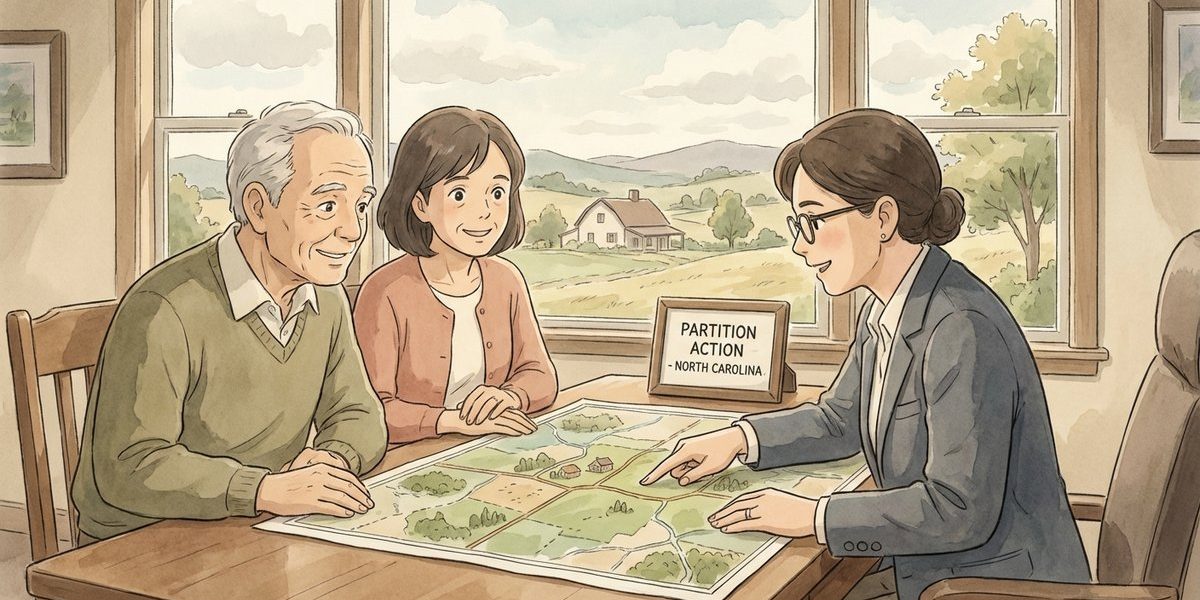
What options do we have to keep the land in the family if a forced sale becomes likely? – NC
Short Answer
In North Carolina, a family can often avoid a court-ordered sale of jointly owned land by reaching a voluntary deed agreement, asking for mediation, pushing for an actual partition instead of a sale, or arranging for one group of co-owners to buy out another group’s share. A forced sale is not automatic. The party asking for a sale must prove that dividing the land would cause substantial injury, and the court can consider other ways to resolve the dispute first.
Understanding the Problem
In North Carolina, the decision point is whether family members who jointly own inherited or long-held land can keep it in the family when one or more co-owners may seek partition relief that could end in a sale. The issue usually turns on whether the co-owners can agree on a deed or other transfer, whether the land can be divided fairly, and whether court involvement becomes necessary before a sale is ordered. The main focus is the family’s options to preserve ownership rather than let the property move toward a partition sale.
Apply the Law
North Carolina partition law gives the court more than one option. The court may order an actual partition, a partition sale, a mix of both, or divide part of the property while leaving another part in cotenancy if the parties agree. A sale is allowed only when the party seeking it proves, by a preponderance of the evidence, that an actual partition cannot be made without substantial injury to one or more parties. Partition cases involving land are generally handled as special proceedings, and a petition to partition real property may be filed in superior court in the county where the property is situated. Mediation may be ordered before the court decides whether to allow a sale.
Key Requirements
- Common ownership: The land must be owned by cotenants, such as family members who each hold an undivided interest.
- Proof for a sale: A co-owner asking for a sale must show that physically dividing the land would materially harm the parties compared with selling the whole property.
- Practical alternatives: The court can consider actual division, grouping some relatives together as one parcel, or partial division instead of ordering the whole tract sold.
What the Statutes Say
- N.C. Gen. Stat. § 46A-26 (Methods of partition) – The court may choose actual partition, sale, a combination of both, or leave part in shared ownership if appropriate.
- N.C. Gen. Stat. § 46A-29 (Mediation) – The parties may agree to mediation at any time, and the court may order mediation before deciding whether to allow a sale.
- N.C. Gen. Stat. § 46A-53 (Apportionment of shares in common) – Two or more cotenants may ask to have their shares grouped together as one parcel if that does not harm another cotenant.
- N.C. Gen. Stat. § 46A-75 (Sale in lieu of actual partition) – A sale may be ordered only if actual partition would cause substantial injury, and the party seeking sale has the burden of proof.
- N.C. Gen. Stat. § 46A-76 (Sale procedure) – If a public sale is ordered, mailed notice must go out at least 20 days before the sale to parties previously served.
Analysis
Apply the Rule to the Facts: Here, the land has been in the family for a long time, and the stated goal is to get all co-owners to sign a deed that keeps the property in the family. That is often the best off-ramp from a partition fight because a voluntary deed can settle ownership without asking the court to divide or sell the land. If full agreement is not possible, North Carolina law still leaves room to argue for an actual partition, a partial partition, or a grouped family share instead of a full sale.
If one branch of the family wants to keep the property and another branch wants out, a buyout can sometimes solve the problem even if the statute does not force continued cotenancy over objection. In practice, that usually means identifying each owner’s share, valuing the property, and preparing deeds so the departing owners transfer their interests to the relatives who want to keep the land. If the dispute reaches court, evidence about the land’s layout, use, access, and whether separate parcels can be created without unfair loss becomes important because the sale requestor must prove substantial injury from division.
Another practical point is that North Carolina allows two or more cotenants to ask that their shares be apportioned together as one parcel if doing so does not injure anyone else. That can help a family preserve a core portion of the property even when not every relative wants the same outcome. It also means the choice is not always all-or-nothing; sometimes part of the tract can stay with family members together while another part is divided or sold.
If the case moves toward a sale, mediation can be a useful last chance to avoid losing the land outside the family. Mediation often helps families address title issues, unknown shares, and disagreements over value before the court decides whether sale is necessary. That matters because disputed ownership interests do not always stop the court from moving forward, so waiting too long to organize deeds, title records, and a family proposal can weaken the effort to keep the property.
Process & Timing
- Who files: a cotenant or group of cotenants. Where: superior court in the county where the land is located. What: a partition petition, or if no case has been filed yet, deeds and settlement documents transferring interests by agreement. When: as early as possible, before the court enters an order directing sale; if a public sale is ordered, mailed notice must be sent at least 20 days before the sale.
- Next step with realistic timeframes; the parties identify all owners, confirm title, value the property, and decide whether a full family deed, a buyout, mediation, or an actual partition proposal is workable. If a case is pending, a party can ask the court to consider mediation before ruling on sale, and timing can vary by county.
- Final step and expected outcome/document. The matter may end with recorded deeds, a mediated settlement, or a court order for actual partition, partial partition, or sale. If the court orders sale, the case then follows judicial sale procedures and notice requirements.
Exceptions & Pitfalls
- Common exceptions or defenses that change the answer include disputed ownership shares, missing heirs, unknown cotenants, access problems, and land features that make a fair physical division hard.
- Common mistakes include assuming every owner must want the same result, waiting too long to gather signatures, and failing to get a clear value for the interests being transferred.
- Service and notice problems matter. A court can move forward even when some title disputes remain, so families should not assume an unresolved ownership issue will automatically stop the case.
Conclusion
In North Carolina, a forced sale is not the only outcome when family land is jointly owned. The strongest options are a voluntary deed among all co-owners, a buyout of the owners who want out, mediation, or asking the court for actual or partial partition instead of sale. Because a sale requires proof of substantial injury from division, the key next step is to organize ownership records and present a concrete deed or partition proposal before any sale order is entered.
Talk to a Partition Action Attorney
If a family is trying to keep long-held land from being sold through a partition dispute, our firm has experienced attorneys who can help explain the available options, ownership issues, and timing concerns. Call us today at 919-341-7055.
Disclaimer: This article provides general information about North Carolina law based on the single question stated above. It is not legal advice for your specific situation and does not create an attorney-client relationship. Laws, procedures, and local practice can change and may vary by county. If you have a deadline, act promptly and speak with a licensed North Carolina attorney.

