
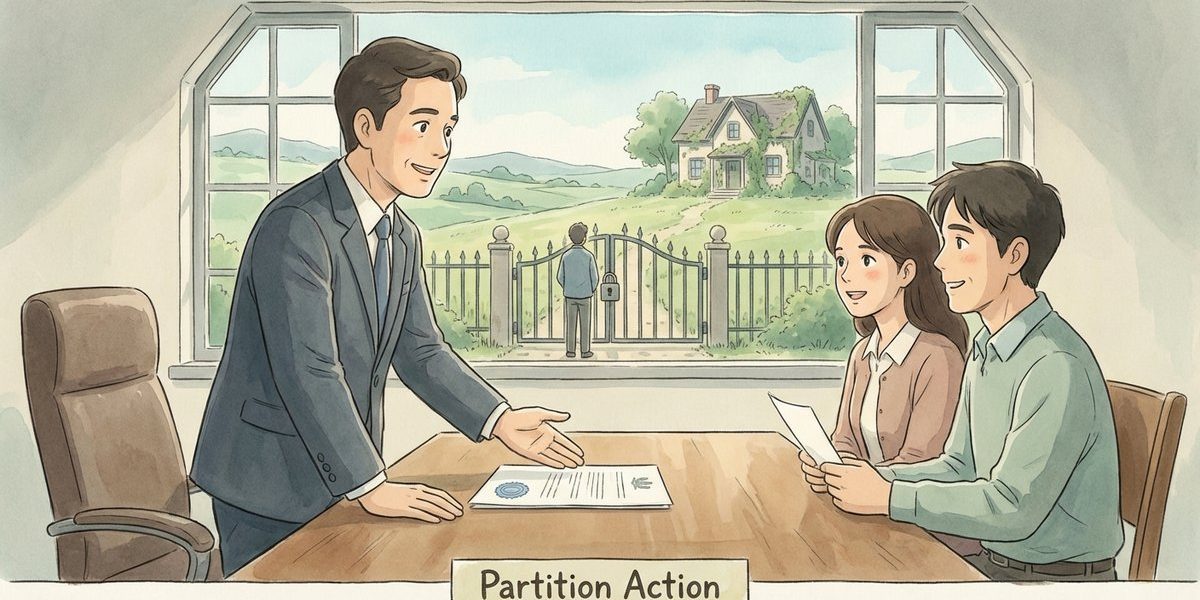
How does the commissioner or court handle getting access to the property if one co-owner won’t communicate or let people in? – NC
Short Answer
In North Carolina, a court-appointed commissioner handling a partition sale can ask the clerk or judge for orders needed to carry out the sale when one co-owner blocks access, ignores communication, or refuses to allow entry for inspections, repairs, or showings. The court generally keeps control over the sale process and can enter practical enforcement orders so the property can be marketed and sold. If the dispute continues through the end of the case, North Carolina law also provides a process for obtaining possession after confirmation and conveyance.
Understanding the Problem
In a North Carolina partition action, the main issue is whether the commissioner appointed to sell co-owned real estate can get lawful access when a co-owner in possession will not respond, will not provide keys, or will not allow entry needed to prepare the property for sale. The question focuses on the commissioner’s ability to carry out the court-ordered sale and the court’s power to require cooperation at the time access becomes necessary.
Apply the Law
North Carolina partition sales are court-supervised. Once the court orders a partition sale, the commissioner acts under that order and follows the sale procedure required by statute. In practice, that means the commissioner may return to the clerk of superior court or the assigned judge for additional directions if a co-owner’s noncooperation prevents inspections, listing work, cleaning, repairs, photography, appraisals, or buyer showings. The main forum is the partition case itself in the county where the property is located, and timing matters because delays can interfere with notice, marketing, and the scheduled sale process.
Key Requirements
- Court-ordered sale: There must already be a partition proceeding in which the court has ordered sale and appointed a commissioner to carry it out.
- Need for access tied to the sale: The requested entry must relate to tasks reasonably necessary to market, protect, inspect, or transfer the property.
- Request for enforcement or direction: If a co-owner blocks the process, the commissioner or a party usually asks the court for a more specific order requiring access, cooperation, scheduling, or turnover of keys.
What the Statutes Say
- N.C. Gen. Stat. § 46A-76 (Sale procedure) – A partition sale follows North Carolina’s judicial sale procedures, with a commissioner carrying out the sale under court authority.
- N.C. Gen. Stat. § 46A-59 (Order for possession) – In an actual partition setting, after confirmation of the commissioners’ report, recording, and 10 days’ notice, the clerk may issue an order directing the sheriff to place the party receiving the apportioned property in possession.
Analysis
Apply the Rule to the Facts: Here, a commissioner and real estate agent have already been appointed to prepare the co-owned property for sale, while one sibling living there has been difficult to contact and has not cooperated. That makes access a sale-related need, not a side dispute. In this setting, the usual step is for the commissioner or a party to ask the court in the existing partition case for a specific order requiring reasonable access, communication, key turnover, or scheduled entry so the sale can move forward.
The carrying costs being paid by the non-occupying co-owner also matter because delay can increase taxes, HOA charges, and other expenses while the property sits unsold. Courts handling partition matters generally try to keep the sale process moving and may set practical conditions for entry, notice, and cooperation rather than allowing one co-owner in possession to stop the case by silence alone.
Process & Timing
- Who files: usually the commissioner, or sometimes a party through counsel. Where: the Clerk of Superior Court in the North Carolina county where the partition action is pending. What: a motion or request for instructions, enforcement, or access-related relief within the existing partition file. When: as soon as the lack of access starts interfering with inspection, listing, repairs, showings, or sale scheduling.
- The clerk or judge may set a hearing or enter a more detailed order that spells out how access will occur, who must provide keys or alarm codes, what notice must be given before entry, and whether the commissioner or agent may enter for defined sale tasks. Local practice can vary by county.
- If the occupant still refuses to comply, the moving party may seek further enforcement in the same case. If possession becomes the issue after the required stage of the partition process, North Carolina law provides a possession procedure that can lead to sheriff-assisted enforcement after confirmation and conveyance.
Exceptions & Pitfalls
- A co-owner in possession does not lose all rights just because a sale has been ordered, so the court usually expects access requests to be reasonable in scope, tied to the sale, and documented.
- A common mistake is relying on informal texts or unanswered calls for too long instead of asking the court for a clear access order in the partition file.
- Notice problems can slow relief. Keep records of attempted contact, proposed entry dates, and the commissioner’s specific need for access so the court can see why immediate direction is necessary.
Conclusion
In North Carolina, when a co-owner in possession will not communicate or allow entry during a partition sale, the commissioner or a party can ask the court in the existing case for a specific order requiring reasonable access needed to market and sell the property. The key point is that access must be tied to carrying out the court-ordered sale. The next step is to file a motion for access or enforcement with the Clerk of Superior Court promptly once the refusal begins delaying the sale.
Talk to a Partition Action Attorney
If a co-owner is blocking entry, ignoring the commissioner, or delaying a court-ordered sale, our firm has experienced attorneys who can help explain the available court procedures, timing issues, and next steps. Call us today at 919-341-7055. Related issues often come up when the co-owner who lives in the home refuses to cooperate with listing or showings or when one co-owner changed the locks and won’t let the others enter.
Disclaimer: This article provides general information about North Carolina law based on the single question stated above. It is not legal advice for your specific situation and does not create an attorney-client relationship. Laws, procedures, and local practice can change and may vary by county. If you have a deadline, act promptly and speak with a licensed North Carolina attorney.

