
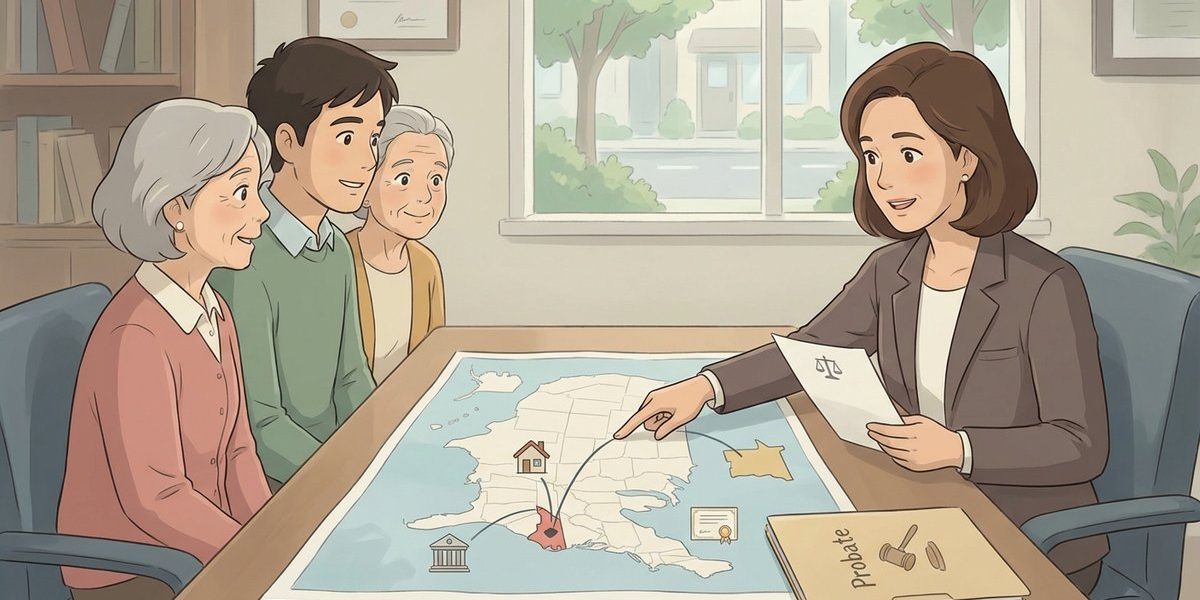
How do we figure out which jurisdiction has authority over different estate assets located in different states? – NC
Short Answer
In North Carolina, the main estate usually opens in the state where the decedent was domiciled at death, but that court does not automatically control every asset in every other state. Real estate is usually governed by the law and probate process of the state where the land sits, while personal property is often handled through the primary estate based on the decedent’s domicile. When assets are spread across states, the attorneys often divide the work between a primary probate and one or more ancillary proceedings in the states where local assets require local authority.
Understanding the Problem
In a North Carolina probate matter, the core question is which court or probate office has authority over a decedent’s assets when those assets are not all in one state. The decision usually turns on the decedent’s domicile, the type of asset involved, and where that asset is legally located. In practice, the issue is not whether one office handles everything, but which office handles which part of the estate and when a second state must open its own related proceeding.
Apply the Law
North Carolina gives probate authority to the superior court division, acting through the clerk of superior court as ex officio judge of probate, for estate administration opened here. As a general rule, the primary estate is opened in the state of the decedent’s domicile at death. From there, asset-by-asset analysis matters: real property is usually controlled by the state where the land is located, while intangible personal property is usually tied to the decedent’s domicile unless a local institution or title system in another state requires separate authority. If a North Carolina estate includes out-of-state land, a North Carolina clerk can administer the local estate, but a separate proceeding may still be needed in the other state to transfer or manage that land.
Key Requirements
- Domicile controls the main estate: The first question is where the decedent was legally domiciled at death, because that state usually hosts the primary probate file.
- Situs controls real estate: Land is usually governed by the law of the state where the property sits, so real estate in another state often requires local probate authority there.
- Asset type changes the answer: Bank accounts, brokerage accounts, and other personal property may be handled through the domiciliary estate, but title rules, local institutions, or court procedure may require extra steps in another state.
What the Statutes Say
- N.C. Gen. Stat. § 7A-241 (Probate jurisdiction) – gives the superior court division, through the superior courts and the clerks of superior court as ex officio judges of probate, exclusive original jurisdiction over the probate of wills and the administration of decedents’ estates in North Carolina.
- N.C. Gen. Stat. § 1-301.3 (Estate matters determined by clerk) – confirms that the clerk decides trust and estate matters in the first instance, with a 10-day appeal period running from service of the order on the aggrieved party, subject to tolling by a timely Rule 52(b) or 59 motion.
Analysis
Apply the Rule to the Facts: The facts describe attorneys coordinating estate work across more than one jurisdiction, which usually means the estate has assets that do not all fall under one probate office’s practical authority. Under North Carolina law, the first office identifies the decedent’s domicile and opens or confirms the primary estate there. Then each asset is sorted by type and location so the attorneys can decide whether the North Carolina clerk can act directly or whether another state must handle a local transfer, recording step, or ancillary probate.
If, for example, the primary estate is pending in North Carolina but the decedent owned land in another state, the other state usually controls the transfer of that land. By contrast, if the out-of-state asset is an investment account with no separate local title issue, the domiciliary estate may be enough, though the institution may still ask for certified appointment papers or local documentation. That is why cross-jurisdiction coordination usually starts with an asset list, title review, and confirmation of where each item is legally situated.
This division of authority also explains why one attorney may handle the main probate file while another handles only the local proceeding elsewhere. That approach is common when the estate includes North Carolina assets plus property in another state, and it often avoids asking one court to do something only another state can authorize. For related guidance, see real estate in more than one state and who has authority to act in an ancillary probate.
Process & Timing
- Who files: the personal representative or the attorney for the estate. Where: the clerk of superior court in the proper North Carolina county for the domiciliary estate, and in the proper probate court or clerk’s office in any other state that requires local authority. What: the estate application or probate filing used by that office, plus certified copies of the will and appointment papers if another state needs proof of the primary estate. When: as soon as the asset review shows that local authority is needed to collect, transfer, sell, or record title to a specific asset.
- Next, counsel usually classifies each asset as North Carolina real estate, out-of-state real estate, tangible personal property, or intangible personal property, then matches each category to the office that can issue effective authority. Timing varies by county and by state, and ancillary filings often wait until certified copies of the domiciliary appointment are available.
- Finally, each office issues the document that allows action on the assets within its reach, such as letters testamentary, letters of administration, or comparable ancillary authority, and the attorneys coordinate distributions, transfers, or sale steps so the estate administration stays consistent across states.
Exceptions & Pitfalls
- Nonprobate assets can change the answer. Joint accounts, payable-on-death accounts, trust assets, and beneficiary-designated assets may pass outside probate, so jurisdiction over the estate does not always mean control over the asset.
- A common mistake is assuming the primary probate state can transfer out-of-state land by itself. In many cases, the state where the land sits still controls title and recording.
- Another common problem is incomplete asset classification. An account statement mailing address does not decide jurisdiction; title, situs, and the institution’s requirements matter more. Delay can also create problems if a local court order, notice, or appeal deadline is missed.
Conclusion
To figure out which jurisdiction has authority over estate assets in different states, start with the decedent’s domicile to identify the primary probate, then sort each asset by type and legal location. In North Carolina, the clerk of superior court handles the estate opened here, but out-of-state real estate often requires a separate local proceeding in the state where the property sits. The next step is to file the needed probate or ancillary papers with the correct probate office as soon as the asset review shows local authority is required.
Talk to a Probate Attorney
If an estate involves assets in more than one state and counsel needs to sort out which court handles what, our firm can help explain the division of authority, required filings, and timing. Call us today at 919-341-7055.
Disclaimer: This article provides general information about North Carolina law based on the single question stated above. It is not legal advice for your specific situation and does not create an attorney-client relationship. Laws, procedures, and local practice can change and may vary by county. If you have a deadline, act promptly and speak with a licensed North Carolina attorney.

