
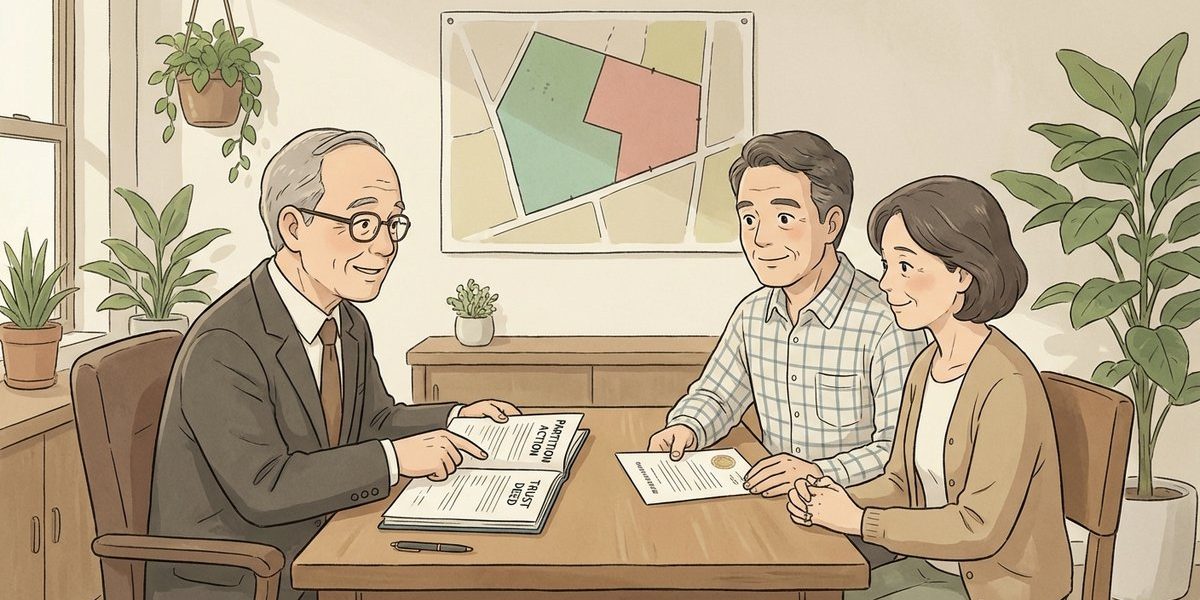
Can a trust be added to or substituted into a partition case when the trust holds an ownership interest in the property? – NC
Short Answer
Yes. In North Carolina, a trust may need to be joined or substituted in a partition case if the trust holds record title or claims an ownership interest in the property. The main question is whether the trust is one of the actual cotenants or another interest holder whose rights could be affected, because all cotenants must be joined, and title disputes can sometimes be addressed without stopping the partition process.
Understanding the Problem
In a North Carolina partition action, the decision point is whether a trust that holds an ownership interest in the property must be brought into the case as a party so the court can address the correct ownership interests before moving forward with partition or sale. That issue often matters when one co-owner claims a buyout should have ended the dispute, but the court file or land records still show a trust or another title holder with an interest that has not been properly addressed.
Apply the Law
North Carolina partition cases are filed in superior court. A person claiming property as a tenant in common or joint tenant may petition for partition, and the petitioner must serve and join all tenants in common and joint tenants. Other persons with an interest in the property, including lienholders, may also be joined. If the trust holds title to an undivided share, the trust’s interest usually cannot be ignored. In practice, that means the case may require joinder of the trust, substitution of the proper title-holding party, or both, depending on how title is actually held and whether the original party still owns the claimed share. North Carolina law also allows a partition case to continue even when competing parties dispute who owns a particular undivided interest, with that ownership controversy decided later in the same case or in a separate proceeding.
Key Requirements
- Actual ownership interest: The court looks first to who holds the ownership interest shown by the deed, recorded title documents, or other competent proof. If a trust holds the share, the trust is not just a bystander.
- Proper parties: All cotenants must be joined in the partition case. A trust that owns part of the property usually must be included so any order binds the correct title holder.
- Procedural timing: If the case has already moved to an order directing partition or sale, the trust issue must be raised quickly through the available trial-court motions, and any appeal or request for a stay must be filed on time to prevent the sale process from moving ahead.
What the Statutes Say
- N.C. Gen. Stat. § 46A-21 (Necessary and proper parties) – requires the petitioner to serve and join all tenants in common and joint tenants, and permits joinder of other persons with an interest in the property.
- N.C. Gen. Stat. § 46A-52 (Title disputed in partition) – allows partition to proceed even when parties dispute who owns the same undivided interest, with that dispute decided later in the same or a separate proceeding.
- N.C. Gen. Stat. § 46A-76 (Sale procedure) – applies the partition sale process and requires mailed notice before a public sale.
- N.C. Gen. Stat. § 46A-101 (Commissioners’ report and objections) – sets a 10-day period to file exceptions after service of a commissioners’ report in an actual partition proceeding.
Analysis
Apply the Rule to the Facts: Here, the reported problem is not just a disagreement between former co-owners. The facts suggest that a family trust, and possibly a second trust, may hold part of the ownership interest that is at stake in the partition case. If the land records or the operative deed place title in a trust, the court generally needs the trust brought into the case so the order addresses the correct owner. If the buyout settlement changed the parties’ rights but the deed transfer was never completed or recorded, the court may still treat the trust or prior title holder as a necessary party until the ownership issue is properly resolved.
The lien and deed-recording problems also matter because partition cases often move based on record title, not on an uncompleted expectation that title would be transferred later. A missing original deed, unresolved judgment issue, or refinancing problem may support the position that ownership and sale rights are still disputed, but those facts do not automatically stop the partition case. They usually need to be presented through the correct motion, supported by the title documents, trust documents, and any settlement papers.
North Carolina procedure also recognizes that a dispute over which party owns a particular undivided share does not always prevent the court from ordering partition or sale. That means a trust can be added because it claims the interest, yet the court may still keep the case moving while reserving the ownership fight for later decision. That practical point often surprises parties who assume a title dispute alone freezes the case.
Process & Timing
- Who files: the party seeking to correct the parties before the court, often the trust through its trustee or the current named party asking to join or substitute the proper title holder. Where: the Superior Court in the North Carolina county where the partition case is pending. What: a motion to join or substitute the proper party, and if an order has already been entered, any related motion for relief, notice of appeal, and motion to stay enforcement of the sale order. When: as soon as the trust ownership issue is discovered, and before the commissioner completes the sale steps if a sale has been ordered.
- Next, the court reviews the deed chain, trust documents, settlement papers, and any order already entered. If a sale has been authorized, the commissioner may continue preparing the sale unless the court or appellate division enters a stay. North Carolina partition sales also require mailed notice before a public sale, and local scheduling can vary by county.
- Final step: the court either adds or substitutes the trust, leaves the existing parties in place while reserving the title dispute, or denies the request if the trust does not actually hold the claimed interest. If no stay is entered, the case can continue toward sale confirmation and later distribution issues.
Exceptions & Pitfalls
- A trust is not automatically the right party just because it is mentioned in negotiations. The key question is whether the trust actually holds title or claims the undivided share at issue.
- A settlement agreement may not replace a recorded deed. If the buyout was never fully carried out through proper transfer documents, the court may still rely on the existing title record.
- Waiting too long is a common mistake. Once a commissioner is appointed or a sale is noticed, failing to seek joinder, substitution, appeal, or a stay promptly can make it much harder to stop the process.
- Notice and service problems can also change the analysis. If a trust that should have been joined never received proper service, that may affect the validity or scope of later orders, but the issue must be raised through the proper procedure.
- Judgment liens and deed-of-trust issues can complicate title and closing, but they do not necessarily defeat partition. They often affect who must be joined and how sale proceeds are handled.
Conclusion
Yes, a trust can be added to or substituted into a North Carolina partition case when the trust holds the ownership interest being partitioned, because all cotenants must be joined and title disputes must be addressed with the correct parties before the case is fully resolved. If an order directing sale has already been entered, the key next step is to file the appropriate motion and any notice of appeal or stay request with the Superior Court immediately before the sale process moves forward.
Talk to a Partition Action Attorney
If a partition case involves a trust, a disputed buyout, or a fast-moving sale process, our firm has experienced attorneys who can help evaluate the title record, identify the proper parties, and act on urgent deadlines. Call us today at 919-341-7055. For related issues, see stop a co-owner from forcing the sale or stop or delay a private sale.
Disclaimer: This article provides general information about North Carolina law based on the single question stated above. It is not legal advice for your specific situation and does not create an attorney-client relationship. Laws, procedures, and local practice can change and may vary by county. If you have a deadline, act promptly and speak with a licensed North Carolina attorney.

