
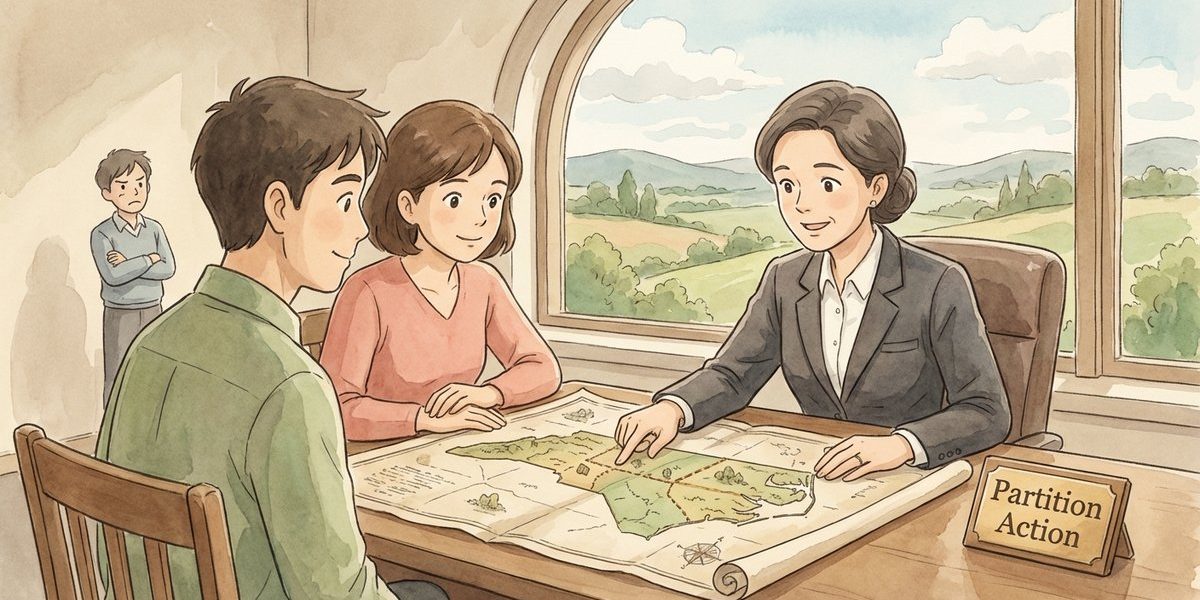
If some co-owners won’t agree to sign deeds, can I still get a specific portion of the property set aside for my spouse? – NC
Short Answer
Yes, in North Carolina, a co-owner can ask the court for a partition even if other co-owners refuse to sign deeds. If the land can be fairly divided, the court can order an actual partition and have commissioners lay out separate shares instead of waiting for everyone to cooperate. If the ownership shares are unclear or some heirs dispute who owns what, the case can still move forward, although the court may need to sort out title issues as part of the process.
Understanding the Problem
In North Carolina, the question is whether a cotenant can have a defined part of inherited land set aside when other cotenants will not sign deeds and the will does not clearly assign each parcel. The main issue is not simple family agreement. It is whether the spouse’s ownership interest can be separated through a partition proceeding, and whether that can happen even when the property description and shares need court involvement before a survey and deed work can be completed.
Apply the Law
North Carolina partition law gives a cotenant a court process to divide jointly owned real estate. The usual forum is the Clerk of Superior Court in the county where the land lies. The court may order an actual partition, a sale, a mix of both, or partition of only part of the property, depending on whether the land can be divided fairly without substantial injury to any party. In an actual partition, court-appointed commissioners inspect the land and apportion shares as nearly equal in value as possible, and they may use owelty, which is a balancing payment, if one share is worth more than another. North Carolina law also allows the case to proceed even when some cotenants are unknown or when two people claim the same undivided interest, which matters in inherited land cases where a will is broad or the chain of title is incomplete.
Key Requirements
- Cotenant status: The spouse must have an ownership interest in the land, usually as an heir or devisee, before the court can set aside a share.
- Property capable of division: The court must decide whether the land can be fairly divided in kind, rather than sold, without causing substantial injury to any party.
- Proper court process: All known interested parties must be brought into the case so the clerk can appoint commissioners, review their report, and confirm the final division.
What the Statutes Say
- N.C. Gen. Stat. § 46A-26 (Methods of partition) – The court may order actual partition, a sale, a combination, or partition of only part of the property.
- N.C. Gen. Stat. § 46A-51 (Commissioners; apportioning shares; owelty) – Commissioners inspect the land and divide it into shares proportionate in value as nearly as possible, with balancing payments if needed.
- N.C. Gen. Stat. § 46A-52 (Unknown cotenants or disputed title) – A partition case can proceed even if some ownership interests are unknown or disputed.
- N.C. Gen. Stat. § 46A-75 (Sale in lieu of actual partition) – A sale is allowed only if actual partition would cause substantial injury, and the party seeking sale must prove that point by a preponderance of the evidence.
- N.C. Gen. Stat. § 46A-56 (Confirmation of commissioners’ report) – Parties have 10 days after service of the commissioners’ report to file exceptions before the clerk confirms it.
Analysis
Apply the Rule to the Facts: Here, the spouse appears to be one of several heirs with an undivided interest in a large tract, but the will does not clearly match each heir to a specific parcel. That is exactly the kind of situation where a private deed solution can stall, especially if a surveyor will not prepare a final map without a court-backed description and some co-owners refuse to sign. A partition action may allow the court to determine that the spouse is entitled to a share and, if the land can be fairly divided, have commissioners set apart a specific tract rather than wait for unanimous consent.
The related issue involving a home place and extra acreage that was never deeded out may also affect how the court views the title picture and the fairness of any proposed division. Even so, North Carolina law does not always require every ownership dispute to be fully resolved before the court can move the partition case forward. That can be important in inherited property matters where one branch of the family claims a larger share or a prior promised tract was never formally conveyed. For related title problems in inherited land, see ownership interests are disputed or unclear among heirs and get clear ownership of a property when multiple people are on the deed.
Process & Timing
- Who files: A cotenant with an ownership interest, such as the spouse or another person holding through that spouse. Where: The Clerk of Superior Court in the North Carolina county where the land is located. What: A partition petition describing the property, the claimed ownership interests, and the requested relief, usually actual partition if a specific tract is sought. When: There is no single short statewide filing deadline just to start a partition case, but delay can make title proof, service, and valuation harder.
- If the clerk determines the petitioner is entitled to relief, the court can appoint commissioners to inspect the land and propose a division into shares that are as equal in value as possible. If one proposed tract is better or larger, the commissioners may recommend owelty to balance the difference. If another party argues the land cannot be fairly divided, that party may push for a sale instead.
- The commissioners file a report, serve it on the parties, and the clerk reviews whether to confirm it. If confirmed and recorded, the allotted tract can become the legal basis for a separate ownership interest and later deed or possession steps, instead of relying on voluntary signatures from every co-owner.
Exceptions & Pitfalls
- A court may refuse to set aside a specific tract if the requested parcel would unfairly favor one branch of the family or leave the rest of the land materially impaired.
- A spouse cannot receive more than the ownership interest actually held, so unclear probate records, missing heirs, or an uncompleted earlier conveyance can slow the case and affect the final layout.
- Service problems, unknown heirs, and incomplete title histories are common traps in inherited land cases. Even though the case can proceed with disputed interests, every known claimant still needs proper notice.
Conclusion
Yes. In North Carolina, a co-owner does not need every other co-owner to sign deeds before asking the court to set aside a defined share of inherited land. If the spouse has a valid ownership interest and the tract can be fairly divided, the proper next step is to file a partition proceeding with the Clerk of Superior Court in the county where the land sits and be ready to object within 10 days after the commissioners’ report is served.
Talk to a Partition Action Attorney
If a family-owned tract cannot be divided because some co-owners will not sign and the inherited shares are unclear, our firm has experienced attorneys who can help explain the partition process, title issues, and timing. Call us today at 919-341-7055.
Disclaimer: This article provides general information about North Carolina law based on the single question stated above. It is not legal advice for your specific situation and does not create an attorney-client relationship. Laws, procedures, and local practice can change and may vary by county. If you have a deadline, act promptly and speak with a licensed North Carolina attorney.

