
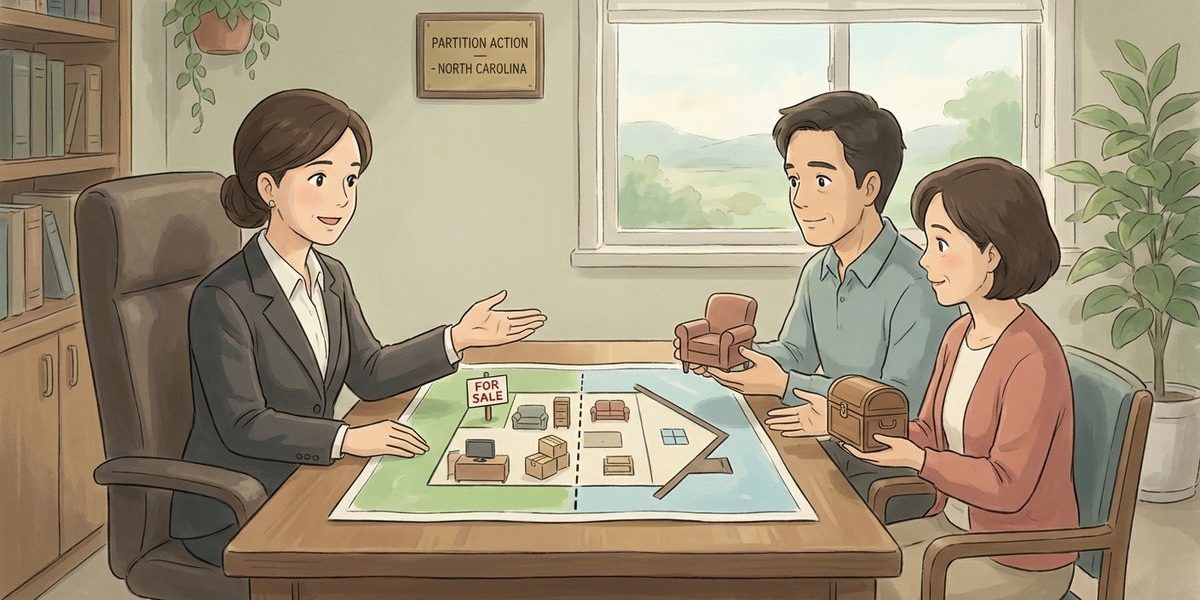
What happens to personal property left inside a co-owned house when one co-owner wants to sell? – North Carolina
Short Answer
In North Carolina, personal property left inside a co-owned house does not automatically become part of a partition (forced sale) of the real estate. The house can still be partitioned and sold, but the contents usually must be identified, claimed, removed, or otherwise handled separately—often by agreement, a court order about access and removal, or (if the items belong to a deceased parent) through the estate process. A threatened probate filing may affect who has authority over the parent’s belongings, but it does not necessarily stop a partition sale of the house.
Understanding the Problem
In a North Carolina partition action, can a co-owner force the sale of a co-owned house when the house still contains a parent’s personal belongings, and what happens to those belongings if the co-owners disagree about them? The key decision point is whether the items inside the home are (1) jointly owned personal property of the co-owners, (2) personal property owned by only one co-owner, or (3) property that belongs to a deceased parent’s estate and therefore must be handled by the person with legal authority for the estate.
Apply the Law
North Carolina partition law focuses on dividing or selling the real property (the house and land). Personal property (the contents) is a separate category. If the contents are jointly owned, North Carolina law allows a separate partition of personal property through the superior court. If the contents belong to a deceased parent, North Carolina estate rules generally require that a personal representative (when one exists) administer and distribute the decedent’s personal property, and certain allowances for a surviving spouse or children may be decided by the clerk.
Key Requirements
- Identify what the items are (real property vs. personal property): A partition sale addresses the house and land; furniture, tools, heirlooms, and household goods are personal property and usually require a separate plan.
- Identify who owns the personal property: Ownership may be shared between co-owners, belong to one co-owner, or belong to a deceased parent’s estate.
- Use the correct forum and procedure for the contents: Jointly owned personal property can be partitioned in superior court; estate-owned property is typically handled through the clerk’s estate jurisdiction and the personal representative’s authority.
What the Statutes Say
- N.C. Gen. Stat. § 46A-100 (Personal property may be partitioned) – Allows a tenant in common or joint tenant of personal property to file in superior court to partition that personal property.
- N.C. Gen. Stat. § 46A-102 (Partition sale of personal property) – Allows the court to order a sale of personal property if dividing it would result in substantial injury to one or more parties.
- N.C. Gen. Stat. § 30-18 (Allowance assigned from personal property) – Provides that certain allowances are awarded only out of personal property of the decedent’s estate.
- N.C. Gen. Stat. § 30-20 (Clerk procedure for assigning allowance) – Describes the clerk’s process for awarding certain estate allowances from personal property.
Analysis
Apply the Rule to the Facts: The house can be the subject of a partition action even if it contains a parent’s belongings, because the contents are personal property and are not automatically “sold with the house” as part of partition of real estate. The practical problem is that the sale process (showings, inspections, closing, and possession) works best when the home is cleared, so the co-owners often need a written agreement or a court order setting deadlines for inventory and removal. If the parent’s items still legally belong to the parent’s estate, a probate filing may determine who has authority to decide what gets removed, stored, sold, or distributed, but that authority issue is separate from whether the co-owned real estate can be partitioned.
Process & Timing
- Who files: The co-owner seeking a sale. Where: Superior Court (partition) in the county where the real property is located in North Carolina. What: A partition petition seeking partition by sale (or other appropriate method). When: Timing depends on service of process, the court’s schedule, and whether the case becomes contested.
- Address the contents early: The parties (or the court) typically need a plan for access, inventory, and removal of personal property so the home can be marketed and transferred without disputes over missing items or damage.
- If the contents are jointly owned: A party may seek partition of the personal property in superior court under North Carolina’s personal property partition statutes, which can include an order to sell the items if dividing them would result in substantial injury to one or more parties.
- If the contents belong to a deceased parent’s estate: The estate process may be used to appoint a personal representative (if one is not already appointed) and to handle distribution of estate personal property, including any allowances the clerk may award from personal property under Chapter 30.
Exceptions & Pitfalls
- Assuming the house sale automatically includes the contents: Unless the parties agree otherwise in writing, personal property generally does not transfer with the deed just because it is inside the house.
- Not proving ownership of key items: Family disputes often turn on whether an item was gifted, jointly owned, or still part of a parent’s estate. Photos, lists, receipts, and written family communications can matter.
- Access and removal disputes: One co-owner changing locks, blocking entry, or removing items without documentation can escalate the case and create claims about waste, conversion, or missing property. A clear access schedule and inventory process can reduce conflict.
- Probate threats used as leverage: Opening an estate can be appropriate when estate property must be administered, but it is not automatically a legal “pause button” on a partition sale of co-owned real estate.
Conclusion
In North Carolina, a partition action to sell a co-owned house focuses on the real estate, not the personal property left inside. The contents must be handled based on who owns them: jointly owned items may be partitioned separately in superior court, while a deceased parent’s belongings may require estate authority and clerk involvement for certain personal-property allowances. A practical next step is to file the partition petition and, at the same time, seek a written agreement or court order setting an inventory and removal deadline for the contents.
Talk to a Partition Action Attorney
If a co-owned house needs to be sold but family personal property is still inside and probate is being threatened as a delay tactic, our firm has experienced attorneys who can help explain options, likely timelines, and the steps needed to move the sale forward. Call us today at [919-341-7055].
Disclaimer: This article provides general information about North Carolina law based on the single question stated above. It is not legal advice for your specific situation and does not create an attorney-client relationship. Laws, procedures, and local practice can change and may vary by county. If you have a deadline, act promptly and speak with a licensed North Carolina attorney.

