
How does a buyout work when some co-owners want to keep the property and another co-owner wants to cash out their share? – North Carolina
Short Answer
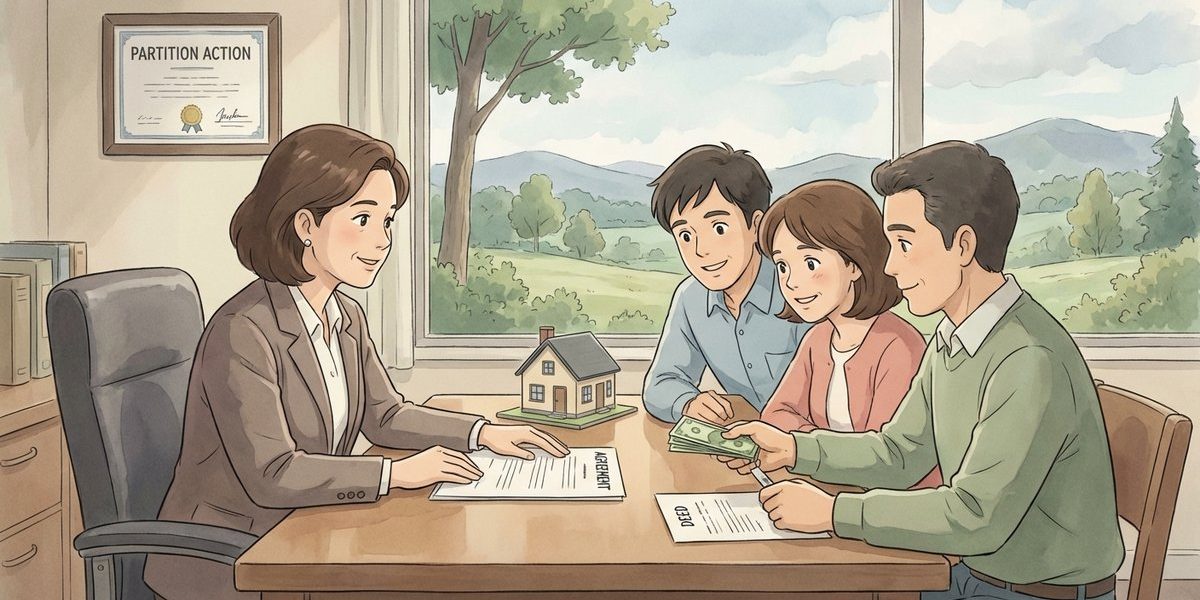
In North Carolina, a “buyout” between co-owners usually happens by agreement (a settlement) where the co-owners who want to keep the home pay the cash-out co-owner for that person’s share and receive a deed transferring the interest. If the case is already in court as a partition action, the parties can still settle at any time, but North Carolina’s partition statutes do not automatically give the keep-the-property group a guaranteed right to force a buyout instead of a court-ordered sale. If the parties cannot agree, the court generally decides between an actual partition (splitting the property) and a partition sale, based on the statutory standards.
Understanding the Problem
When multiple family members inherit and co-own a North Carolina home, a common question is whether the co-owners who want to keep the property can “buy out” the co-owner who wants to cash out. The practical decision point is whether the cash-out co-owner will voluntarily transfer an ownership share for an agreed price, or whether the dispute will continue as a partition case in Superior Court where the court chooses a method to end the co-ownership. The fact that a petition was filed and later amended usually means the dispute is already in the court process, but a buyout can still be negotiated and documented if everyone agrees.
Apply the Law
North Carolina treats most co-ownership disputes over land as partition proceedings filed in the superior court division in the county where the property is located. A partition case exists to end a co-ownership relationship when at least one co-owner does not want to continue owning together. Under Chapter 46A, the court must choose a method of partition, which can include physically dividing the property (actual partition) or ordering a sale (partition sale) if the legal requirements for a sale are met. A “buyout” is typically a settlement outcome rather than the default statutory remedy, but it often functions as a practical alternative to a public sale when the parties can agree on value and terms.
Key Requirements
- Standing and co-ownership: The person asking the court to act must be a tenant in common or joint tenant (or otherwise qualify under the statute), and all co-owners generally must be joined in the case.
- Method the court must order: The court must select a partition method authorized by statute (for example, actual partition, partition sale, or a combination), and it cannot force a co-owner to remain in co-ownership over that co-owner’s objection.
- Sale requires proof of “substantial injury” from a split: If a party wants a court-ordered sale instead of a physical division, that party generally must prove that an actual partition cannot be made without substantial injury, and the court must make specific findings supporting a sale.
What the Statutes Say
- N.C. Gen. Stat. § 46A-21 (Who may file; necessary parties) – Allows a cotenant to file a partition petition in superior court and requires joining/serving the other cotenants.
- N.C. Gen. Stat. § 46A-26 (Methods of partition) – Lists the methods the court may order and states the court cannot force a cotenant to continue in cotenancy over objection.
- N.C. Gen. Stat. § 46A-75 (Sale in lieu of actual partition) – Sets the standard for when the court may order a partition sale and places the burden on the party seeking sale to prove substantial injury.
- N.C. Gen. Stat. § 46A-76 (Sale procedure) – Explains that partition sale procedure generally follows Chapter 1, Article 29A and includes notice requirements for a public sale.
Analysis
Apply the Rule to the Facts: Here, multiple family members co-own a home after a parent’s death, and one co-owner has already filed (and amended) a petition seeking a court-ordered sale. That filing signals at least one co-owner objects to continuing the co-ownership, so the court will need to choose a statutory partition method under Chapter 46A unless the case settles. A buyout can still happen, but it typically requires the co-owners who want to keep the home to reach a written agreement on price and terms and then complete a deed transfer so the cash-out co-owner’s interest is actually conveyed.
Process & Timing
- Who files: Any cotenant (or, in some situations, a deceased cotenant’s personal representative). Where: Superior court division in the county where the property is located. What: A partition petition (and any amended petition) naming and serving all cotenants and other interested parties as required. When: North Carolina’s partition statutes do not use a single universal “file by” deadline in the way some claims do, but timing can become urgent once a sale is requested or scheduled.
- Negotiating a buyout during the case: The parties can negotiate at any point. A typical buyout settlement addresses (i) how the property will be valued (often an appraisal or agreed number), (ii) how liens/mortgages and closing costs will be handled, (iii) whether any credits will be claimed for payments like taxes, insurance, or necessary repairs, and (iv) the deadline to close. If agreement is reached, the parties usually file a consent order or dismissal and complete the deed transfer through a closing.
- If no buyout agreement is reached: The court proceeds to decide the partition method. If the party seeking a sale proves the statutory standard for a sale, the court can order a partition sale and appoint a commissioner to conduct the sale process and report back to the court for confirmation and distribution of proceeds.
Exceptions & Pitfalls
- Assuming a buyout is automatic: In many family disputes, one side expects the court to “make” the other side accept a buyout. In practice, a buyout usually requires agreement; otherwise, the court focuses on the statutory partition remedies (actual partition versus sale) and the evidence supporting them.
- Not matching the buyout to the deed: A buyout is not complete until the cash-out co-owner signs a proper deed and the transaction is handled correctly (often through a closing). Paying money without getting a recorded deed can leave title problems.
- Valuation fights and credits: Disputes often arise over what the property is worth and whether one co-owner should receive credit for mortgage payments, taxes, insurance, or necessary repairs (or be charged for exclusive use). These issues can affect the buyout number and can also affect how sale proceeds are distributed.
- Service and missing parties: Partition requires joining and serving all cotenants and other interest-holders. Missing an heir or lienholder can delay the case and complicate any settlement or closing.
For more background on the court process when co-owners do not agree, see force the sale of inherited land when some co-owners refuse to sell and avoid going to court by doing a private sale or settlement agreement.
Conclusion
In North Carolina, a buyout in a co-owner dispute usually works as a negotiated settlement: the co-owners who want to keep the property pay an agreed amount for the cash-out co-owner’s share, and the cash-out co-owner signs a deed transferring that interest. If the parties cannot agree, the partition case continues in the superior court division, where the court must choose a statutory method of partition and may order a sale only if the legal standard is met. The next step is to document a written buyout agreement and schedule a closing before the case reaches a sale order.
Talk to a Partition Action Attorney
If a co-owner wants to cash out and other co-owners want to keep the property, our firm has experienced attorneys who can help explain the partition process, evaluate buyout options, and map out realistic timelines. Call us today at [CONTACT NUMBER].
Disclaimer: This article provides general information about North Carolina law based on the single question stated above. It is not legal advice for your specific situation and does not create an attorney-client relationship. Laws, procedures, and local practice can change and may vary by county. If you have a deadline, act promptly and speak with a licensed North Carolina attorney.

