
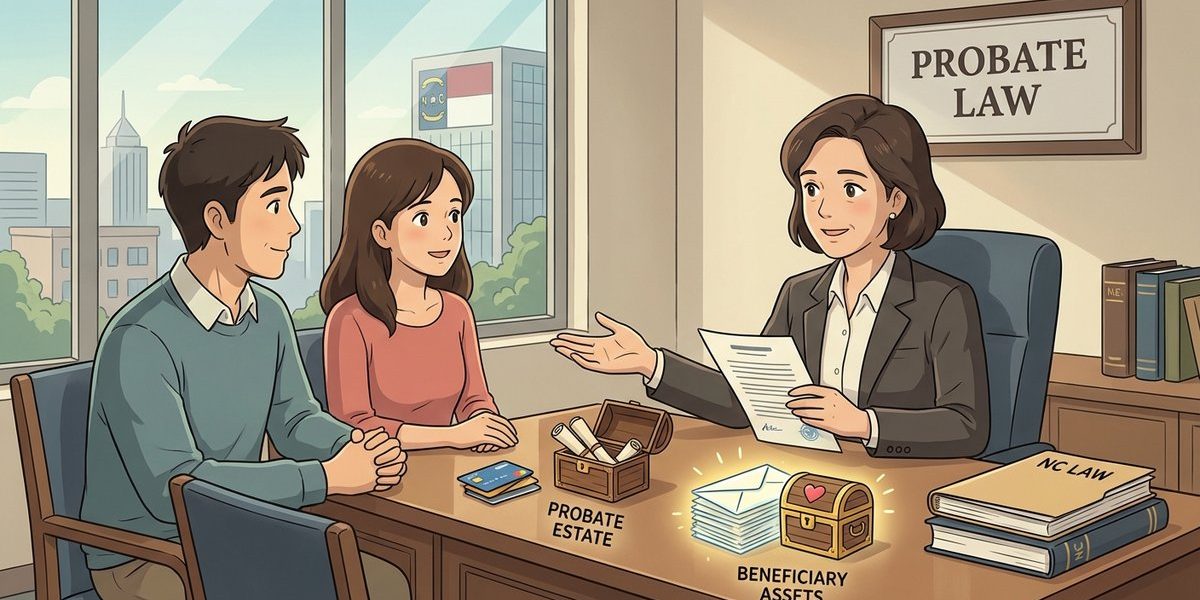
If the bank account and life insurance have beneficiaries and pass outside the estate, how are the deceased person’s credit card debts supposed to be paid? – North Carolina
Short Answer
In North Carolina, credit card debt is normally paid from the probate estate (assets titled in the deceased person’s name alone), not automatically from life insurance or beneficiary-designated accounts. If the probate estate does not have enough money to pay valid claims, North Carolina law can allow the personal representative to recover certain “nonprobate” assets (like some payable-on-death or survivorship accounts) to the extent needed to pay estate debts. Beneficiaries are not personally responsible for the deceased person’s credit card debt unless they were a co-obligor or they received assets that the law allows the estate to pull back to cover unpaid claims.
Understanding the Problem
In North Carolina probate, the key question is: when a person dies with credit card debt, but the main cash assets are set up to transfer by beneficiary designation (such as a payable-on-death bank account) or by contract (such as life insurance), what source is supposed to pay the debt. The actor is the executor/personal representative named in the will, working through the Clerk of Superior Court estate file. The action is paying valid creditor claims in the correct order before distributing what is left to heirs or will beneficiaries, including siblings expecting to split a house.
Apply the Law
North Carolina generally treats credit card balances as unsecured claims against the estate. The personal representative gathers probate assets, gives required notice to creditors, reviews claims, and pays approved claims from estate funds. “Nonprobate” transfers (like certain payable-on-death and survivorship accounts) can still be reachable in limited circumstances if the estate is otherwise short on funds, but that recovery is typically a last resort and must follow the statute-driven process.
Key Requirements
- There must be an estate asset pool to pay claims: Credit card debts are paid from probate assets first (for example, a bank account with no beneficiary, refunds, personal property, or proceeds from selling estate property like a house if it is an estate asset).
- Claims must be handled through the estate process: The personal representative must identify, allow/deny, and pay claims through the estate administration rather than paying bills informally from whoever received beneficiary assets.
- Nonprobate assets may be recoverable if the estate is insolvent: If probate assets are not enough, North Carolina law can allow recovery from certain survivorship/TOD/POD-type transfers to cover unpaid debts, but only to the extent needed and typically only after probate assets are exhausted.
What the Statutes Say
- N.C. Gen. Stat. Chapter 28A (Estates and Fiduciaries) – North Carolina’s main estate administration chapter, including rules on collecting assets and handling creditor claims.
- N.C. Gen. Stat. § 28A-19-6 (Priority of claims) – Sets the order the personal representative must follow when paying estate expenses and creditor claims (credit cards are generally in the “all other claims” category).
- N.C. Gen. Stat. § 41-2.1 (Joint accounts with right of survivorship) – Survivorship bank funds can be subject to certain estate claims on the deceased person’s share, with special handling rules.
- N.C. Gen. Stat. § 41-48 (Transfer on death; liability for debts) – Provides that TOD-registered interests can remain liable for the decedent’s debts if the estate is insufficient, with recovery from the surviving owner or TOD beneficiary.
- N.C. Gen. Stat. § 54C-166.1 (POD accounts at savings banks) – Describes POD accounts and recognizes that the personal representative may have collection rights tied to estate administration.
Analysis
Apply the Rule to the Facts: Here, the will names one sibling as executor (personal representative) with another sibling as backup, and the family expects the house to be split among siblings. Even if a bank account and life insurance have named beneficiaries, the executor still must open the North Carolina estate (if required), publish notice to creditors, and pay approved claims from probate assets first. If the only meaningful probate asset is the house, paying credit card debts may require using estate cash (if any) and, if needed, selling or borrowing against the house through the estate process before distributing shares to siblings.
Process & Timing
- Who files: The named executor (or the backup if the first cannot serve). Where: The Clerk of Superior Court (Estates) in the North Carolina county where the estate is opened. What: An application to qualify as personal representative and open the estate file, followed by the required creditor-notice steps and inventories/accountings as applicable. When: As soon as practical after death, especially if bills are coming due or property must be protected.
- Notice and claim review: The personal representative gives statutory notice to creditors, then reviews claims as they come in. Valid claims get paid in the statutory order of priority; lower-priority claims (like most credit cards) may be paid only after higher-priority items are covered.
- If the estate lacks cash: The personal representative may need to convert estate property to cash (often by selling estate assets) or, if allowed and appropriate, pursue recovery from certain nonprobate transfers when the estate is insufficient. Only after claims and expenses are handled can the personal representative distribute what remains to the beneficiaries/heirs.
Exceptions & Pitfalls
- Do not assume beneficiaries must pay credit cards out of their own pocket: A beneficiary is usually not personally liable for the deceased person’s credit card debt unless the beneficiary was a joint account holder on the credit card, a co-signer, or otherwise legally obligated on the debt.
- Do not pay creditors “informally” from beneficiary funds without a plan: Paying a credit card from life insurance proceeds or a POD payout can create family disputes and may conflict with the estate’s required payment order if higher-priority claims exist.
- Insolvent estate risk: If probate assets are not enough, North Carolina law may allow the estate to reach certain survivorship/TOD/POD-type assets to satisfy debts. That is fact-specific and often requires a formal recovery process rather than a simple request.
- House distribution expectations can change: If the house is an estate asset and the estate needs money to pay claims, the house (or part of its value) may effectively be used to satisfy debts before siblings receive their shares.
- Multi-state living creates administration traps: When a parent lived part-time in another state but still had a North Carolina house and ties, the correct place to open the estate (and whether another state’s proceeding is also needed) can affect timing and what assets are available to pay claims.
For more on how beneficiary designations interact with estate administration, see life insurance with a named beneficiary and payable-on-death bank accounts and other nonprobate transfers.
Conclusion
In North Carolina, credit card debts are supposed to be paid through the probate estate, in the statutory order of priority, before heirs or will beneficiaries receive distributions. Beneficiary-designated assets like life insurance and certain bank accounts often transfer outside probate, but some nonprobate transfers can still be reachable if the estate does not have enough assets to pay valid claims. The next step is for the named executor to open the estate with the Clerk of Superior Court and follow the creditor-notice process so claims can be handled correctly and on time.
Talk to a Probate Attorney
If you’re dealing with a parent’s death where most assets pass by beneficiary designation but credit card bills are still arriving, our firm has experienced attorneys who can help you understand your options and timelines. Call us today at [919-341-7055].
Disclaimer: This article provides general information about North Carolina law based on the single question stated above. It is not legal advice for your specific situation and does not create an attorney-client relationship. Laws, procedures, and local practice can change and may vary by county. If you have a deadline, act promptly and speak with a licensed North Carolina attorney.

