
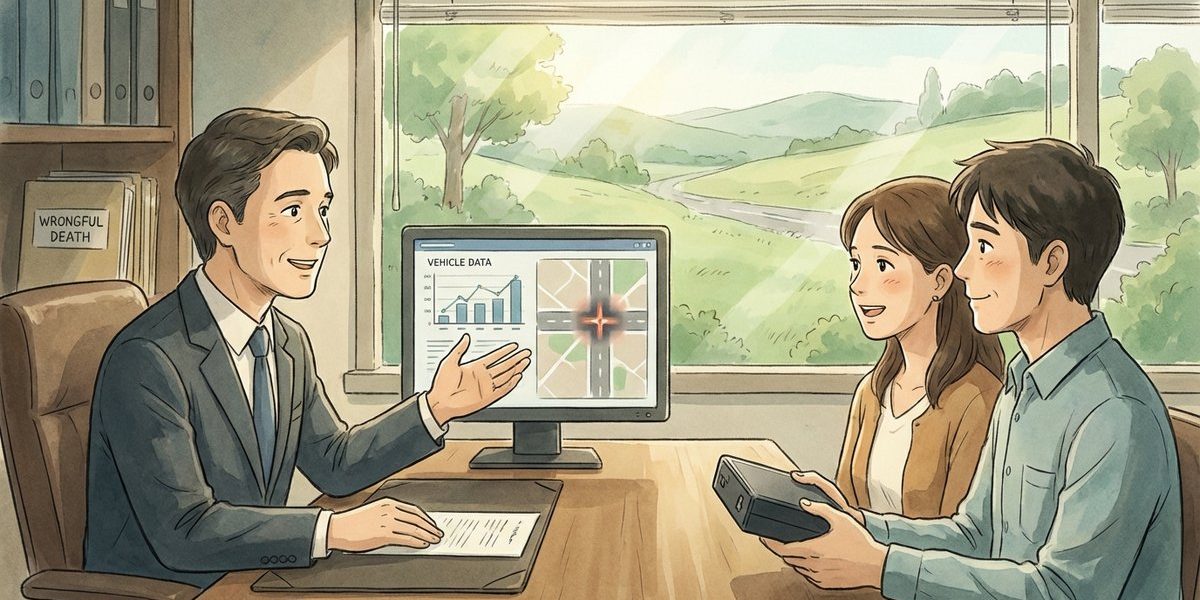
How do I get and use vehicle data recordings or intersection camera footage to prove what happened in a crash? – North Carolina
Short Answer
In North Carolina, vehicle “black box” data (often called an event data recorder, or EDR) and intersection or government-held video usually are not handed over automatically after a crash. The practical approach is to (1) identify who controls each recording, (2) send fast, written preservation requests so the data is not overwritten or lost, and (3) use subpoenas and court orders in a civil case when voluntary requests do not work. Law-enforcement video has its own rules and often requires a superior court process to obtain a copy.
Understanding the Problem
In a North Carolina crash case, can vehicle data recordings (like EDR/telematics) or intersection camera footage be obtained and used to show how the collision happened when the investigating officer did not cite the other driver? The decision point is whether the recording is controlled by a private party (a driver, insurer, towing/storage yard, business, or manufacturer) or by a government agency (law enforcement or a city/county traffic system), because the request method and the speed required to preserve the evidence often differ.
Apply the Law
North Carolina civil cases generally rely on preservation letters, voluntary requests, and—if needed—formal discovery tools (like subpoenas) to obtain recordings and electronic data from the people or entities that control them. Crash reports are generally obtainable through the North Carolina Division of Motor Vehicles (DMV), and law-enforcement recordings (body-worn and dash camera) are governed by a specific statute that limits public access and often requires a superior court order to obtain a copy. The main forum for forcing production is typically North Carolina Superior Court once a lawsuit is filed (or, for certain law-enforcement recordings, superior court even before a civil case is fully underway).
Key Requirements
- Identify the custodian: Determine who actually possesses and controls the data (vehicle owner/insurer, a repair facility, a towing/storage yard, a business with cameras, a city traffic department, or a law-enforcement agency).
- Preserve quickly: Send written preservation requests immediately because many systems overwrite video or lose EDR/telematics data after repairs, battery loss, total-loss processing, or routine retention cycles.
- Obtain in an admissible form: Plan for chain-of-custody and authenticity (who downloaded it, what device/software was used, date/time accuracy, and whether the footage is complete and unedited).
What the Statutes Say
- N.C. Gen. Stat. § 20-166.1 (Crash reports; investigation; public access) – Requires an officer’s written crash report and provides that law-enforcement crash reports are public records available through DMV (with a fee).
- N.C. Gen. Stat. § 132-1.4A (Law enforcement agency recordings) – Sets the rules for disclosure and release of body-worn and dashboard camera recordings, including a superior-court process for release of a copy.
Analysis
Apply the Rule to the Facts: The facts describe a disputed-fault collision where the investigating officer did not cite the other driver, and there may be vehicle data and nearby camera footage that could clarify speed, braking, impact timing, or signal phases. Because that evidence can be controlled by multiple custodians (the vehicles, insurers, towing/storage, nearby businesses, or government agencies), the most important step is quickly identifying custodians and sending preservation requests before repairs, total-loss processing, or routine video overwrites occur. If voluntary requests fail—especially with government-held recordings—formal court procedures are often required to obtain usable copies.
Process & Timing
- Who starts the evidence hold: The injured party (through counsel) typically sends preservation letters. Where: Sent directly to the likely custodians (other driver/insurer, towing/storage yard, repair facility, nearby businesses, and any city/county traffic or law-enforcement agency). What: A written preservation request that identifies the crash date/time/location, vehicles involved, and the specific categories requested (EDR download, telematics logs, dash-cam/body-cam, intersection video, 911/dispatch audio, and any traffic-signal or controller logs if applicable). When: As soon as possible after the crash, because many systems overwrite or are lost during routine operations.
- Get baseline public records early: Request the DMV crash report and any supplemental reports. Under North Carolina law, the investigating officer must complete a written report and it is generally available as a public record through DMV with the required fee. See N.C. Gen. Stat. § 20-166.1. This report helps pinpoint the exact time, diagram, witnesses, and agency case number needed to target video requests.
- Escalate to subpoenas or court orders when needed: If a business, insurer, or government office will not voluntarily provide footage or data, the next step is usually a subpoena in a filed civil case. For law-enforcement body-worn/dash recordings, a copy generally requires a superior court order under the release process in N.C. Gen. Stat. § 132-1.4A, and the court may set conditions (such as redactions or limits on dissemination).
Exceptions & Pitfalls
- Assuming “the city has it forever”: Many intersection and nearby-business systems overwrite quickly. Even when a camera exists, the footage may not be retained unless a timely request is made.
- Confusing “disclosure” with “release” for police video: North Carolina treats law-enforcement recordings differently than ordinary public records. A person may be allowed to view (“disclosure”) in limited situations, but getting a copy (“release”) typically requires a superior court order under N.C. Gen. Stat. § 132-1.4A.
- Letting the vehicle get repaired or totaled without preserving EDR/telematics evidence: Once a vehicle is repaired, salvaged, or processed as a total loss, access to modules, power, and connectors can change. A preservation letter should go to the owner/insurer and any storage yard immediately, and an inspection/download should be coordinated in a way that documents chain-of-custody.
- Not capturing authentication details: To use footage or data effectively, it helps to document who extracted it, the method used, the original file format, whether metadata exists, and whether the system clock was accurate.
- Over-focusing on the ticket issue: A lack of citation does not control civil fault. Objective evidence (video, EDR, photos, scene measurements, and consistent medical documentation) often matters more than whether an officer issued a ticket.
Related reading can help round out the evidence picture, including what to do if the police report is not available right away and how photos of vehicle damage can help prove what happened.
Conclusion
In North Carolina, proving what happened with vehicle data and camera footage usually requires fast preservation and the right legal process for the custodian who controls the recording. Crash reports are generally obtainable through DMV under N.C. Gen. Stat. § 20-166.1, while law-enforcement video is governed by N.C. Gen. Stat. § 132-1.4A and often needs a superior court order to obtain a copy. The most important next step is to send written preservation requests immediately so the footage and electronic data are not overwritten or lost.
Talk to a Wrongful Death Attorney
If a crash involves disputed fault and there may be vehicle data or camera footage that could clarify what happened, our firm has experienced attorneys who can help identify custodians, send preservation notices, and use subpoenas or court procedures when needed. Call us today at [919-341-7055].
Disclaimer: This article provides general information about North Carolina law based on the single question stated above. It is not legal advice for your specific situation and does not create an attorney-client relationship. Laws, procedures, and local practice can change and may vary by county. If you have a deadline, act promptly and speak with a licensed North Carolina attorney.

